At a glance
Key facts
The essentials to compare before deciding whether this breed fits your home and routine.
- Size
- Giant
- Lifespan
- 6 to 10 years
- Energy
- Low to medium
- Temperament
- Calm, protective and surprisingly gentle at home
- Good with children
- Often good, though its size calls for careful supervision
- Exercise
- About 45 minutes to an hour of steady walking daily
- Trainability
- Experienced handler
- Grooming
- Minimal brushing, but heavy drooling and facial cleaning year round
- Estimated monthly cost, GBP
- £180 to £280 per month
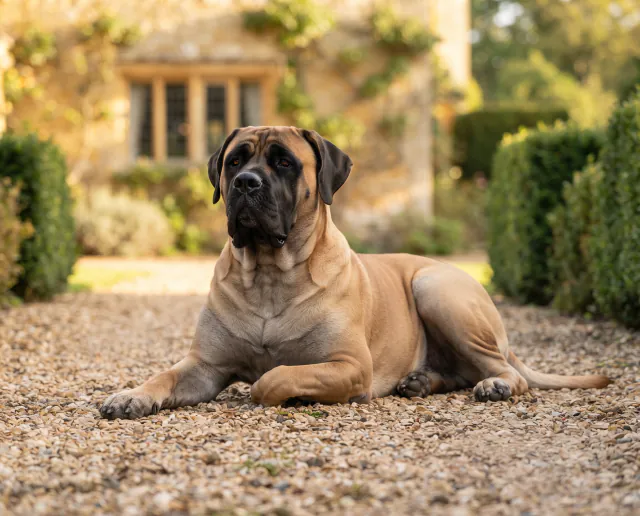
Ask which breed weighs the most and the answer is usually the Mastiff, sometimes called the English Mastiff to distinguish it from the many other Mastiff type breeds worldwide. Kept for centuries on English estates as a guard against poachers, the breed’s job was simply to look and sound formidable enough that nobody tested the point. Modern Mastiffs rarely need to prove anything. Most spend their days as enormous, affectionate furniture that happens to breathe heavily and drool on command.
These numbers come before anything else. A grown male commonly weighs 70 to 90 kilograms, occasionally more, and every aspect of ownership, from the size of car boot required to the dose on a flea treatment packet, scales with that weight. Anyone charmed by a Mastiff puppy needs to picture the adult sitting on the sofa, not the puppy asleep in a basket.
Temperament in the home
A well raised Mastiff is calm, deeply attached to its family and generally undemanding once past the boisterous puppy stage. The breed’s guarding instinct shows itself as watchfulness rather than aggression in most individuals, and a Mastiff will often position itself between visitors and the family without any training to do so. That watchfulness makes early socialisation important, since a wary reaction from a dog this size unsettles people far more than the same reaction from a smaller breed. Mastiffs bond closely with their households and tend to dislike being left alone for long stretches, becoming subdued or destructive if regularly isolated. Drool is a genuine daily feature of life with the breed, not an occasional inconvenience, and walls, ceilings and clothing all need to be defended accordingly.
Exercise and training
Exercise needs are modest for the dog’s size, and 45 minutes to an hour of steady walking a day satisfies most adults. Mastiffs are not built for speed or distance, and pushing a heavy, deep chested dog into prolonged jogging or repeated jumping does the joints no favours. Puppies need considerably less, with short outings and free play preferred over structured walks while the frame is still forming. Training benefits from starting early, while the dog is still small enough to physically manage, since a fully grown Mastiff that pulls on a lead or ignores a recall is very difficult to correct through strength alone. The breed can be stubborn, and food rewards combined with patience generally work better than repetition for its own sake.
Coat and grooming
The short, dense coat needs only a weekly brush to look after itself and sheds at a moderate, manageable rate rather than the heavy seasonal blow of a double coated breed. Grooming time is instead spent on the face. Loose lips and heavy jowls mean drool collects constantly, particularly after drinking or in warm weather, and most owners keep a cloth to hand throughout the day. Facial wrinkles need checking and drying to prevent soreness, and the deep chest and heavy frame make pressure sores on elbows a risk on hard flooring, so thick bedding is worth providing. Nails need regular trimming, since an overgrown nail changes how a dog of this weight bears its stance.
Health and lifespan
Life expectancy is short even by giant breed standards, commonly six to ten years, and this should factor into the decision from the outset rather than come as a surprise later. The breed carries a well known risk of hip and elbow dysplasia, and asking to see current BVA and Kennel Club scoring certificates for both parents is reasonable due diligence before any deposit changes hands. Gastric dilatation and volvulus, a life threatening twisting of the stomach, is a real risk in deep chested giants, and owners should know the signs, a swollen abdomen, unproductive retching and sudden distress, and treat them as an emergency. Heart disease is recognised in the breed, and asking a breeder whether their dogs have been assessed is reasonable. Keeping a Mastiff lean throughout its life, rather than allowing the heavy build to slide into obesity, does more for joint health and longevity than any other single decision an owner makes.
Costs and space
Everything about keeping a Mastiff costs more than it would for an average sized dog. Food quantities are substantial, medication and anaesthesia are priced by body weight, and insurance premiums reflect both the size and the breed’s known health risks. A monthly figure in the region of £180 to £280 is indicative rather than fixed, and actual costs vary with insurer, region and the individual dog. Furniture built to support the weight, a car with a boot large enough for a dog this size and floors that will not send an ageing Mastiff sliding all matter more than they might for a smaller breed. Space indoors counts for more than garden size, since the breed is not a big exerciser, but a household should have room for a dog that takes up most of a doorway when it lies down.
Verdict
The Mastiff suits a calm household with space, a realistic budget and genuine tolerance for drool, wanting an affectionate, protective dog without high exercise demands. Owners who have kept a large breed before, and who plan finances around the size involved, tend to get on well with the breed.
A tight budget, a house full of delicate furnishings or an unwillingness to plan for a short lifespan should rule the breed out. The Mastiff rewards owners who go in accepting exactly what a dog of this size involves.