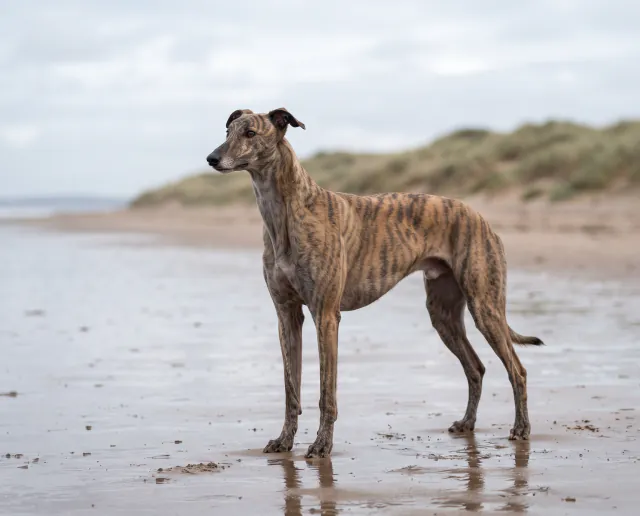
At a glance
Key facts
The essentials to compare before deciding whether this breed fits your home and routine.
- Size
- Large
- Lifespan
- 10 to 14 years
- Energy
- Low to medium
- Temperament
- Quiet, gentle and remarkably still indoors
- Good with children
- Usually very good with calm, unhurried children
- Exercise
- Two shorter walks a day plus occasional safe sprinting
- Trainability
- Moderate
- Grooming
- Weekly brushing with light shedding
- Estimated monthly cost, GBP
- £70 to £130 per month
The question greyhound owners are asked most often in the park is how many hours a day the dog has to be walked. The answer disappoints people. A greyhound is a sprinter, not a distance athlete, built to reach high speed over a few hundred metres and then stop. Two walks of twenty to thirty minutes suit most adults perfectly well, and the rest of the day is spent asleep on something soft. Owners who set out to exercise a greyhound like a working gundog usually end up with a bored, footsore dog and no improvement in behaviour.
That mismatch between reputation and reality is why so many retired racers settle into ordinary homes so quickly. Most leave the track between three and five years old, healthy and with a long life still ahead. What they have not had is a house. A kennel-raised dog may never have climbed stairs, walked on laminate, seen a glass door or spent an evening alone in a quiet room, and the first fortnight of rehoming is mostly about those things rather than about training in the usual sense.
Suitability
Greyhounds fit a wider range of homes than their size suggests. Flats work, provided the lift or stairs are manageable, because a dog that sleeps for eighteen hours takes up less household energy than a terrier. Adults stand tall but weigh less than they appear to, carrying almost no body fat over a lean frame. Most are gentle and undemonstrative with people, and many are so quiet with visitors that they barely lift their head. Children are usually fine as long as they understand that a sleeping sighthound should never be startled awake. The significant caution is prey drive. Some greyhounds live happily with cats and small dogs and some genuinely cannot, which is why reputable homing charities assess each dog and say so plainly.
Exercise
Short, regular and on-lead covers most days. Two outings a day with a chance to sniff, plus a bit of trotting, keeps a healthy adult in good condition. Free running is a different matter. A greyhound at full speed covers ground faster than any recall can travel, so off-lead running belongs in secure enclosed fields rather than open parks, and many owners hire one for half an hour a week. Even then, sprints should be brief; the muscles are built for short efforts and a dog that has been kennelled for months needs conditioning first. Hard tarmac and repeated turns on wet grass both cause injuries. Greyhounds also feel the cold badly, so a fitted coat in winter is practical rather than decorative.
Grooming
Coat care is close to negligible. A weekly going over with a rubber mitt or hound glove removes the loose hair, and shedding stays light throughout the year. The skin beneath is thin and tears easily on brambles, wire and door frames, so cuts that would be superficial on another breed sometimes need veterinary attention. Nails grow quickly and need regular trimming, particularly on a dog no longer running on sand. Bedding is part of grooming here in a practical sense, because a bony dog lying on a hard floor develops pressure sores at the elbows and hips. Teeth deserve daily effort, since dental disease is one of the commonest problems in retired racers.
Health
Greyhounds are generally sound and often reach twelve or more. Their physiology differs from other breeds in ways that matter clinically, including blood values and their response to anaesthetic, so a practice used to sighthounds is an advantage and worth asking about when registering. Dental treatment is frequently needed soon after adoption. Corns on the pads cause a persistent, puzzling lameness that a vet should investigate rather than an owner treat at home. Bone tumours and, in a deep-chested dog, gastric torsion are both recognised risks; sudden lameness, or restlessness with unproductive retching and a swollen abdomen, needs immediate veterinary assessment. Monthly costs of around £70 to £130 are indicative, and food, insurance, grooming and veterinary care all vary by circumstances.
Choosing and training
Adoption through an established charity is the usual route, and the process is a genuine benefit rather than a formality. Staff will have observed the dog with cats, small dogs, children and traffic, and a good organisation matches honestly and takes the dog back if the home does not work. Expect a home visit and a conversation about how long the dog would be left. Many charities ask that a muzzle is worn in public at first, which is sensible while the dog learns about squirrels and small fluffy breeds. Training should be patient and reward-based. House training, stair confidence, being alone and a lead-side recall come first; formal obedience is rarely the priority, and a greyhound that is nagged simply switches off.
Verdict
A greyhound suits people who want a large, calm, low-mileage dog and can offer soft beds, warmth and company. Older owners, flat dwellers, quiet families and first-time owners often do far better with one than with a smaller, busier breed.
The wrong home is one with free-roaming cats or small pets and no willingness to manage them, one that walks off-lead in open country as a matter of routine, or one expecting a dog that will run alongside a bike for an hour. Take the homing charity’s assessment seriously, since it usually knows the individual dog better than any breed description can.