At a glance
Key facts
The essentials to compare before deciding whether this breed fits your home and routine.
- Size
- Toy
- Lifespan
- 12 to 15 years
- Energy
- Medium to high
- Temperament
- Alert, affectionate and physically delicate
- Good with children
- Better suited to households with careful older children
- Exercise
- Short brisk walks plus controlled sprinting in a secure space
- Trainability
- Moderate
- Grooming
- Minimal brushing but routine coat protection in cold weather
- Estimated monthly cost, GBP
- £80 to £150 per month
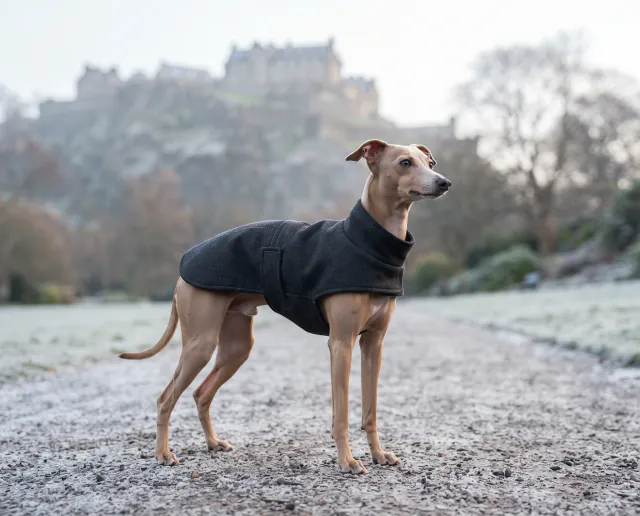
A full-sized Greyhound scaled down to under five kilograms sounds like a novelty, but the Italian Greyhound has been bred that way for over two thousand years, appearing in Mediterranean art long before it became a fixture of European court life. Nothing about the shrinking process softened the sighthound behind it. The same instinct to spot movement at distance and cover ground at speed lives inside a body built more like fine porcelain than working dog.
That contrast is the whole story of ownership. An Italian Greyhound can outrun most dogs many times its size over a short distance, then spend the rest of the day buried under a blanket shivering at a closed window. Owners describe the breed as a study in extremes, alternately electric and immobile, and almost every practical difficulty traces back to how little structure protects those legs.
Temperament in the home
Indoors the breed is affectionate, watchful and strongly bonded to its own household, often choosing one person as a particular favourite. Strangers are met with reserve rather than hostility, and a startled Italian Greyhound is more likely to bolt than to growl. Furniture climbing comes naturally, and most end up sleeping under a duvet rather than in a bed on the floor, since the thin coat gives almost no insulation. Households with toddlers or rough play are a genuine mismatch, not because the dog is unfriendly but because a collision that a Labrador shrugs off can break a leg on a dog this fine boned. Calm, older children who understand the rules tend to get on with the breed very well. Left alone for long stretches, many become anxious and vocal, so building tolerance to short absences early matters as much as anything else in the first year.
Exercise and training
Short, brisk walks suit the breed better than long slow ones, and a securely fenced space for genuine sprinting satisfies the sighthound side of the temperament far more than trudging round a block. Recall cannot be trusted near open roads or livestock, since a running Italian Greyhound is chasing before it has decided to, and many owners use a harness and long line as standard practice in any unfenced area. Cold weather changes the routine considerably. A coat is not an affectation on this breed but a practical necessity below a few degrees, and short toilet trips rather than proper walks are the sensible pattern on frosty mornings. House training tends to take longer than owners expect and often longer than with other toy breeds, since the combination of a small bladder and a dislike of wet or cold ground makes accidents common well past puppyhood. Patience and a consistent routine work better than correction, which tends to make an already sensitive dog more anxious rather than more reliable.
Coat and grooming
The coat is about as low maintenance as it gets, a fine, smooth layer that needs no more than an occasional wipe with a damp cloth and barely sheds. What replaces coat care is injury prevention. Furniture with steps or ramps reduces the strain of repeated jumping, and non-slip flooring matters more for this breed than almost any other, since a leg can fracture on a bad landing from a modest height. Nails should be kept short, since overgrown nails alter the way a light-framed leg lands. Teeth deserve particular attention, since the breed carries a well recognised tendency toward early dental disease, and a routine of brushing from puppyhood pays off later in fewer extractions.
Health and lifespan
Twelve to fifteen years is typical, among the longer spans for a purebred dog, but the years are punctuated by orthopaedic risk. Leg fractures, particularly of the lower foreleg, are common enough in the breed that many owners treat stairs, sofas and slick floors as hazards to manage rather than background furniture. Patellar luxation and Legg-Calve-Perthes disease both occur, and a breeder who screens breeding stock and can discuss both conditions is worth more than one offering only a general assurance of good health. Progressive retinal atrophy has a DNA test available, and asking whether the parents have been tested is a fair question. Dental disease, as mentioned, tends to arrive early and needs proactive management rather than a wait and see approach.
Costs and space
Running costs sit slightly above what the breed’s size alone would suggest, largely because of coats, orthopaedic veterinary care and dental treatment, and a working range of £80 to £150 a month is a reasonable planning figure rather than a guarantee. Insurance is worth arranging early, since a single fracture repair can be a substantial bill. Space requirements are genuinely minimal, and the breed does well in a flat with no garden provided secure outdoor sprinting is available elsewhere. What the home needs more than square metres is warmth, soft furnishings the dog is allowed to use, and floors that will not send a light-framed leg skidding.
Verdict
The Italian Greyhound suits a quiet adult household, a couple, or a family with older, gentle children who understand that this is a genuinely fragile dog rather than a small version of a robust one. Owners who enjoy a dog that alternates between a sprint and a nap under a blanket tend to find the breed deeply rewarding.
It is a poor fit for homes with toddlers, boisterous larger dogs, unfenced gardens near roads, or owners unwilling to fuss over coats, floors and furniture. First-time owners can manage the breed well with realistic expectations, but only if the household is set up to protect those legs from the outset.