At a glance
Key facts
The essentials to compare before deciding whether this breed fits your home and routine.
- Size
- Large
- Lifespan
- 10 to 12 years
- Energy
- High
- Temperament
- Watchful, loyal and slow to reach full maturity
- Good with children
- Often good once fully mature and well socialised
- Exercise
- Well over an hour a day plus mental work
- Trainability
- Experienced handler
- Grooming
- Twice weekly brushing with moderate shedding
- Estimated monthly cost, GBP
- £110 to £190 per month
Living with the breed
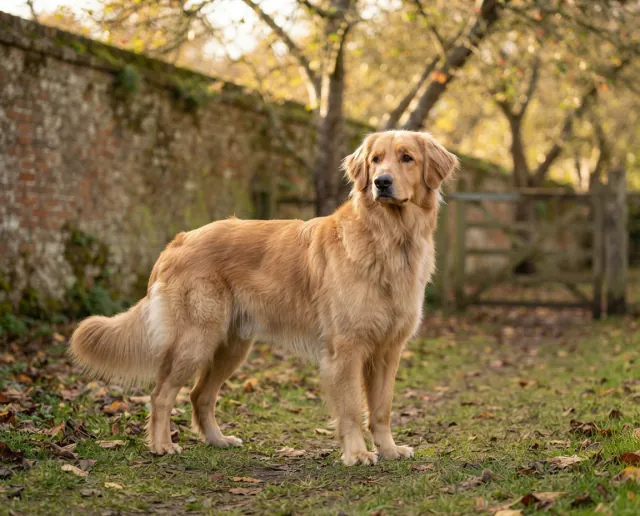
The name translates roughly as guard of the farmstead, and the Hovawart was documented protecting German estates and villages as far back as medieval records go, though the modern breed was reconstructed in the 1920s from surviving farm dogs rather than preserved as an unbroken line. What emerged is a large, handsome, long coated dog that looks softer than it behaves, since genuine guarding instinct sits close to the surface in most individuals and shapes how the breed needs to be raised and managed.
Within the family a well raised Hovawart is typically devoted, calm around routine and physically affectionate with people it trusts completely. That trust is not automatically extended to strangers, and the breed’s watchfulness needs channelling through consistent early socialisation rather than being allowed to develop unsupervised into suspicion or reactivity. One of the more demanding features of the breed is a genuinely long adolescence, with many dogs not settling into full adult temperament until two or three years old, which asks real patience of an owner expecting a mature, sensible dog much sooner. Children generally do well with a fully grown, properly socialised Hovawart, though the exuberance and size of a young adult dog need active management around smaller children.
Daily exercise
The breed needs well over an hour of exercise most days and does considerably better with a mix of physical activity and mental challenge than with repetitive walking alone. Hovawarts were never bred purely for stamina in the way a sled dog was, but they carry genuine working drive and benefit from structured outlets such as tracking, search work, obedience training or protection sport run by a properly qualified club. A securely fenced garden matters given the size and the guarding instinct, since the breed will patrol and may react to activity beyond a boundary it considers its own. Puppies should have exercise built up gradually to protect joints heading toward a substantial adult frame.
Training and mental work
Consistency from the very start of puppyhood matters more with this breed than with most, since the natural guarding instinct can develop into genuine problems if socialisation is patchy or delayed. A confident, calm, reward based approach suits the temperament well, and harsh handling tends to make a naturally watchful dog more suspicious rather than more compliant. Priorities include calm behaviour with visitors arriving at the home, a reliable recall, and settling on command, all of which need reinforcing through the breed’s unusually long adolescent phase rather than assumed to be fixed once taught. Mental work through scent games, structured training and a genuine task keeps a Hovawart occupied in a way plain exercise alone does not.
Grooming and shedding
The coat is long, slightly wavy and weather resistant, needing a thorough brush at least twice a week to prevent matting, particularly behind the ears, under the legs and around the tail. Shedding is moderate rather than heavy for a coat of this length, with a noticeable increase during seasonal changes. Bathing is occasional, and the feathering on the legs and tail benefits from regular checking after walks through mud or long grass. Nails, ears and teeth need the standard routine care for an active outdoor dog.
Health and costs
Ten to twelve years is a fair range for the breed, with many living toward the top of that range when kept lean and fit. Hip dysplasia is recognised in the breed and hip scoring under the BVA and Kennel Club scheme is a reasonable question for any breeder, alongside general awareness of elbow health given the size and activity level. Epilepsy has been reported in some lines, and a responsible breeder should be open about what conditions have appeared in their own dogs rather than presenting a blanket assurance of a clean history. The breed remains relatively uncommon outside Germany, so buyers may need to travel or wait for a suitable litter, and the breed club is a sensible first contact. Costs sit in the upper middle range for a large breed, commonly £110 to £190 a month across food, insurance, veterinary care and coat maintenance.
Size and lifespan
Males typically stand 63 to 70 cm (25 to 27.5 in) at the shoulder and weigh 30 to 40 kg (66 to 88 lb). Females are smaller, usually 58 to 65 cm (23 to 25.5 in) and 25 to 35 kg (55 to 77 lb). It is a substantial, athletic breed with a long, slightly wavy coat that can make it look heavier than it actually is.
A typical lifespan is 10 to 12 years. The breed matures slowly, both physically and in temperament, and many Hovawarts are not considered fully mature until two or three years old.
Verdict
The Hovawart suits an experienced, patient owner with secure outdoor space who is prepared for a long adolescence, committed to early and thorough socialisation, and interested in giving the dog genuine working style activity rather than plain walks alone. Handled well, the breed becomes an exceptionally loyal, watchful companion.
Anyone wanting a quick to mature dog, an easy first experience of large breed ownership, or a companion indifferent to strangers at the door should look toward a different breed. The guarding instinct at the heart of the Hovawart is a feature to manage deliberately, not a switch that training simply turns off.