
At a glance
Key facts
The essentials to compare before deciding whether this breed fits your home and routine.
- Size
- Medium
- Lifespan
- 12 to 13 years
- Energy
- High
- Temperament
- Quick, curious and constantly commenting on the world
- Good with children
- Can be good with older children who respect its space
- Exercise
- About an hour to 90 minutes a day of training and games
- Trainability
- Moderate
- Grooming
- Brushing every week or two plus routine trimming
- Estimated monthly cost, GBP
- £85 to £145 per month
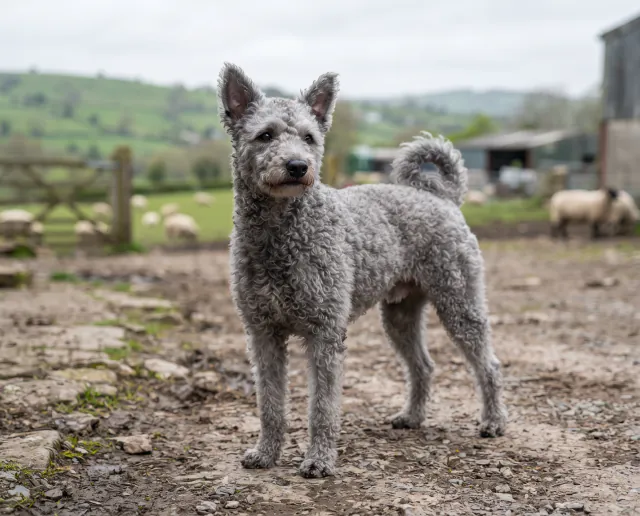
Look at a Pumi’s ears before anything else. They stand up for most of their length and then tip forward at the last third, giving the breed a permanently quizzical expression that seems to match its personality rather well. Developed in Hungary from Puli stock crossed with imported herding and terrier type dogs, the Pumi ended up with a sharper, more terrier like edge than its corded cousin, quick to react, quick to comment and rarely still for long.
The breed remains rare outside Hungary and is listed on the UK Kennel Club’s Imported Breed Register, and anyone wanting one should expect to wait, to consider a puppy bred overseas, and to make the breed club their first point of contact rather than relying on general advertising.
Living with the breed
Life with a Pumi is rarely quiet. The breed is alert to every change in its surroundings and inclined to announce most of them vocally, from the arrival of the post to a bird landing in the garden, and prospective owners need to hear this clearly before committing rather than discovering it afterwards. Within the family the Pumi tends to be affectionate, playful and often quite comical, forming a close bond with its people while remaining watchful of visitors. Older children who enjoy an energetic, opinionated companion generally get on well with the breed, though its herding instinct can express itself as nipping or circling during rough play, which benefits from early, calm redirection.
Daily exercise
Around an hour to ninety minutes of active exercise a day suits most adults, ideally combining a proper walk with training, agility or herding style games that give the mind something to do alongside the body. A Pumi denied mental work tends to invent its own projects, which rarely align with what an owner would have chosen. Puppies are naturally bouncy and enthusiastic, and exercise should be kept controlled and varied rather than long and repetitive while their joints mature. Recall benefits from an early, consistent start, since the breed’s quick reactions and herding drive can pull its attention toward moving traffic, joggers or other dogs faster than a young or inexperienced handler expects.
Training and mental work
Few breeds respond as readily to structured training, and the Pumi’s combination of intelligence and eagerness to work makes it a strong candidate for obedience, agility and herding trials. That same sharpness means training needs to stay interesting, since a bored Pumi disengages quickly and can become fixated on barking or self directed activity instead. A confident but gentle approach works best, since the breed can be sensitive to harsh correction despite its bold, terrier like manner. Socialisation from an early age helps keep the breed’s natural wariness of strangers within reasonable bounds and reduces the likelihood of excessive barking becoming a fixed habit.
Grooming and shedding
The coat is medium length, densely curled and closer to a terrier’s wiry texture than the smooth curls seen in some other breeds, sitting over a soft undercoat. Regular brushing every week or two, along with periodic trimming around the eyes, ears and feet, keeps the coat tidy and free of the matting that curly coats are prone to if neglected. Shedding is moderate rather than heavy, and much of what does come loose stays trapped in the curl until it is brushed out, which some owners find preferable to a coat that drops hair constantly around the house. A full clip every few months is common practice among pet owners and makes the routine considerably easier to maintain.
Health and costs
Twelve to thirteen years is typical, and the breed benefits from a comparatively broad genetic base given its varied ancestry. Hip evaluation under the British Veterinary Association and Kennel Club scheme is worth discussing with a breeder given the breed’s athleticism, and inherited eye conditions found in some herding breeds make the joint BVA and Kennel Club eye scheme a reasonable question too. Because litters are scarce in most countries, buyers often need to draw on health information from Hungarian and other continental breed clubs, and asking directly about temperament and noise levels in the parents is just as important as asking about physical health. Monthly costs typically run from around eighty five to one hundred and forty five pounds, covering food, insurance and routine veterinary care.
Size and lifespan
Males typically stand 41 to 47 cm (16 to 18.5 in) at the shoulder and weigh 10 to 15 kg (22 to 33 lb). Females are slightly smaller, usually 38 to 44 cm (15 to 17 in) and 8 to 13 kg (18 to 29 lb). The breed’s curly, dense coat and prick ears give it a distinctive silhouette out of proportion to its compact, medium-small frame.
A typical lifespan is 12 to 13 years, and most Pumik stay lively and alert for the whole of that span, in keeping with the breed’s generally sound, working-dog constitution.
Verdict
The Hungarian Pumi suits an active, engaged owner who wants a small, highly trainable dog with real personality and is prepared for a genuinely vocal companion. It thrives with people willing to give it structured work rather than a purely relaxed routine.
It is not the right choice for anyone needing a quiet dog, living in close quarters where barking would cause problems, or hoping that its small size means correspondingly small exercise and stimulation needs.