
At a glance
Key facts
The essentials to compare before deciding whether this breed fits your home and routine.
- Size
- Medium
- Lifespan
- 12 to 15 years
- Energy
- High
- Temperament
- Bold, loyal and quick to answer a challenge
- Good with children
- Often good with children raised alongside the dog
- Exercise
- About 90 minutes a day with real off lead running
- Trainability
- Moderate
- Grooming
- Hand stripping two or three times a year plus weekly brushing
- Estimated monthly cost, GBP
- £85 to £140 per month
Soldiers in the First World War called the Irish Terrier the poor man’s sentinel, valued as a messenger and ratter for a nerve that apparently did not register artillery the way other dogs did. That reputation for raw courage has followed the breed since it was formalised from farm terriers around Cork and elsewhere in Ireland, and it remains an accurate description of the dog’s character rather than a piece of folklore trotted out for the breed standard.
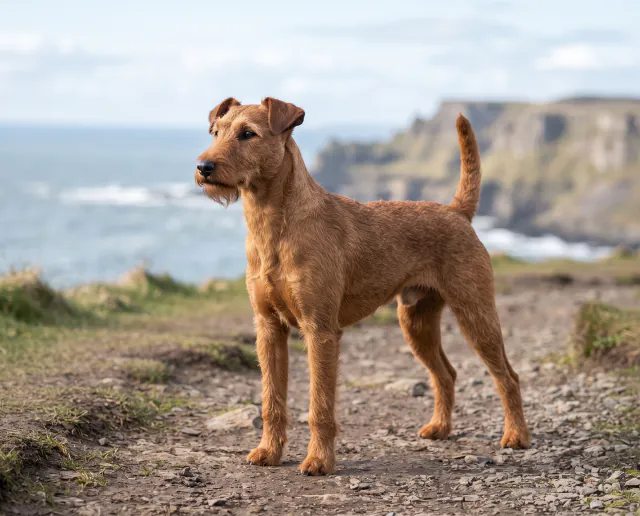
Everything about the Irish Terrier reads slightly larger than its size suggests. It stands taller and leggier than most wire terriers, moves with a confident, purposeful gait, and carries itself with what breed enthusiasts call the daredevil look, a phrase that undersells how genuinely fearless the dog can be when challenged. That fire is directed almost entirely outward. Within its own household the breed is famously affectionate and can be a devoted, faintly comic shadow to the people it belongs to.
Suitability
An Irish Terrier does best with an owner who already understands strong, characterful dogs, since the breed’s honesty and loyalty at home coexist with a genuine willingness to take on another dog that provokes it. Same sex aggression is a recognised issue in the breed, and many owners of two Irish Terriers keep them separated when unsupervised rather than risk a serious fight. Small pets are not a safe combination given the terrier drive underneath the coat. Children who are part of the family unit tend to be treated with real gentleness, and the breed has a long history as a nursemaid to Irish farm children, but visiting children and strange dogs both need careful management. First time owners can succeed with the breed if they take training seriously from the outset and are honest about what a bold red terrier requires.
Exercise
This is a genuinely energetic dog, and an hour and a half of exercise most days keeps an adult content rather than restless. Flat road walking alone rarely satisfies the breed. Proper off lead running in a safe, enclosed space, combined with scent work and games that let the dog use its nose and its considerable turn of speed, does far more good than distance for its own sake. Recall needs early, consistent investment, because a terrier that spots a cat, a squirrel or an unfamiliar dog across a field can commit to the chase before a call registers. Puppies should have exercise measured in short bursts to protect developing joints, building gradually toward the adult routine over the first year or so.
Grooming
The dense, wiry red coat should be hand stripped two or three times a year to keep its harsh, weatherproof texture and rich colour, since clipping softens the coat and dulls it toward a duller shade over time. Between strips a weekly brush through the furnishings on the legs, chest and beard prevents matting and keeps debris from accumulating after muddy walks. Shedding from a properly maintained coat is genuinely light, which suits owners keen to avoid hair on the sofa, though the beard needs wiping after meals and the ears benefit from a regular check given how they sit close to undergrowth on a walk.
Health
Twelve to fifteen years is a fair expectation for the breed, and Irish Terriers are generally considered a robust, hardy type without the long list of inherited conditions seen in some pedigree dogs. Cystinuria, a metabolic condition affecting how the kidneys handle certain amino acids and predisposing affected dogs to bladder stones, is documented in the breed, and a DNA test exists that a buyer should ask their breeder about. Hyperkeratosis of the paw pads, a thickening and cracking of the pads, is also reported and worth knowing about even though it rarely threatens the dog’s overall health. As with any athletic medium sized dog, hip and elbow soundness benefits from keeping weight down and avoiding hard exercise on immature joints.
Choosing and training
Firm, fair, reward based training started early gives the best results, since heavy handed correction tends to harden an already assertive character rather than settle it. Socialisation with other dogs must be managed deliberately and continued throughout the dog’s life rather than treated as a puppyhood task that is later finished. Buyers should expect a modest wait for a litter, since the breed is uncommon compared with more fashionable terriers, and the breed club is a sensible first point of contact for anyone serious about finding a well bred puppy. Monthly costs for feeding, insurance and coat care generally sit in a middling band for a dog this size, with professional stripping the main recurring extra for owners who do not learn the technique themselves.
Verdict
The Irish Terrier suits an experienced or committed owner who wants a bold, affectionate, genuinely brave dog and who will manage its temper toward other animals responsibly for its entire life. It rewards households prepared to give it real exercise and a job for its mind.
It is not the right choice for homes with small pets, anyone hoping to keep multiple same sex dogs without careful management, or an owner unwilling to put in consistent early training. Given that commitment, few breeds return the same fierce, good humoured loyalty.