
At a glance
Key facts
The essentials to compare before deciding whether this breed fits your home and routine.
- Size
- Large
- Lifespan
- 10 to 13 years
- Energy
- High
- Temperament
- Clownish, clever, aloof with strangers and devoted at home
- Good with children
- Often good with older children used to a boisterous large dog
- Exercise
- 90 minutes a day including swimming and retrieving where possible
- Trainability
- Beginner friendly
- Grooming
- Brush several times weekly with professional scissoring every couple of months, little shedding
- Estimated monthly cost, GBP
- £110 to £190 per month
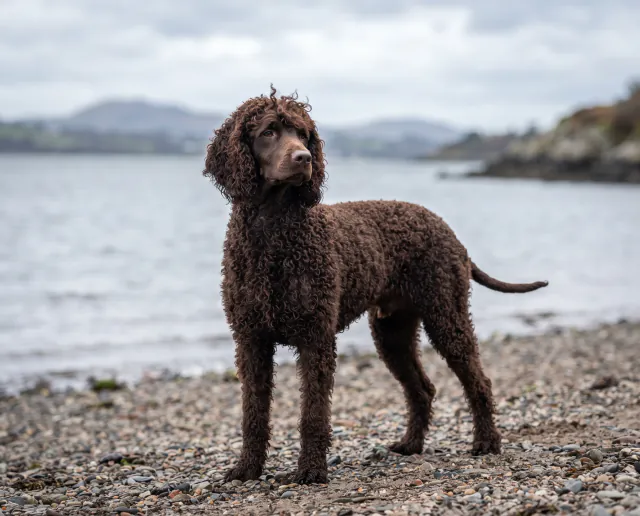
From a distance an Irish Water Spaniel is often mistaken for a brown poodle with an odd haircut. Closer up the differences are plain. The coat is a mass of tight liver curls over the body and legs, the face is smooth, a loose topknot falls over the eyes, and the tail is short haired and tapered like a rat’s. Standing up to 58 centimetres and weighing 20 to 30 kilos, it is the tallest of the spaniels and closer in size to a Labrador.
The breed was standardised in Ireland in the 1830s by Justin McCarthy of Dublin, made for retrieving duck from cold water and marsh. It still does that with enthusiasm, and the same drive expresses itself at home as a dog that carries socks, finds puddles and cannot pass a river without checking whether it is deep enough.
Living with the breed
At home the Irish Water Spaniel is affectionate with its family, funny and inventive, and considerably more independent than the average retriever. Strangers are treated with a cool appraisal that can look unfriendly, and some will guard the house, so early and broad socialising matters to keep aloofness from hardening into suspicion. They form strong bonds and can be clingy with the person they choose, and many do not cope well with long working days alone. The sense of humour shows in stealing, wrestling and inventing games, charming in a puppy and needing management in a 28 kilo adult. Children are usually well tolerated, though the breed’s size and bounce suit it better to older children who can hold their ground. Other dogs are generally fine, cats are possible with early introduction, and anything in a hutch is fair game.
Daily exercise
An adult needs around ninety minutes of real exercise a day and will take more. Swimming is the natural outlet and a river, lake or coastline used several times a week keeps an Irish Water Spaniel fit and sane. Retrieving from water, cover and long grass suits the breed exactly, and a dummy in the bag turns an ordinary walk into work. Running alongside a bike is possible once the dog is fully mature. Puppies grow into a tall, heavy frame and need the standard protection of short walks, no stairs and no repetitive jumping until the joints close at around a year. The oily coat sheds water, and a dog that has been in the sea will happily go in again a mile further along. Near livestock the lead goes on, and recall around waterfowl needs to be reliable before the dog is trusted off lead, because a swimming spaniel chasing ducks is hard to call off.
Training and mental work
The breed learns fast and forgets nothing. Training needs to be consistent, fair and interesting, with plenty of reward and variety, because a bored Irish Water Spaniel will start improvising. Heavy handed methods produce a dog that switches off or argues. Gundog training, working tests and scent work all suit it, and the breed can hold its own in agility and obedience with a handler who keeps things fun. Mental work at home should be a daily fixture, whether a food puzzle, a hidden retrieve or a short trick session, since a dog this clever with nothing to do will find its own entertainment in the kitchen bin. Early exposure to visitors, handling and busy places is the most valuable investment of the first four months.
Grooming and shedding
The curly coat sheds very little, which makes the breed a possibility for some who react to dog hair. What it does instead is mat. The curls need combing through to the skin two or three times a week, more when the dog is swimming regularly, with particular attention to the armpits, behind the ears and the feathering on the legs. Every six to eight weeks the coat is scissored back to shape, either by a groomer familiar with the breed or by an owner who has learned, and a tidy pet trim is far easier to keep than the fuller show coat. The smooth face and rat tail need no work. Ears are heavy and pendulous and need weekly checking, and a dog that swims must have them dried every time. The oil in the coat gives a faint doggy smell.
Health and costs
Ten to thirteen years is typical. Hip dysplasia occurs and hip scoring under the BVA and Kennel Club scheme should be asked for on both parents. Eye conditions, including cataracts, are recognised, so annual eye examination under the same scheme is the other standard request. Low thyroid function is reported and shows as weight gain and a thinning coat. Hair loss over the tail and body in middle age is recognised in some lines, unsightly rather than dangerous. Weight management is straightforward in a dog that exercises this hard, provided the food matches the work. Costs run at around £110 to £190 a month across food, insurance, veterinary care and coat care, with a groomer as the main extra. The Kennel Club counts the breed among the vulnerable native breeds, litters are few, and the breed club is the sensible first call. A wait is normal.
Verdict
The Irish Water Spaniel suits an active, humorous owner near water who enjoys training, is happy to learn a coat or pay a groomer, and wants a large, clever, low shedding gundog that will be reserved with the world and devoted at home.
It is the wrong dog for someone wanting an easy going retriever that loves everyone, a household that is out all day, or a first time owner who wants a breed that simply complies. A Labrador or a Flat Coated Retriever will suit most of those people far better.