
At a glance
Key facts
The essentials to compare before deciding whether this breed fits your home and routine.
- Size
- Small
- Lifespan
- 12 to 18 years
- Energy
- High
- Temperament
- Busy, clever and strongly attached to its household
- Good with children
- Usually good with children who play fairly
- Exercise
- Around an hour a day plus games at home
- Trainability
- Moderate
- Grooming
- A quick weekly brush and routine nail care
- Estimated monthly cost, GBP
- £60 to £110 per month
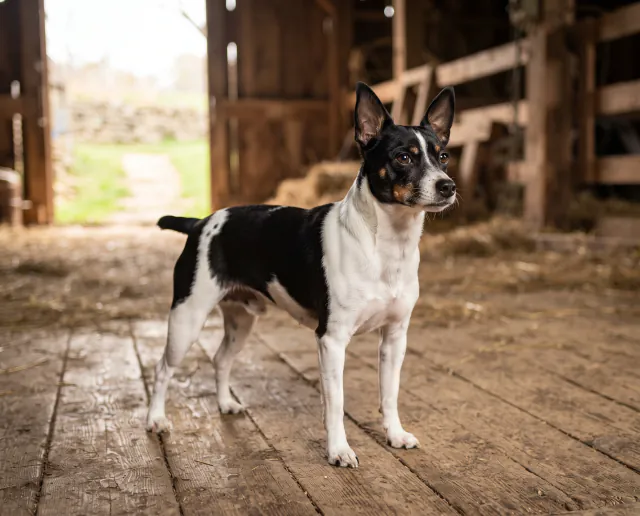
The Rat Terrier is an American farm dog built for vermin control, and it still behaves like one. Compact, muscular and startlingly fast for its size, it combines a terrier’s persistence with a level of attachment to people that many terrier breeds lack. Owners describe a dog that follows them from room to room and then explodes into activity the moment something moves in the garden. It is an appealing package for the right home, but the underlying drive to hunt, dig and investigate is not a habit to be trained out.
Origin and purpose
The breed developed on farms across the United States during the nineteenth and early twentieth centuries, built from terriers brought over by British and Irish settlers and then crossed with whatever improved the working result. Smooth Fox Terrier and Manchester Terrier stock supplied the base, while Beagle, Whippet and Italian Greyhound crosses added scenting ability, speed and a little extra range. The job was rodent control in barns, grain stores and fields, often in packs. Numbers fell sharply once chemical rodenticides took over that work. The American Kennel Club recognised the breed in 2013, and outside North America it remains uncommon.
Temperament and behaviour
Expect an alert, inquisitive and genuinely clever dog that misses very little. Rat Terriers tend to be affectionate and physically close with their own household while remaining cautious rather than instantly friendly with strangers, and early socialisation makes a real difference to how that caution develops. Barking is moderate by terrier standards, used to announce arrivals rather than as constant background noise, though a bored individual will escalate. Digging is normal and persistent. So is chasing anything small and moving, which is the single behaviour most likely to cause trouble on a walk.
Family life and other animals
The breed generally fits family life well and enjoys the activity of a household with children, provided those children have learned to play fairly and to leave a resting dog alone. Miniatures are small enough to be injured by rough handling. Other dogs are usually accepted, particularly with early exposure, though some individuals are pushy with dogs of the same sex. Cats can work where the dog is raised with them from puppyhood. Rodent pets are simply incompatible with what this breed was created to do. First-time owners can manage with support and realistic expectations.
Exercise and mental stimulation
An hour a day suits most adults, split across walks, free running in a secure space and structured games. Physical exercise alone rarely satisfies the breed, since the mind is the harder part to tire. Scent games, hidden food searches, tug with rules, trick training and a designated digging area all channel the instincts productively. Terrier racing, agility and earthdog style activities suit dogs with the temperament for them. Fencing needs checking properly, as a determined Rat Terrier will dig under a barrier and can jump higher than its size suggests.
Training
Reward based training works well, since the breed is bright, food motivated and keen to be involved. Independence is the complication. This is a dog bred to make its own decisions at speed, so compliance is offered rather than assumed, and dull repetition loses attention quickly. Keep sessions short, varied and worth the dog’s while. Recall around wildlife needs sustained work and honest assessment, and many owners find a long line the sensible compromise in open country. House training can be slower than average, particularly in the smaller sizes.
Coat, grooming and shedding
Grooming demands are among the lightest of any terrier. The short, dense, close lying coat needs a weekly brush with a rubber mitt or bristle brush to lift dead hair and keep the skin healthy. Shedding is moderate and continuous, with a heavier spring moult, so a smooth coat does not mean a hair free house. There is no trimming or stripping to arrange. Thin coated dogs feel the cold, and a coat is sensible for winter walks in colder climates. Routine nail trimming, tooth brushing and ear checks complete the picture.
Size, lifespan and health
Two sizes are recognised. Miniatures typically stand 25 to 33 cm (10 to 13 in) at the withers and standards 33 to 46 cm (13 to 18 in), with weights across the breed running from about 4.5 to 11 kg (10 to 25 lb). Lifespans of 12 to 18 years are reported, which places the breed among the longer lived small dogs. Recognised screening themes include patella assessment, hip evaluation, cardiac checks, eye testing and DNA testing for primary lens luxation. Legg Calve Perthes disease is also seen in small terrier types. Discuss any breeder’s written results with a vet.
Living costs, space and time alone
Running costs are modest for a dog of this size, with low grooming bills and moderate food requirements, leaving insurance and veterinary care as the main variables. A flat or small house works well as long as daily exercise is genuinely delivered, though a secure garden makes life considerably easier. Time alone is handled reasonably by a settled adult that has been exercised first, but this is an attached breed that does not enjoy long stretches of solitude and may become noisy, destructive or fixated on digging if left too often.
Verdict
The Rat Terrier suits an active household that wants a small, sharp, involved dog and finds terrier character entertaining rather than exhausting. Low grooming, good longevity and real trainability make it a practical choice for people willing to work with the instincts rather than against them.
It is a poor match for homes with small pets, for anyone expecting reliable off lead recall around wildlife without training, or for a quiet household hoping for a placid lap dog. Finding one outside North America takes patience.