At a glance
Key facts
The essentials to compare before deciding whether this breed fits your home and routine.
- Size
- Toy
- Lifespan
- 13 to 15 years
- Energy
- High
- Temperament
- Bold, quick witted and devoted to its owner
- Good with children
- Better suited to older, careful children
- Exercise
- Thirty to forty five minutes plus active indoor games
- Trainability
- Beginner friendly
- Grooming
- A weekly brush with routine nail and tooth care
- Estimated monthly cost, GBP
- £55 to £100 per month
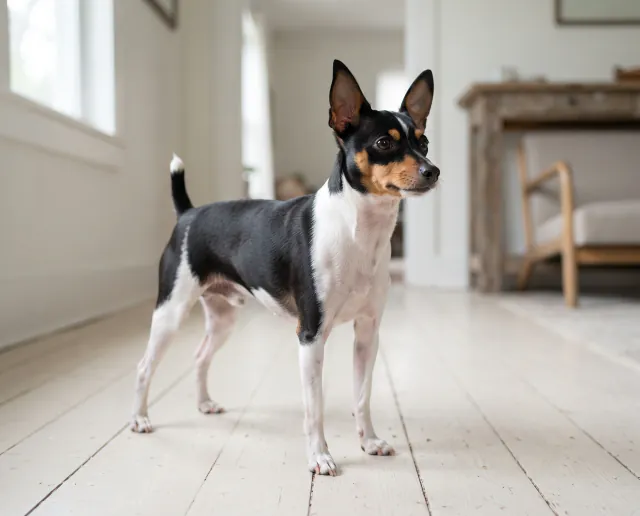
The Toy Fox Terrier is a genuine terrier scaled down to a toy dog’s dimensions, and the temperament came with the size reduction rather than being bred out of it. Owners get a bold, athletic, highly responsive companion in a body that weighs less than a bag of sugar. That combination is the breed’s great appeal and its main practical difficulty, because a dog this small still wants to chase, dig, patrol and announce every arrival. Treating it as a terrier rather than a lap ornament produces far better results.
Origin and purpose
The breed was created in the United States during the first half of the twentieth century, when breeders selected the smallest Smooth Fox Terriers and crossed them with Chihuahua, Manchester Terrier and Italian Greyhound stock to fix a compact, refined type without losing working nerve. The intended job was rat control around farms and grain stores, where a small dog could work in tight spaces. The breed also became a popular circus performer, valued for its agility and quick learning. The United Kennel Club recognised it in 1936 and the American Kennel Club in 2003, placing it in the Toy Group. It is rarely seen outside North America.
Temperament and behaviour
This is a confident, curious dog that behaves as though it were considerably larger. Attachment to one or two people in the household is often intense, and the breed follows its owner closely and dislikes being excluded. Alertness translates directly into noise, and barking at doorbells, passers by and unexpected sounds is one of the most consistent traits reported. Prey drive is real, so squirrels, birds and anything scuttling will trigger a chase. Some individuals are pushy with much larger dogs, which is a safety concern rather than a charming one.
Family life and other animals
The breed enjoys family life but is physically fragile, and a dog weighing two or three kilograms can be seriously injured by a fall, a trodden foot or an over enthusiastic hug. Households with older children who understand careful handling are a better fit than those with toddlers. Other dogs are usually accepted with sensible introductions, though supervision around large, boisterous dogs is important given the size difference. Cats often work out where the dog is raised with them. Rodent and bird pets do not. First-time owners can succeed if they train properly rather than indulging the size.
Exercise and mental stimulation
Thirty to forty five minutes of daily walking suits most adults, supplemented by active indoor play, which this breed happily supplies for itself. The mental side matters more than the distance covered. Trick training, food puzzles, scent games and short recall exercises use the breed’s considerable aptitude and reduce nuisance barking more effectively than extra walking does. Agility scaled to the size is popular and well suited to the breed’s speed and coordination. A secure garden is valuable, since the dog is fast, small enough to slip through gaps and inclined to give chase.
Training
Few toy breeds learn as readily. The Toy Fox Terrier is attentive, food motivated and enjoys structured work, so reward based training tends to move quickly. The common failure is not the dog. Small dogs are frequently carried past situations they should have learned to handle, and behaviour tolerated in a tiny dog would never be accepted in a large one. Teach a quiet cue early, work seriously on recall, and build calm around visitors. House training can take longer than average and benefits from a consistent routine and, in cold climates, a sheltered spot outdoors.
Coat, grooming and shedding
Coat care is minimal. The short, fine, smooth coat needs a weekly going over with a soft brush or rubber mitt to remove loose hair and distribute skin oils. Shedding is moderate and year round rather than seasonal, and fine white hairs are noticeable on dark fabrics. There is no clipping or stripping involved. The thin coat and low body mass mean the breed feels the cold acutely, so a proper coat for winter walks is a practical necessity rather than a fashion choice. Nails, teeth and ears need regular routine attention.
Size, lifespan and health
Adults typically stand 22 to 29 cm (8.5 to 11.5 in) at the withers and weigh 1.5 to 3.2 kg (3.5 to 7 lb), making this one of the smaller recognised breeds. A lifespan of 13 to 15 years is usual. Recognised screening themes include patella assessment, eye testing, cardiac evaluation and DNA tests available for primary lens luxation and for congenital hypothyroidism with goitre. Legg Calve Perthes disease and dental crowding are also seen in toy breeds generally, and very young puppies can be prone to low blood sugar. Discuss screening results and any concerns with a vet.
Living costs, space and time alone
This is an inexpensive dog to run by most standards, with small food portions, negligible grooming bills and low equipment costs, leaving insurance and veterinary treatment as the main expenses. Flats and small homes suit the breed well, provided walks and training genuinely happen, though barking is a real consideration where neighbours share walls. Time alone is manageable for a settled adult but not for long working days, since the breed bonds tightly and can become vocal or anxious when regularly left. Building independence gradually from puppyhood pays off.
Verdict
The Toy Fox Terrier suits someone who wants a small, portable, highly trainable dog and is prepared to raise it with the same rules a larger terrier would get. Handled that way, it is an engaging, long lived and surprisingly capable companion.
It is a poor choice for homes with very young children, for anyone who cannot tolerate a reactive barker, or for owners hoping for a placid lap dog. Availability outside North America is limited.