
At a glance
Key facts
The essentials to compare before deciding whether this breed fits your home and routine.
- Size
- Medium
- Lifespan
- 12 to 14 years
- Energy
- High
- Temperament
- Affectionate, bold and people-focused
- Good with children
- Often affectionate, with careful supervision
- Exercise
- About 1 hour a day plus play and training
- Trainability
- Moderate
- Grooming
- Weekly brushing
- Estimated monthly cost, GBP
- £80 to £150 per month
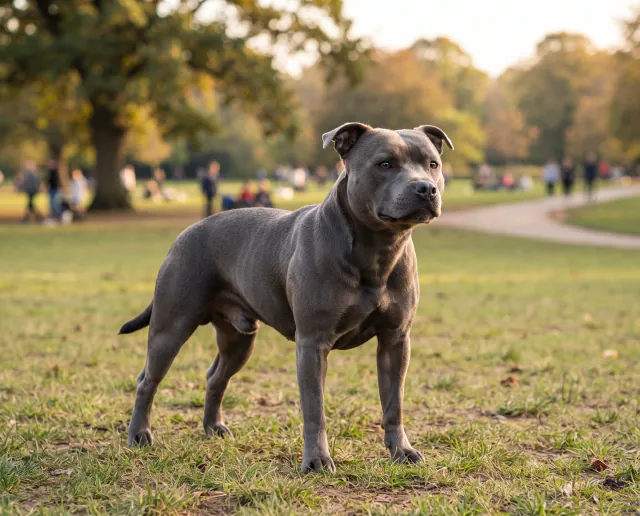
Staffordshire Bull Terriers are compact, muscular dogs with a strong attachment to people. Many are playful, affectionate and keen participants in household life. They are also powerful for their size and can become over-excited without clear guidance. Individual responses to other dogs vary, so sociability should never be assumed from friendliness with humans. Responsible ownership combines reward-based training, secure handling, good breeding or rescue assessment and respect for the dog’s need to rest.
Origin and purpose
The Staffordshire Bull Terrier was developed in the English Midlands during the nineteenth century, crossing bull-baiting dogs with terriers to produce something smaller and faster for the pit fighting that followed the ban on baiting in 1835. Those contests were themselves outlawed, and the breed was afterwards kept and bred as a companion, gaining Kennel Club recognition in 1935. Two things carried across. The first is an unusual tolerance of people, including strangers, which was selected for deliberately because handlers needed to separate dogs safely. The second is that behaviour towards other dogs was never selected for in the same way and remains highly variable between individuals. Modern Staffies are many generations from that history, but the combination of intense human attachment with unpredictable dog sociability is a direct inheritance rather than a coincidence.
Suitability
A Staffy can suit an active family, a committed first-time owner or a smaller home with good walking access. Long routine absences are often difficult because the breed values company. Most are not especially vocal and bark less than many terriers, although excitement and frustration can produce noise. Children and dogs always need adult supervision. Teach children not to climb on, hug or disturb a sleeping dog. A strong adolescent may pull or jump, so everyone handling the lead needs confidence and consistent skills. Check tenancy, travel and insurance arrangements before adoption because unfair restrictions can affect bull-type dogs.
Exercise
Most healthy adults need around an hour of purposeful exercise plus play and training. Build fitness gradually and include sniffing, exploration and controlled games. Tug can be useful when the dog learns to start, stop and release on cue. Repetitive jumping is unnecessary, particularly for growing dogs. Staffies can become hot during hard activity, so carry water and adjust plans in warm conditions. Use secure areas for off-lead exercise until recall is dependable around dogs and wildlife. Mental work helps without creating constant physical arousal.
Grooming
The short coat requires a weekly brush and occasional bathing. Shedding still occurs, and pale hair can be noticeable on furnishings. Check skin, paws and ears for irritation during grooming. Some individuals experience recurring skin problems, which need veterinary diagnosis rather than frequent changes of food or untested remedies. Keep nails at a comfortable length and introduce tooth brushing through gradual rewards. A durable, washable bed is useful. Choose toys by supervision and condition, replacing damaged items before pieces can be swallowed.
Health
Ask breeders for results from current recommended screening. The Kennel Club highlights DNA testing for hereditary cataracts and L-2-hydroxyglutaric aciduria, alongside eye and elbow assessment among breed recommendations. Request original documentation and understand what each result covers. Screening reduces risk but cannot guarantee health. Watch for persistent skin trouble, changes in vision, unusual movement or episodes of disorientation and seek veterinary advice. Maintain a lean body condition to protect joints. Insurance should reflect the cost of investigation as well as routine treatment.
Choosing and training
A good breeder prioritises stable temperament, health and functional build. Meet the mother and observe whether the environment is clean and calm. Rescue centres can match an adult to children, dogs and working patterns using observed behaviour. Train loose-lead walking, recall, calm greetings, swapping objects and settling. Avoid punishment, which can increase fear or conflict. Introduce other dogs at a pace the individual can manage and do not force greetings. Living alongside a cat is possible, particularly for a dog raised with one, but the introduction needs the same slow, managed approach and secure separation until the response is known. Neutral coexistence is a valid goal even if the dog does not enjoy busy dog parks.
Size and lifespan
Adults typically stand 36 to 41 cm (14 to 16 in) at the withers and weigh 11 to 17 kg (24 to 37 lb), with males heavier than females at the same height. The breed is dense and heavily muscled, so a Staffy feels considerably weightier than the measurements suggest, which matters when lifting an injured or elderly dog into a car. A typical lifespan is 12 to 14 years. Muscle should be visible without a thick covering of fat, and an overweight Staffy tires faster and overheats sooner in warm conditions. Beyond the screening described above, the most useful habit is recording what normal looks like for your own dog, including usual weight, skin condition, movement and tolerance of exercise. Changes measured against that baseline give a vet more to work with than a list of conditions associated with the breed.
Verdict
The Staffordshire Bull Terrier can be a devoted, lively companion for owners who value close contact and consistent training. The breed is not defined by either sentimental claims or negative stereotypes. Each dog needs sensible assessment and management. A suitable home can provide daily company, secure exercise, supervision with children and controlled introductions to other animals. People wanting an independent dog or effortless social behaviour in every setting should choose a different match.
Meet adult Staffies and observe calm, everyday handling. A puppy’s friendliness does not predict every future interaction. Clear plans for training, housing, insurance and dog introductions give the relationship a stronger foundation than assumptions based on reputation.