
At a glance
Key facts
The essentials to compare before deciding whether this breed fits your home and routine.
- Size
- Small
- Lifespan
- 13 to 15 years
- Energy
- Medium to high
- Temperament
- Bold, comical and busier than its size suggests
- Good with children
- Often good with children in a structured, active home
- Exercise
- About 45 minutes a day plus games that use the brain
- Trainability
- Moderate
- Grooming
- Weekly brushing keeps the short coat tidy and glossy
- Estimated monthly cost, GBP
- £75 to £140 per month
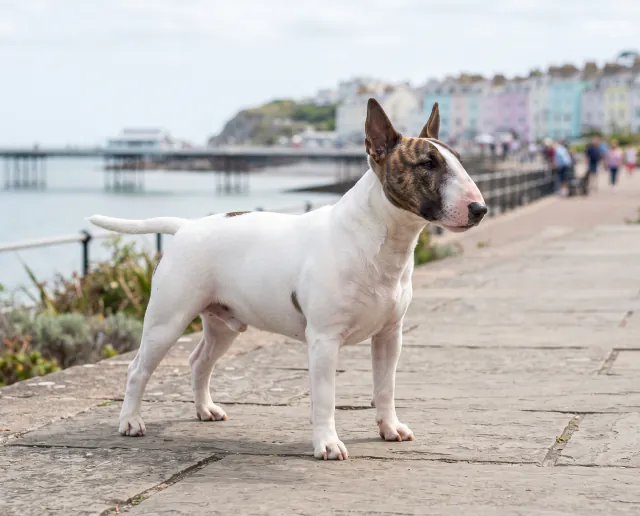
Shrinking a breed rarely shrinks its opinions, and the Miniature Bull Terrier proves the point. Developed alongside the standard Bull Terrier from the same nineteenth century stock, the miniature was bred down in size for people who wanted the distinctive egg shaped head, the muscular build and the determined character without a dog that could shoulder a door open. Kennel Clubs classify it as a separate breed rather than a small version of the other, and spending time with both makes clear why. Similar in outline, the two nonetheless differ enough in scale, exercise capacity and the practicalities of daily life to deserve their own entries.
At roughly a third of the weight of a standard Bull Terrier, a Miniature still carries most of the same conviction in a body that fits more households. That combination, considerable personality packaged into a manageable size, explains much of its appeal and most of the mistakes new owners make in underestimating it.
Suitability
A confident, food motivated household that enjoys a dog with genuine opinions tends to get on well with this breed. It is not the easiest first dog, since a stubborn streak and a talent for selective hearing require an owner willing to stay patient and consistent rather than escalate to force. Children who understand that even a small, muscular dog should not be wound up or cornered generally do fine, and supervision matters more for the child’s exuberance than for any inherent aggression in a well socialised dog. Other dogs can be a mixed picture, with same sex pairings sometimes proving harder work than mixed households. Flats and small houses both suit the breed provided exercise and mental stimulation genuinely happen each day.
Exercise
Around 45 minutes of varied activity suits most adults, ideally split between a proper walk and something that involves problem solving rather than pure repetition. The breed carries real physical drive for its size and can become destructive or vocal if left under-occupied, so a tired body without a tired mind rarely produces a settled dog. Heat needs watching given a relatively short muzzle and dense build, so summer exercise belongs in cooler parts of the day. Puppies benefit from short, frequent outings rather than long walks while joints are still developing, and adolescence in this breed often runs later than owners expect, with boundary testing well into the second year being entirely normal.
Grooming
The coat is short, dense and glossy, and a weekly session with a rubber grooming mitt removes most loose hair and keeps the skin healthy. Bathing is rarely needed beyond an occasional wash, since the coat does not hold dirt or odour the way a longer jacket would. White or partly white individuals benefit from sun protection on exposed skin, particularly the nose and ear tips, during strong summer sun. Nails wear unevenly on an active dog and usually need regular trimming, and a weekly check of ears, teeth and the skin folds around the mouth catches minor problems early.
Health
Primary lens luxation is the condition breeders and buyers should know best, an inherited eye disorder in which the lens detaches from its normal position and can cause sudden pain and vision loss if untreated. A DNA test identifies dogs at risk before symptoms appear, and asking to see clear or hereditarily clear results for both parents is a reasonable, straightforward request. Kidney disease has also been documented in the breed, and many breeders now screen breeding stock through urine and blood testing for early signs of impaired function. Heart checks by a vet familiar with the breed are worth asking about too, since murmurs and structural heart conditions are recognised often enough to take seriously. A lifespan of thirteen to fifteen years is realistic for a dog kept lean, since excess weight strains joints that already carry a compact, heavily muscled frame.
Choosing and training
Finding a puppy from a breeder who tests for primary lens luxation and screens for kidney and heart concerns takes more effort than answering the first advertisement found online, and that effort is worth making given how serious untreated lens luxation can become. Training works best in short, upbeat sessions built around food and play, since harsh handling tends to produce a dog that either shuts down or digs in further. Consistency across the whole household matters more than any single technique, because a Miniature Bull Terrier that learns a rule is negotiable with one family member will test every other member the same way. Early, wide ranging socialisation reduces the chance of wariness or reactivity developing later.
Verdict
This breed suits owners who want the character and build of a Bull Terrier without the size, who will commit to genuine mental and physical exercise daily, and who are prepared to seek out a breeder testing properly for eye, kidney and heart conditions. Households with older, sensible children and a taste for a comical, opinionated dog tend to do particularly well with it.
Anyone wanting an easily led first dog, a quiet flat companion content with minimal activity, or an owner unwilling to research health testing thoroughly should look toward a different breed. Meeting adult dogs and talking to their owners about temperament and training gives a far better sense of the breed than a photograph of a puppy ever can.