At a glance
Key facts
The essentials to compare before deciding whether this breed fits your home and routine.
- Size
- Medium
- Lifespan
- 12 to 15 years
- Energy
- High
- Temperament
- Confident, affectionate and physically bold
- Good with children
- Often affectionate with children, though supervision matters
- Exercise
- One to two hours daily with training built in
- Trainability
- Moderate
- Grooming
- A weekly rub down and routine skin and ear checks
- Estimated monthly cost, GBP
- £80 to £140 per month
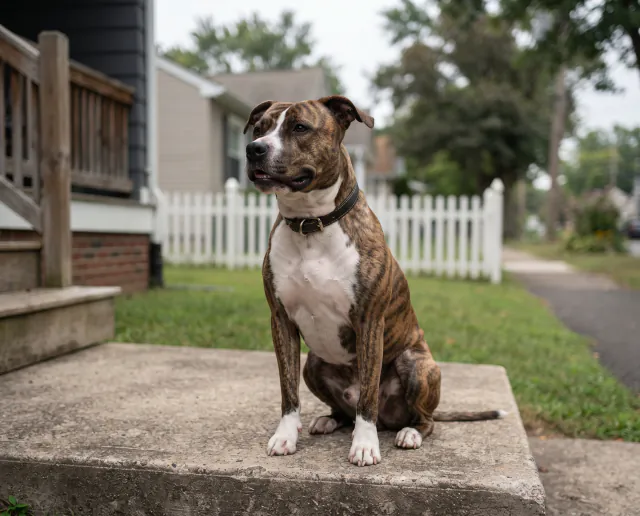
The American Staffordshire Terrier is a compact, heavily muscled bull-type breed with a reputation that says more about its history than about the dogs most owners actually live with. Sound examples are affectionate, confident and strongly oriented towards people. They are also powerful for their size, physically determined and often less tolerant of other dogs than of humans. The breed is recognised by the American Kennel Club but not by the United Kingdom Kennel Club, and breed specific legislation in some countries restricts or bans bull-type dogs, so local law needs checking before anything else.
Origin and purpose
The breed traces back to crosses of bulldog and terrier types in nineteenth century Britain, produced for the fighting pits and later exported to North America. Once that use was outlawed, American breeders selected larger, heavier dogs for the show ring and for general farm and companion work. The American Kennel Club recognised the resulting type in 1936 as the Staffordshire Terrier, renamed in 1972 to separate it from the smaller Staffordshire Bull Terrier. Selection since then has been for a stable, biddable temperament with people. That history matters, because tolerance of other dogs was never a priority in the original selection and still varies widely between individuals.
Temperament and behaviour
Most are outgoing, physically affectionate and keen to be involved in whatever the household is doing. They tend to be confident rather than nervous, and many are noticeably tolerant of handling. The behavioural work centres on two areas. The first is arousal, since these dogs go from relaxed to highly excited quickly and take time to come back down. The second is other dogs, where some individuals stay sociable for life while others become selective or reactive in adolescence, often around twelve to eighteen months. Barking is moderate. Chewing strength is considerable, and cheap toys do not survive.
Family life and other animals
Within the family these dogs are usually gentle and demonstrative, and many are patient with children to a degree that surprises people who know only the reputation. Supervision still matters, mostly because an enthusiastic dog of this build knocks small children over easily. With other dogs, honest management is safer than optimism. Many live happily with a companion of the opposite sex, but same sex pairs can be difficult, and a dog that has shown reactivity should not be walked in crowded off lead spaces. Cats can work with careful introductions. A committed first time owner can succeed with good training support.
Exercise and mental stimulation
Plan for one to two hours a day across two or more outings, with training folded into the walk rather than treated separately. Physical exercise alone is not enough, and a dog run to exhaustion daily becomes fitter and needs more. Scentwork, obedience practice, controlled tug with clear rules, structured retrieve and puzzle feeding all give the mental work these dogs want. Weight pulling and similar strength sports suit the build where the dog is mature. Heavy muscle means care in hot weather, and growing puppies need jumping and hard surfaces limited.
Training
Reward based methods work well, and the breed’s willingness to engage with people makes progress fast when sessions are short and clear. Harsh handling raises arousal rather than reducing it. Priorities are a solid recall, lead manners that hold when another dog appears, an off cue for excitement, calm greetings and comfortable acceptance of grooming and veterinary examination. Muzzle training taught positively is worth having regardless of local law, because it removes stress from vet visits and travel. Early socialisation should be calm exposure rather than repeated free-for-all play, which teaches a dog that every meeting is exciting.
Coat, grooming and shedding
The coat is short, stiff and close, and needs very little. A weekly rub down with a rubber mitt removes loose hair and keeps the skin in condition. Shedding is moderate and constant rather than seasonal, and the short bristly hairs work themselves into fabric. Skin is worth watching, since allergic and contact skin problems are common in bull-type breeds and often show first as itching, redness between the toes or repeated ear irritation. Nails need regular trimming, and teeth benefit from brushing established early.
Size, lifespan and health
Males typically stand 46 to 48 cm (18 to 19 in) at the withers and weigh 25 to 32 kg (55 to 70 lb). Females typically stand 43 to 46 cm (17 to 18 in) and weigh 22 to 27 kg (48 to 60 lb). Correct condition shows muscle rather than bulk. Life expectancy is generally 12 to 15 years, good for a dog of this substance. Recognised screening themes include hip scoring, eye testing, cardiac assessment, and DNA testing for cerebellar ataxia, for which a test is available. Ask for written parental results and discuss them with a vet rather than relying on a breeder’s summary. Skin and allergy problems are a common reason for veterinary visits in the breed.
Living costs, space and time alone
Costs are moderate for a dog of this size, with roughly £80 to £140 per month covering food, preventive care, insurance and equipment. Insurance can be harder to arrange where bull-type breeds are treated differently by insurers. A medium sized home with a securely fenced garden is adequate, and the breed does not need land. Most adults settle alone for a few hours once mature, though young dogs left unoccupied are destructive. Noise is not usually a problem for neighbours. Where legislation applies, requirements around insurance, muzzling and registration add cost and restrict travel.
Verdict
An American Staffordshire Terrier suits an active, consistent owner who enjoys training, will manage the dog properly around other dogs, and has checked what the law allows where they live and travel.
It is not a low effort breed despite the modest grooming and moderate size. Anyone unwilling to supervise carefully, invest in training or accept that some individuals never become sociable with other dogs should choose differently.