At a glance
Key facts
The essentials to compare before deciding whether this breed fits your home and routine.
- Size
- Medium
- Lifespan
- 12 to 14 years
- Energy
- High
- Temperament
- Independent, watchful, athletic and reserved with strangers
- Good with children
- Better with older children in a household the dog knows well
- Exercise
- One to two hours daily behind high, secure fencing
- Trainability
- Experienced handler
- Grooming
- A weekly rub over, with very little shedding
- Estimated monthly cost, GBP
- £80 to £140 per month
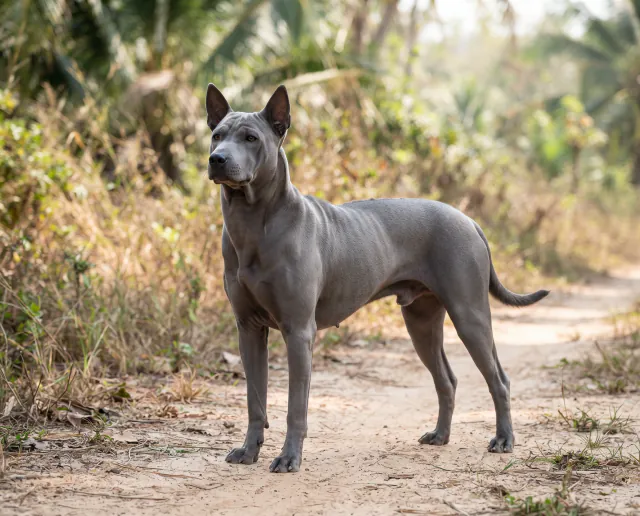
The Thai Ridgeback is a lean, muscular, short-coated dog with a ridge of hair along its back that grows against the lie of the coat. It developed in relative isolation in eastern Thailand and was largely unknown elsewhere until the late twentieth century. It remains rare outside its homeland. This is not a general-purpose family dog, and the breed’s own enthusiasts are usually the first to say so.
Origin and purpose
The breed comes from the eastern provinces of Thailand, where poor roads and river geography kept dog populations separate. Villagers used them for hunting small game and vermin, accompanying carts and guarding property. Nothing about that work rewarded a dog that waited to be told what to do, so independence, watchfulness and physical capability were selected for. Formal registration began in Thailand in the twentieth century, with international recognition following slowly. The ridge appears in several recognised patterns and is a defining feature rather than a functional one.
Temperament and behaviour
Thai Ridgebacks are loyal and affectionate within their own household and distinctly reserved outside it. A well-socialised adult is neither nervous nor aggressive, but it is watchful and makes its own assessment before accepting anyone. Poorly socialised individuals become suspicious, which in a strong, quick dog is a serious problem. They are natural guardians and alert to disturbance, but they are not habitual barkers and are quiet in ordinary circumstances. Prey drive is high, and cats, rabbits and poultry all trigger it. They are exceptional jumpers and climbers, and a fence that holds an ordinary dog of this size may not hold one.
Family life and other animals
Within a household they know, Thai Ridgebacks are gentle and closely bonded to their people. They do better with older children who know not to crowd or handle a dog roughly. Very young children and busy open-house arrangements do not suit the breed. With other dogs results vary, and same-sex tension is common enough to plan for. Small pets are generally not compatible. This is a breed for an experienced owner. Anyone whose previous dogs were biddable companion breeds will find the independence, reserve and physical ability a step up, and a trainer familiar with primitive breeds is a sensible investment.
Exercise and mental stimulation
One to two hours a day suits most adults, who prefer running, climbing and exploring to repetitive lead walking. Free running belongs in securely fenced ground, since recall is unreliable once a Thai Ridgeback is committed to a chase. Fencing needs real height, often around two metres, with nothing beside it to climb from and a secure base. Mental work matters as much, and scent games, problem-solving toys, varied routes and trick training all help. A bored one finds its own occupation, usually getting out of the garden or into something it should not.
Training
Training rewards consistency, fairness and a clear structure. They are intelligent and learn fast, but they were never bred to take direction and assess whether the handler is worth listening to. Reward-based methods work; heavy-handed correction produces avoidance or, in a confident individual, confrontation. Sessions should be short and varied, and the rules should be the same every day. Socialisation from puppyhood through adolescence is the most important part of training here, since reserve hardens into suspicion without it. Recall should be trained thoroughly and still not relied on in open space.
Coat, grooming and shedding
The coat is very short, smooth and close, in blue, black, red or fawn, occasionally brindle. A weekly wipe with a mitt lifts the loose hair, and shedding is light, with a modest seasonal increase. Bathing is rarely needed. The thin coat gives little protection against cold and wet, so a dog in a cool climate needs a coat in winter and should not be left outdoors for long. Skin shows sunburn and irritation readily and should be checked routinely.
Size, lifespan and health
Adults typically stand 51 to 61 cm (20 to 24 in) at the withers and weigh 16 to 32 kg (35 to 70 lb), with males clearly larger than females. Twelve to fourteen years is typical. The breed is generally healthy, helped by natural selection rather than intensive line breeding, but there are recognised concerns. Dermoid sinus, a tube-like defect in the skin over the spine, is associated with ridged breeds; puppies should be examined for it and any suspected case assessed by a vet. Hip dysplasia occurs, and hip scoring of breeding stock is the accepted screening route, alongside elbow assessment and eye examination in many lines. Buyers should ask what screening has been carried out and discuss the results with a vet rather than accept a general assurance of good health.
Living costs, space and time alone
Roughly £80 to £140 a month covers food, insurance and routine care for most adults, with grooming adding almost nothing. The purchase price and the effort of finding a well-bred puppy are bigger obstacles, since the breed is uncommon outside Thailand and some countries have very few breeders. A medium-sized home with a secured garden works well, and a flat is possible only with an unusually committed exercise routine. Time alone is manageable for a few hours in an exercised adult with something to do, though a young dog left too long will test the fencing. Noise is one of the breed’s easier features: these are quiet dogs that bark with reason.
Verdict
The Thai Ridgeback suits an experienced, active owner who wants an independent, watchful, physically capable dog, who will commit to lifelong socialisation and has a garden fenced to a standard that would hold a larger animal.
It is a poor fit for a first-time owner, a household with small pets or very young children, or anyone who wants an obedient, sociable dog that greets everybody. The breed’s reserve is not a flaw to be trained out, and an owner who does not want it should choose differently.