An owner who adopts, or has lived for years with, a dog that jumps up at every visitor, pulls hard on every walk, guards a food bowl, or barks and lunges at other dogs will often be told the same thing a puppy owner is told: reward the behaviour you want, be consistent, and the problem will resolve. That advice is not wrong, but it is incomplete for this situation in a way that matters. A five-year-old dog with a rehearsed pattern behind a behaviour is not the same training problem as a sixteen-week-old puppy encountering the same scenario for the first time, and treating the two as identical is one of the most common reasons owners feel training “isn’t working” when the real issue is that the plan was built for the wrong problem.
This is not because older dogs cannot learn. They can, at any age, and the basic mechanics of learning do not change with a birthday. What changes is that an established pattern has a history behind it: years of the behaviour producing some result the dog found worthwhile, in a specific environment, in response to specific triggers, often with an inconsistent human response mixed in along the way. This guide covers what taking that history seriously actually means in practice, why safety and a medical check come before or alongside training rather than after it, and why a genuinely established pattern needs a realistic timeframe and, in most cases, individual professional guidance rather than a generic article.
Take the reinforcement history seriously
A behaviour that has been rehearsed for years has almost always been reinforced along the way, whether or not anyone intended that. A dog that jumps up at visitors has likely been getting attention, physical contact or at least eye contact from at least some of the people it jumps on, even if others push it down. A dog that pulls has probably found that pulling gets it to the interesting smell or the other dog faster, often enough to keep the behaviour going. A dog that guards a bowl or a chew has probably found, at some point, that stiffening or growling made a hand withdraw.
This matters practically because it tells you what the behaviour is actually achieving for the dog, and a plan that does not address that underlying pay-off tends to fail even when the owner is applying textbook technique. Asking “what has this dog been getting out of this for years” is usually more useful than asking “how do I stop this” as a first question, because the answer points directly at what needs to change in the environment and the reward structure, not just at the behaviour itself.
Physical strength and safety come first, not instead of training
An older or larger dog with a well-rehearsed pattern is often also physically stronger, heavier and more practised at pulling off a lead, jumping past a barrier, or lunging with real force than a puppy learning the same behaviour would be. Safety and physical management need to be sorted out immediately, in parallel with training, not treated as a lesser concern to deal with once the “real” training has progressed.
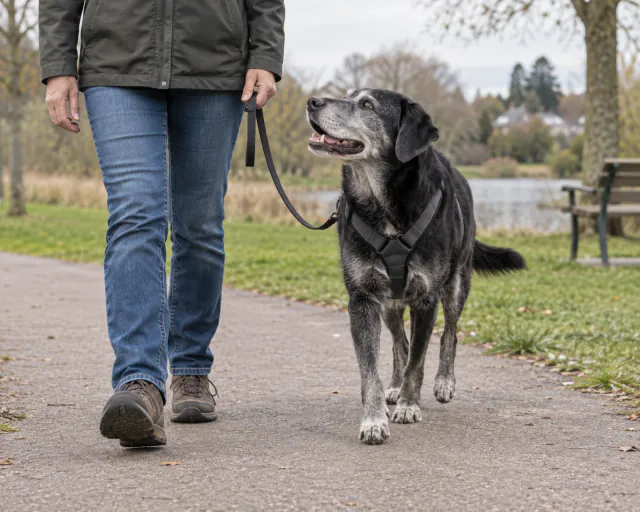
In practice this means a secure, well-fitted harness and a sturdy lead for a dog with any pulling, lunging or bolting history, a securely closing gate or barrier for a dog that jumps on visitors, and genuinely separating a dog that guards resources from children or other animals until a professional has assessed the situation. None of this is itself the training plan. It is what keeps people, other animals and the dog safe while the actual behaviour-change work happens over a realistic timeframe, and it should not be dropped early just because the dog appears to be improving.
Rule out a medical contribution before assuming it is purely behavioural
A sudden change in behaviour, or a gradual worsening of an old pattern, in an older dog deserves a vet visit before training is attempted in isolation. Pain, joint disease, sensory decline, thyroid and other endocrine changes, and cognitive changes in senior dogs are all common and frequently under-recognised contributors to behaviour that looks purely like a training problem on the surface. A dog that has started snapping when handled around the hips may be reacting to pain rather than to anything about the handling itself, and no amount of counterconditioning addresses a physical cause that has not been identified. See recognising pain and discomfort in dogs and senior dog health checks for what this kind of change can look like and when it warrants attention. A medical assessment is not a delay tactic before the “real” work starts. For an older dog with an established or worsening pattern, it is a sensible and often essential first step.
Known triggers are an advantage, not just a challenge
One genuine advantage of working with an older dog rather than a puppy is that the triggers are usually already well mapped. A puppy’s future triggers are still unknown; an older dog with years of rehearsal has a behaviour pattern that is often highly predictable: the same type of visitor, the same stretch of pavement, the same sound of the food cupboard opening. That predictability is worth using deliberately. It allows a plan to be built around controlled practice at a manageable level of difficulty, rather than waiting for unpredictable real-world exposure and hoping for the best. Knowing precisely which doorbell tone sets a dog off, or exactly which distance from another dog keeps it under threshold, turns a vague problem into a plannable one.
Realistic expectations and a longer timeframe
A newly taught puppy skill can sometimes show visible progress within days. An established pattern, rehearsed for years and reinforced along the way, does not resolve on that timescale, and expecting it to is one of the most common reasons owners give up early. Realistic progress with an established behaviour is measured in weeks and months of consistent, incremental change, not single sessions, and setbacks during that period are normal rather than evidence that the plan has failed. A plan that promises rapid transformation for a genuinely established pattern is not being honest about how learning histories actually unwind.
Handler consistency matters even more here
An inconsistent response to a brand-new behaviour in a puppy slows learning. An inconsistent response to a years-old, heavily rehearsed behaviour is considerably more damaging, because the dog has a long history of the behaviour sometimes working, and an occasional lapse back into the old response, one visitor who lets the dog jump up and fuss them, one walk where pulling is allowed because the owner is in a hurry, can maintain the whole pattern almost indefinitely. Every person interacting with the dog needs to apply the same approach every time for a genuinely established behaviour to change, and agreeing this across an entire household, and with visitors, before starting is worth the effort it takes.
Controlled practice, appropriate interruption and a genuine replacement behaviour
A workable plan for an established pattern combines several things, and it is misleading to suggest any single one of them, on its own, resolves the problem.
Controlled practice means deliberately setting up the trigger at a level of intensity the dog can currently manage, such as a visitor who waits calmly at a distance rather than walking straight in, so that the dog can be reinforced for the behaviour you actually want rather than only ever encountering the trigger at full, unmanageable intensity. Appropriate interruption has a role where there is an immediate safety concern, calmly and without physical force removing the dog from the situation or blocking access to it, but this manages the moment and does not by itself teach anything new. Teaching and reinforcing a genuine replacement behaviour, four paws on the floor for a greeting, a settled position near the door instead of at it, moving with the handler instead of pulling ahead, gives the dog something specific and rewarding to do instead of the old pattern, rather than simply trying to suppress the old behaviour and hoping something better fills the gap on its own. Suppression without a taught alternative tends to be temporary at best.
Correction has a genuine, narrow place in some professionally designed plans for established behaviour, applied proportionately and within a system selected and supervised by a qualified professional, never as the primary strategy and never applied to fear, resource guarding around people or animals, or any pattern involving aggression without that professional guidance in place. A generic article cannot responsibly tell an owner how or whether to apply correction to their own dog’s specific history; that judgement depends on the individual case.
When generic guidance stops being enough
This article can describe the shape of a sound approach, but it cannot assess a specific dog’s history, triggers, physical strength, health status or risk level, and a genuinely established pattern, particularly one involving any element of aggression, resource guarding or reactivity, is exactly the situation where individual professional assessment is not an optional upgrade if home efforts stall. It is the actual next step. See when to contact a behaviour professional and when to involve a trainer, behaviourist or vet for how to judge the right kind of help and find it. For the underlying behavioural distinctions this article assumes, nervous, fearful, reactive or aggressive: understanding the differences explains why outwardly similar behaviours can need very different plans.