At a glance
Key facts
The essentials to compare before deciding whether this breed fits your home and routine.
- Size
- Large
- Lifespan
- 11 to 13 years
- Energy
- Very high
- Temperament
- Sociable, driven, independent and led by the nose
- Good with children
- Good natured, though boisterous enough to knock a small child over
- Exercise
- Two hours or more daily, much of it running in secure space
- Trainability
- Experienced handler
- Grooming
- A weekly brush over, with steady year-round shedding
- Estimated monthly cost, GBP
- £90 to £150 per month
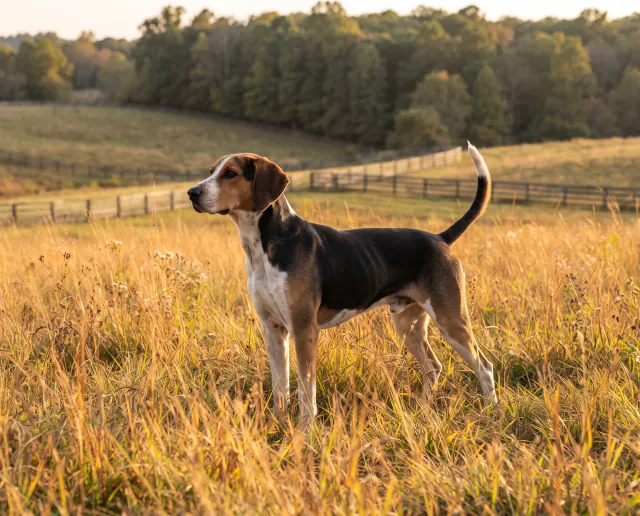
The American Foxhound is built for distance. It is a tall, lean, lightly boned hound with a long stride, a nose that works thin scent across broken country and a voice designed to be heard from a mile away. Most still live and work in hunting kennels rather than houses, and the breed is uncommon as a companion. The gap between that job and ordinary domestic life explains nearly every difficulty owners meet.
Origin and purpose
English hounds reached the American colonies in the seventeenth century and were crossed over two hundred years with French, Irish and further English imports. The country they hunted was larger and more open, scent was often thinner, and the huntsman had less direct control. Breeders selected for speed, stamina, an accurate nose and a clear carrying voice that reported the pack’s progress from far off, and separate strains emerged for field trials and for hunting fox and coyote across open ground. It was never shaped for domestic life, and nothing has been softened since.
Temperament and behaviour
These are sociable, even tempered hounds, bred to live in groups and work alongside other dogs, and they are rarely aggressive. A hound raised to be one of forty also finds an empty house difficult, and says so. The voice is loud, musical and persistent, and it travels through walls, which makes close neighbours a real consideration. Outdoors, a scent line overrides everything. A hound that picks one up will follow it for miles, deaf to a whistle, and many are lost that way. Food motivation is high, kitchen surfaces are not safe, and boredom shows up as digging and roaming.
Family life and other animals
With children the temperament is kind and tolerant, and Foxhounds accept noise and handling well. Size is the practical problem, since an adult at full speed will flatten a small child without meaning any harm. They are usually excellent with other dogs and happier in a home that already has one. Cats and small pets are a different question: one raised with a resident cat may be accepted, but small animals met outdoors will be chased. First-time owners are poorly placed, since the breed asks for kennel-standard fencing, real daily mileage and tolerance of noise.
Exercise and mental stimulation
Two hours a day is a floor rather than a target, and a good share of it needs to be running rather than pavement walking. Off-lead freedom is only safe inside secure fencing, so hired enclosed fields and long lines do most of the work for owners without land. Fencing at home should be around 1.8 metres, reinforced at the base, with gates that latch. Mental work should play to the nose, and scatter feeding, laid trails and formal scent work tire a Foxhound in a way walking never does.
Training
Training is closer to negotiation than instruction. Foxhounds understand perfectly well; they weigh the request against the scent in front of them, and the scent usually wins. Reward-based training with food works, since the breed is greedy, and short sessions beat repetition. Recall should be started early, rewarded generously and never trusted near roads or livestock. Lead manners deserve attention in puppyhood, since an adult that has learned to pull is hard to hold, and harsh handling produces a hound that switches off rather than one that complies. In many countries a dog that worries sheep creates legal problems as well as practical ones.
Coat, grooming and shedding
The coat is short, close and hard, in the classic hound tricolour or any recognised hound colour, and it asks for little beyond a weekly going over with a rubber mitt. Shedding is steady through the year rather than seasonal, and the short stiff hairs work into upholstery and car seats. Drop ears trap warmth and moisture, so a weekly check and cleaning as needed is sensible. Nails need trimming on a pet, and the faint hound odour never quite leaves.
Size, lifespan and health
Adults typically stand 53 to 64 cm (21 to 25 in) at the withers and weigh 20 to 32 kg (44 to 70 lb), with males at the upper end of both ranges. Eleven to thirteen years is a fair expectation. Long selection for function has left the breed comparatively sound, but hip dysplasia is recognised, and hip scoring of breeding stock is the accepted screening route, alongside eye examination and, in some lines, thyroid testing. A deep chest carries some risk of gastric torsion, so smaller meals and quiet time after eating are reasonable precautions. Ear infections are common. Any specific concern belongs in a conversation with a vet, and hunt-bred hounds often come with no formal screening results.
Living costs, space and time alone
Running costs of roughly £90 to £150 a month are a guide rather than a promise, with food the biggest predictable item, insurance the most variable and grooming close to nothing. Space matters more than money. A flat is unworkable and a small urban garden a poor fit, while rural and semi-rural homes with secure ground suit the breed far better. Time alone is the harder constraint. A Foxhound left through a full working day will howl for much of it, so a household out all day should arrange company or choose another breed. Two hounds together cope considerably better than one.
Verdict
The American Foxhound suits an active rural or semi-rural household with land or dependable access to secure space, a tolerance for noise, another dog already in the home and someone about for much of the day. Owners who enjoy scent work and long distances do best.
It is a poor choice for a flat, a quiet terraced street, a first dog, a household out at work, or anyone expecting reliable off-lead recall. People drawn to the temperament but not the mileage usually find a Beagle more realistic, and even that is not an undemanding dog.