At a glance
Key facts
The essentials to compare before deciding whether this breed fits your home and routine.
- Size
- Large
- Lifespan
- 12 to 13 years
- Energy
- Very high
- Temperament
- Friendly, driven, endlessly vocal and fixed on scent
- Good with children
- Usually good with children, though large, fast and clumsy
- Exercise
- Two hours or more daily with secure space to run
- Trainability
- Moderate
- Grooming
- A weekly brush and a weekly ear check
- Estimated monthly cost, GBP
- £85 to £145 per month
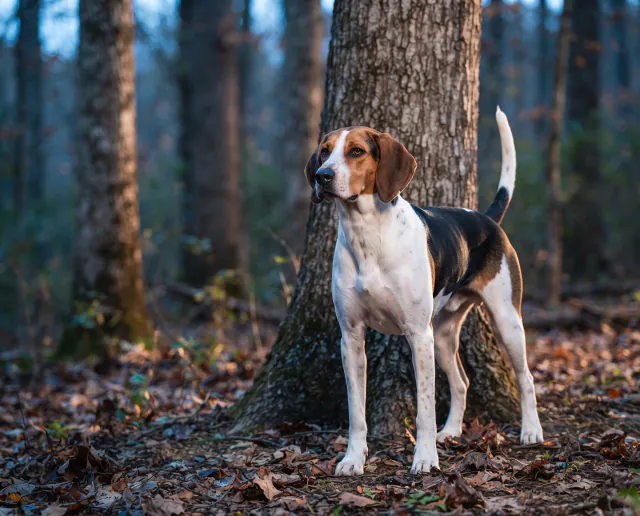
The Treeing Walker Coonhound is a working night hunter with an unusually pleasant disposition and an unusually loud voice. It was bred to find a cold trail, work it at speed in the dark, follow the quarry up a tree and then stand at the base baying until the hunter arrives. That last part of the job is the one most likely to surprise a household. The rest of the breed is straightforward: friendly, athletic, hungry and very hard to call off a scent.
Origin and purpose
The line traces back to English hounds taken to Virginia in the eighteenth century and to the Walker family strain of Foxhound developed in Kentucky. A hound of unknown origin, remembered as Tennessee Lead, was added in the nineteenth century and is credited with the speed and the treeing instinct that set the type apart. It was recognised in its own right by the United Kennel Club in 1945 and by the American Kennel Club only in 2012. Most breeding decisions are still made on working ability.
Temperament and behaviour
The disposition is genuinely amiable. These hounds are confident, outgoing and rarely suspicious of anyone. Two working traits carry over awkwardly into a home. The first is the voice, which is loud, bell-like and used freely, on a trail, in excitement and at a squirrel in the garden. Neighbours in a dense street will notice. The second is the nose, which switches on the moment the dog steps outside. A hound on a line will trot for miles without lifting its head, and recall in open country is unreliable even in a well-trained adult. Left with nothing to do, they roam, dig and climb.
Family life and other animals
Coonhounds usually make easy company for children, being tolerant of both noise and handling. The momentum of a 30 kg hound at full speed still means small children need supervision. Other dogs are seldom a problem, since the breed was developed to hunt in pairs and packs and most individuals prefer canine company to solitude. Cats and small pets are far riskier, because chasing and treeing a small climbing animal is precisely what these hounds were made for. A first-time owner can succeed here more easily than with many hounds, given realistic expectations about noise, fencing and off-lead freedom and support from a trainer who understands scent breeds.
Exercise and mental stimulation
Two hours a day is a realistic minimum, and much of it should be running rather than walking, since these hounds were built to cover rough ground for hours. Free running belongs inside secure fencing or on a long line, because a dog that catches a scent will not hear a recall. Garden fencing needs to be about 1.8 metres, solid at the base, with nothing climbable beside it. Mental work is best delivered through the nose: tracking, scent work classes, laid trails and scatter feeding all suit the breed, and a hound that gets regular nose work is markedly quieter indoors.
Training
Treeing Walkers are more biddable than many hounds and can learn a solid repertoire, but they train on their own terms. Reward-based methods work, food is effective currency, and short frequent sessions beat long ones. The realistic aim is a hound that walks on a loose lead, settles on cue and returns reliably in low-distraction settings, rather than one that will recall off a live trail. Barking deserves early attention, partly through teaching a settle and a quiet cue, mostly through removing the boredom that drives it. Steadiness around livestock is essential in rural areas, where a loose hound among sheep is a legal problem as well as a practical one.
Coat, grooming and shedding
The coat is short, glossy and close, most often tricolour with white predominating. Grooming means a weekly rub down with a hound glove. Shedding is moderate and continuous rather than seasonal. The long drop ears need weekly attention, since they hold moisture and debris and are the commonest site of trouble in the breed. Nails need trimming unless the dog does serious mileage on hard ground.
Size, lifespan and health
Adults typically stand 51 to 69 cm (20 to 27 in) at the withers and weigh 20 to 32 kg (44 to 70 lb), with males noticeably taller and heavier than females. Twelve to thirteen years is typical. Hip dysplasia is the main structural concern, and hip scoring of breeding stock is the recognised screening route, with eye examination also widely advised. Recurrent ear infections are common enough to count as a breed-wide management issue. The deep chest brings some risk of gastric torsion, so smaller meals and rest after eating are sensible. Screening results and any individual health question should be discussed with a vet before a purchase is agreed.
Living costs, space and time alone
Roughly £85 to £145 a month is a fair working estimate, driven mainly by food for a large active dog and by insurance, with grooming close to nothing. This is not a flat dog, and a small garden with low fencing will not hold one. Rural and semi-rural homes, or suburban homes with secure ground and access to open country, work best. Time alone is difficult. A pack-bred hound left through a working day will bay, and that noise strains relations with neighbours quickly. Company, human or canine, makes a considerable difference.
Verdict
The Treeing Walker Coonhound suits an active household with space, secure fencing, tolerance for a loud dog and enthusiasm for long outdoor days. It rewards owners who take up scent work and who accept that the lead stays on in unfenced country.
It is unsuitable for a flat, a household away at work all day, a home with cats or small pets, or an owner hoping for a quiet dog with dependable off-lead recall. The friendliness makes the breed easy to like, and the voice makes it hard to house.