At a glance
Key facts
The essentials to compare before deciding whether this breed fits your home and routine.
- Size
- Medium
- Lifespan
- 12 to 14 years
- Energy
- High
- Temperament
- Gentle, biddable, affectionate and keen to hunt
- Good with children
- Usually very good with children used to a boisterous dog
- Exercise
- 1.5 hours or more a day with free running
- Trainability
- Beginner friendly
- Grooming
- Weekly rub with a hound glove and light year-round shedding
- Estimated monthly cost, GBP
- £85 to £150 per month
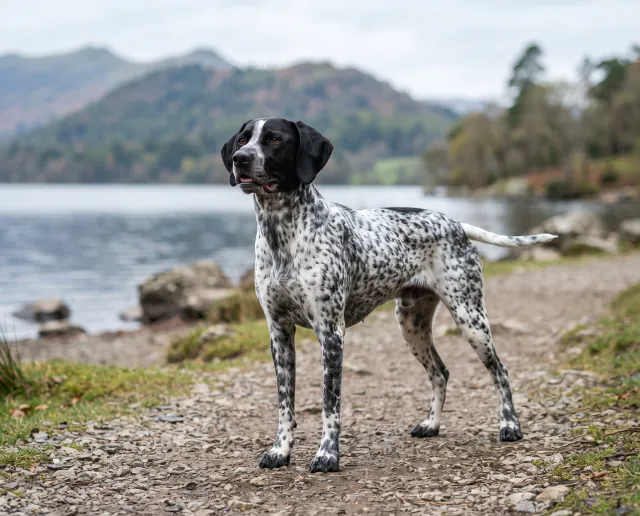
Few British walkers have ever met a Braque d’Auvergne, and most of those who have took it for a heavily ticked German Shorthaired Pointer. The breeds are cousins of a sort, but the Braque is older and more particular. It comes from the Cantal, the high volcanic pasture of central France, where it was bred to point and retrieve game for hunters on foot over rough ground, and its black and white coat, ticked so densely that some dogs look grey at a distance, has been recorded there for two centuries.
The breed came close to extinction during and after the Second World War and was rebuilt from a small number of dogs. It remains uncommon even in France and is very rare elsewhere, and the UK Kennel Club lists it on its Imported Breed Register. Litters here are few and irregular, buyers usually wait, some dogs arrive from French or Dutch breeders, and the UK breed club is the first call for anyone hoping to own one.
Suitability
This is an affectionate, gentle and biddable gundog with a strong attachment to its people and a quiet manner indoors once exercised. Braques are generally friendly with strangers, other dogs and children, though a young dog’s exuberance needs managing around small children. They are not guard dogs beyond a warning bark. The breed does not tolerate isolation well, and a Braque left alone for long days will typically become vocal, destructive or both. Cats can be lived with if introduced early; rabbits and poultry cannot, since the hunting instinct is strong and intact. First-time owners with an active lifestyle can manage the breed if they commit to training and exercise, because the Braque is softer and more cooperative than many hunt, point and retrieve breeds, but it is not a dog for a sedentary home.
Exercise
Adults need ninety minutes or more each day, and much of that should be free running or purposeful work in open country rather than a lap of the park. The breed was made to quarter ground at speed for hours and stays fit and sane only when that need is met. Puppies should be walked briefly and often, on varied but soft surfaces, and kept off long hikes and repetitive ball chasing until their frames have finished growing at around twelve to fifteen months. Recall training starts on the first day, and a long line is sensible in open country until the dog reliably chooses its handler over a departing pheasant. Near sheep, and there are sheep on most of the ground a Braque would enjoy, the lead stays on. Swimming is popular with the breed and offers useful low-impact exercise.
Grooming
The coat is short, fine and close, and it takes little effort beyond a weekly rub with a hound glove to lift dead hair and keep the skin healthy. Shedding is light but continuous, and a black and white dog leaves both colours on the furniture. Ears hang close to the head and need a weekly check for wax and grass seeds, particularly after a summer walk through long grass. Nails, teeth and a look between the toes for seeds complete the routine. A Braque dries quickly after a wet walk and rarely carries much mud indoors, which makes it one of the easier gundogs to keep in a house.
Health
Twelve to fourteen years is typical and the breed is regarded as generally robust, though the small founding population means any hereditary problem can spread quickly, and a careful breeder will be watching for that. Hip dysplasia occurs and both parents should be hip scored under the BVA and Kennel Club scheme. Ask for BVA and Kennel Club eye scheme certificates as well. Ear infections are the most common day-to-day complaint, and deep-chested dogs of this type carry a bloat risk that owners should understand. Weight rarely troubles a properly exercised Braque, but a neutered dog on a pet-food diet can thicken quickly, so watch the waist. Because UK data is thin, a buyer should ask breeders directly what health problems they have seen in their lines and expect a straight answer.
Choosing and training
Finding a puppy is the hard part. Contact the UK breed club before anything else, register interest, and expect to wait a year or more. Visiting a French or other European breeder is a realistic route and some owners have gone that way, which involves rabies vaccination, a health certificate and the associated travel rules. Meet adult dogs first if at all possible, because photographs do not convey the energy involved. Training itself is straightforward. The breed is intelligent, sensitive and keen to please, and it learns fastest with reward-based methods and short, cheerful sessions. Formal gundog training, working tests or scent work give the dog an outlet that pavement walks never will. Adolescence brings some deafness to instruction that patience and consistency resolve. Harshness produces a worried, clingy dog and is never necessary.
Verdict
The Braque d’Auvergne suits an active household, ideally in or near open country, that wants a gentle, cooperative gundog with an easy coat and is prepared to wait and travel for a well-bred puppy.
It is unsuitable for anyone who is out all day, who cannot offer daily free running, or who wants a dog available at short notice. Buyers who simply like the look of the coat should consider the far more available German Shorthaired Pointer and be honest about whether they have the time either breed needs.