
At a glance
Key facts
The essentials to compare before deciding whether this breed fits your home and routine.
- Size
- Large
- Lifespan
- 12 to 14 years
- Energy
- Very high
- Temperament
- Gentle, sensitive and relentless on scent outdoors
- Good with children
- Usually very good with children, though a young dog is clumsy around toddlers
- Exercise
- Two hours a day with much of it off lead and galloping
- Trainability
- Beginner friendly
- Grooming
- Weekly brushing with light year-round shedding
- Estimated monthly cost, GBP
- £100 to £170 per month
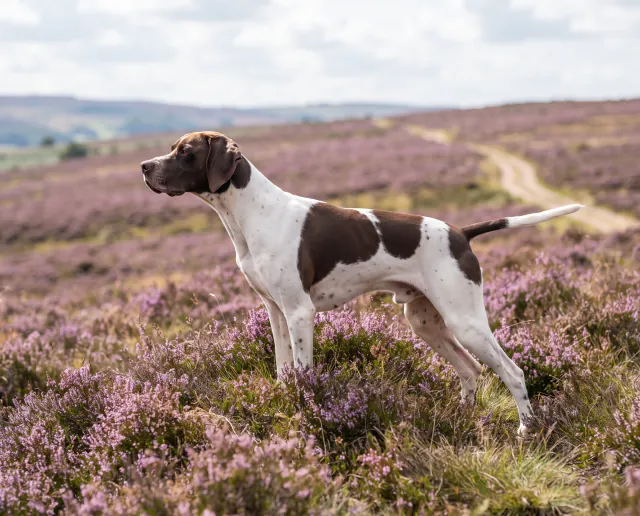
A Pointer that catches scent stops mid stride, one foreleg lifted, tail rigid, nose locked on a bird it cannot see and will not move towards until told. That frozen pose is what the breed exists for, and it has been bred in so thoroughly that puppies of eight weeks will point at a sparrow on the lawn. The breed was developed in England from the late seventeenth century, first to find hare for greyhounds and later to locate game birds for guns walking up over open moor and stubble, and it is still worked that way on grouse moors in Scotland and northern England.
Away from the moor the same dog is soft, affectionate and slightly startled by the world. Pointers are among the gentlest of the gundogs indoors, with none of the possessiveness of some retrievers and little interest in guarding. What they do carry into the house is the engine. A dog built to quarter open ground at a gallop for hours does not switch that off because it lives in Surrey.
Suitability
Pointers are people dogs and dislike being left, and a bored one alone for a working day will chew, bark and pace. They are good with children of school age and usually patient with younger ones, though an adolescent Pointer moves fast and turns sharply, and toddlers get knocked flat. Cats can be fine when the dog is raised with them, but anything that flies or runs outdoors will be found and pointed. The thin coat and lean body mean the breed feels the cold badly, and a coat for winter walks in the north is a sensible purchase rather than an indulgence. Sensitivity is the other thread. Raised voices and rough handling produce a worried, shut-down dog quickly.
Exercise
Two hours a day is a reasonable baseline for an adult, and the quality matters more than the clock. A Pointer walked on a lead around a housing estate is barely exercised at all. The breed needs space to gallop and ground to quarter, which in practice means fields, heath, beach or moor where it can run wide and come back. Recall has to be built early, because a Pointer working a hedge line a quarter of a mile away is not listening to anyone. Near livestock, keep the dog on a lead; a Pointer that has never chased sheep will still range through a flock, and the law in England and Wales does not distinguish. Puppies need the opposite regime. Growth plates in a large fast breed close late, and long walks, road running and repeated jumping before twelve to fourteen months are a common cause of later joint trouble.
Grooming
The coat is short, fine and close, and a weekly session with a rubber mitt or hound glove keeps it tidy and lifts the dead hair. Shedding is light but continuous, and white hairs show on dark clothes. Thin skin and a sparse coat mean the breed collects scratches, thorns and grass seeds, so check feet, armpits and ears after every outing through cover. Ears need a regular look for the redness and smell that signal infection. The tail tip is vulnerable; a happy Pointer in a narrow hallway can split the end open against door frames, and the resulting bleeding is out of all proportion to the injury.
Health
Pointers are a generally sound breed and twelve to fourteen years is realistic, with plenty living beyond that. Hip dysplasia occurs and breeding stock should have BVA and Kennel Club hip scores, so ask for the numbers and the breed median rather than accepting a general reassurance. Eye conditions are recognised, and an annual certificate under the BVA and Kennel Club eye scheme for both parents is a fair expectation. Like other deep-chested breeds the Pointer can suffer gastric torsion, so feed two smaller meals, avoid hard exercise straight after eating and learn the signs of a restless dog retching without producing anything. Weight is rarely a problem in a dog exercised properly, and the ribs should be easy to feel with a clear waist from above.
Choosing and training
Pointers are not a rare breed but they are not common either, and most litters come from either show or working kennels, with a smaller number breeding for both. Working lines from grouse moor kennels tend to be sharper and more driven, and a novice family home is often better served by a show or dual purpose breeder. Expect to wait for a litter from someone who health tests, and treat the Pointer Club and its regional counterparts as the starting point. Training is straightforward in the sense that the breed is biddable and wants to please, and difficult in the sense that scent drowns everything else once outdoors. Reward-based methods, short sessions and a long line in open country for the first year or two give the best results. Steadiness, recall and settling calmly in the house are the priorities.
Verdict
The Pointer suits a fit, outdoor household with access to open ground, a warm home and someone around for most of the day. Runners, walkers, people with land and families with older children who spend long weekends outside tend to get on well with the breed.
A flat in town, a garden as the main exercise area or a working day spent alone would leave a Pointer wretched. Those wanting an off-lead dog that hangs about at heel should look at a different gundog, because this one was bred to run out of sight and does.