
At a glance
Key facts
The essentials to compare before deciding whether this breed fits your home and routine.
- Size
- Medium
- Lifespan
- 12 to 14 years
- Energy
- High
- Temperament
- Affectionate, clingy and keen to work alongside people
- Good with children
- Usually very good with children in an active household
- Exercise
- Around 90 minutes a day with free running and scent work
- Trainability
- Beginner friendly
- Grooming
- Weekly brushing with moderate year-round shedding
- Estimated monthly cost, GBP
- £80 to £150 per month
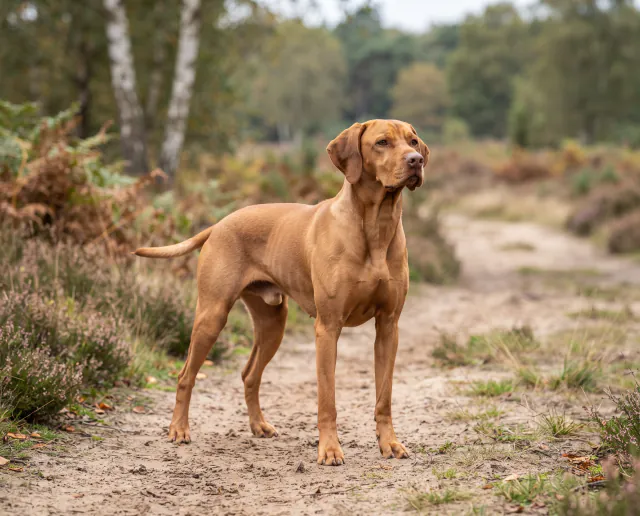
Anyone who has lived with a Hungarian Vizsla will recognise a good deal of the Portuguese Pointer, and the resemblance is not coincidental, since both are short-coated pointing dogs from the warm south of Europe bred to work close to a hunter on foot. The Portuguese dog is smaller, squarer and heavier in the head, with a shorter muzzle and a more compact frame, and it is yellow rather than russet. Its name at home is Perdigueiro Português, the partridge dog, which describes the job exactly.
The breed is old, with dogs of this type recorded in Portugal in the fourteenth century, and it came close to disappearing in the twentieth before Portuguese enthusiasts rebuilt it from the remaining stock. In Britain it is a newcomer. The Kennel Club lists it on the Imported Breed Register, litters are few, and most people who own one either waited a long time or imported the dog themselves.
Temperament in the home
The characteristic owners mention first is attachment. A Portuguese Pointer wants physical contact with its people and will follow from room to room, lean, lie across feet and try to occupy a lap that is far too small for it. That intensity is charming in a dog that is rarely left, and a serious problem in one expected to spend the working day alone, because separation distress is common in the breed and shows as barking, destruction and toileting indoors. With children the breed is gentle and tolerant, and its medium size keeps knocks to a minimum. Cats and small pets need caution, since a pointing dog is still a hunting dog and the instinct to chase is intact. Indoors they are calmer than a Vizsla or a German Shorthaired Pointer, and an exercised adult will settle for the evening without fuss.
Exercise and training
Around ninety minutes a day suits most adults, made up of a proper free run and a walk with scent work rather than two circuits of the same pavement. The breed was developed for walked-up shooting over rough Portuguese ground, and it quarters close, checks back constantly and rarely ranges as far as an English Pointer, which makes recall easier to keep than in most pointing breeds. Puppies should be exercised lightly and often until they are at least a year old, with free play on grass rather than route marches. Training is a pleasure for most owners. These dogs are attentive, food-motivated and sensitive to tone, so reward-based methods and short sessions work, while harsh correction produces a worried, sticky dog that stops offering anything. The main challenge is teaching independence, and a young dog needs to learn early to settle alone for short periods in a crate or on a bed while the household carries on around it.
Coat and grooming
The coat is short, dense and fairly coarse, in shades of yellow from pale fawn to a deep chestnut, sometimes with a little white on the chest and feet. A weekly brush with a hound glove is all it takes, with a little more during the spring and autumn moult. Shedding is moderate and constant, and the short yellow hairs work their way into upholstery. Ears hang close to the head and need checking weekly for the redness and odour that signal infection, particularly in a dog that swims. Thin skin and a short coat mean grass seeds and thorns are a hazard through summer, and the breed feels British winters, so a coat for cold wet walks is a reasonable purchase.
Health and lifespan
Twelve to fourteen years is a fair expectation, and the breed has no long list of well-documented disorders. That is partly a reflection of how few dogs exist rather than proof of unusual soundness, and a small gene pool makes careful breeding decisions more important, not less. Hip dysplasia is recognised in pointing breeds generally, and a breeder should be able to show BVA and Kennel Club hip scores for both parents, or their overseas equivalents for imported stock. Ask about eyes as well, and expect to see certificates rather than assurances. Weight is easy to manage in a dog this active, and the ribs should be easily felt beneath a thin covering.
Costs and space
Running costs are moderate, in the region of £80 to £150 a month across food, insurance, routine veterinary care and the very little grooming the coat needs. The purchase itself involves patience more than money. Litters are infrequent outside Portugal, and buyers typically join a waiting list through the breed club, which is the sensible first contact, or arrange to import a puppy from Portugal or elsewhere in Europe with the paperwork and travel rules that entails. Space is less important than company. A medium dog of this kind lives happily in a modest house with a secure garden and daily access to open ground, and badly in a large house where it is left alone.
Verdict
The Portuguese Pointer suits an active household where someone is at home for most of the day and wants a medium-sized, affectionate gundog that trains easily and stays close on a walk. It fits well with families who walk and with people who want to try gundog work, scent work or agility.
Anyone out at work all day, or wanting an independent dog that is content in its own company, should look elsewhere. The wait for a puppy is real, and the breed’s clinginess is a feature to be managed rather than a phase that passes.