
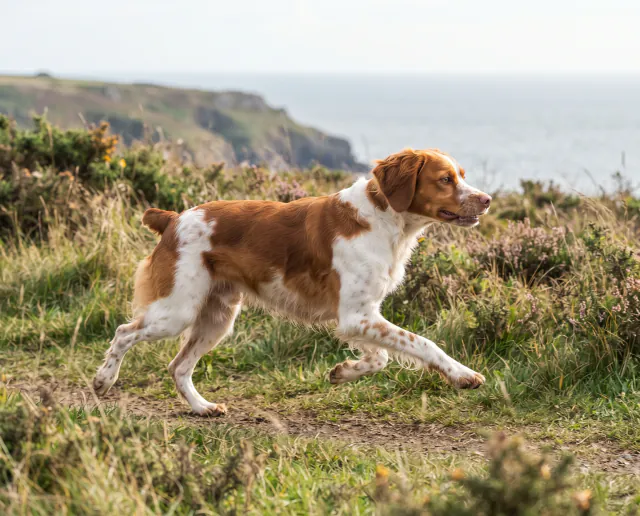
Also known as: Brittany Spaniel.
At a glance
Key facts
The essentials to compare before deciding whether this breed fits your home and routine.
- Size
- Medium
- Lifespan
- 12 to 14 years
- Energy
- Very high
- Temperament
- Sensitive, affectionate, fast and relentlessly busy
- Good with children
- Usually very good with active children who are gentle with a soft dog
- Exercise
- About 2 hours a day, mostly free running over open ground
- Trainability
- Beginner friendly
- Grooming
- Weekly brushing with a comb through the feathering, moderate seasonal shedding
- Estimated monthly cost, GBP
- £80 to £140 per month
A Brittany weighs about the same as a Cocker Spaniel, moves like a small pointer and has the stamina of a working Springer, and that combination catches a lot of owners out. The breed comes from the Breton countryside of north-west France, where it was reputedly the dog of poachers and small farmers who needed one animal to find, point and retrieve game and to stay out of sight of the gamekeeper. It is the smallest of the pointing breeds and the only spaniel that points, and in Britain it is classed as a hunt, point and retrieve gundog rather than a spaniel.
Kennel Club registrations are modest and most puppies go to working or active homes. Litters are not frequent, so buyers usually wait, and the Brittany Club of Great Britain is the sensible first contact. Some dogs are imported from France, where the breed is common, and a few American-bred dogs, which are larger and differently marked, also reach the UK.
Temperament in the home
At home the breed is affectionate, gentle and closely bonded, often to one person in particular, and it wants to be involved in everything. Brittanys are sensitive dogs that pick up on tension and do not cope with raised voices. Many are prone to whining and to separation distress, and a dog of this drive left alone for long hours will find its own occupation, often the sofa cushions. Small children and a bouncing adolescent Brittany need supervision, but the breed is generally soft with children and lives well with other dogs. Cats are possible with early introduction. Ferrets, rabbits and chickens are not, and a Brittany will point the neighbour’s guinea pig through the fence for as long as it is allowed. Most adults are quiet in the house once the day’s work has been done; the trouble comes when it has not.
Exercise and training
Energy is the defining feature. An adult wants two hours a day, with a large share of it free running over rough ground, and a fit Brittany will still be looking for more. Pavement walks on a lead do not touch the sides. Puppies should have short, frequent outings and free play instead of forced mileage until their growth is complete, however much energy they seem to have. Recall must be built early and rewarded generously, because the breed ranges wide and fast and a bird in the next field is a powerful distraction. Near livestock the lead stays on. Training is a pleasure with a dog this bright and willing, provided the handler is patient, gentle and consistent; the Brittany shuts down under pressure and does not forget a fright. Gundog training, working tests, agility and scent work all give the mind an outlet. Many Brittanys are born with a naturally short tail or none at all, and full tails are common too, so the tail is not a guide to whether a dog has been docked.
Coat and grooming
The coat is fine, flat or slightly wavy, with light feathering on the legs and ears, and it takes a weekly brush to stay tidy. Shedding is moderate and seasonal. Feathering picks up burrs, seeds and mud, so a comb after country walks saves matting, and a trim around the feet and ears every few months keeps things neat. Ears should be checked weekly, as with any drop-eared gundog that spends time in water and cover. Grass seeds between the toes are a real summer hazard and are far cheaper to remove at home than at the vet a week later. The coat is one of the easier ones among the spaniels and pointers.
Health and lifespan
Twelve to fourteen years is normal for the breed. Hip dysplasia is the recognised structural concern and both parents should be hip scored under the BVA and Kennel Club scheme. Epilepsy is documented in the breed, and buyers should ask any breeder directly whether it has appeared in their lines and how they manage it. BVA and Kennel Club eye scheme certificates are worth asking for. Ear infections are common and mostly a management issue. A Brittany working at full stretch burns a great deal of fuel, but a pet on the same rations without the mileage will thicken quickly, and a fat Brittany is a sad thing to see.
Costs and space
Running costs are moderate for a dog of fourteen to eighteen kilograms, typically around £80 to £140 a month for food, insurance, routine veterinary care and occasional grooming, though the figure shifts with insurer and region. The real cost is time. Space in the house matters little, since this is a compact dog that curls up small, but a secure garden and easy daily access to open country are essential, and a Brittany in a city flat with a park walk twice a day is a project doomed from the start.
Verdict
The Brittany suits shooting homes, runners, hill walkers and anyone with the daily time and country access to give a small, fast gundog a real job. Handled kindly, it is among the most rewarding of the pointing breeds.
It should be avoided by households out at work all day, by owners hoping for an off-lead dog around livestock without long training, and by anyone whose exercise plan is a lead walk round the block. That level of drive in a house without an outlet produces an anxious, noisy dog.