At a glance
Key facts
The essentials to compare before deciding whether this breed fits your home and routine.
- Size
- Medium
- Lifespan
- 12 to 14 years
- Energy
- High
- Temperament
- Willing, sociable and busy without being frantic
- Good with children
- Usually very good with children in a family that walks daily
- Exercise
- Around 90 minutes to 2 hours a day with scent and retrieving work
- Trainability
- Beginner friendly
- Grooming
- Brush several times weekly to keep feathering free of mats, with moderate shedding
- Estimated monthly cost, GBP
- £80 to £150 per month
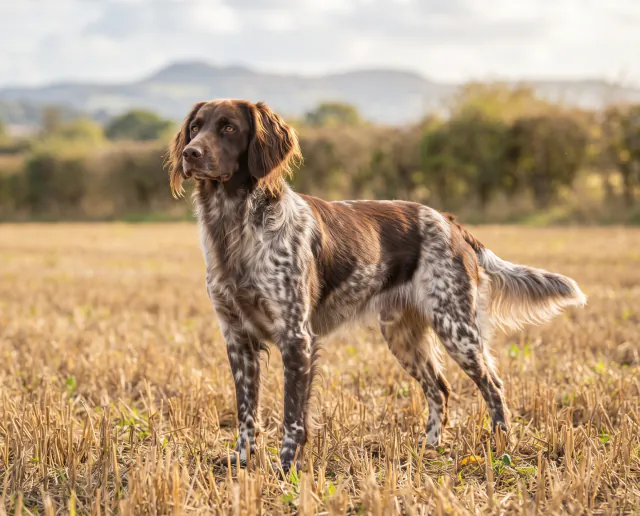
In its native Germany the Small Munsterlander is among the most popular versatile gundogs, a dog for the hunter who wants a single animal to find game, point it, retrieve it from land or water and track wounded deer. In Britain it is barely known, sits on the Kennel Club’s Imported Breed Register and produces a handful of litters a year. Those who own one tend to describe it as the gundog that other gundog owners ask about on a walk, a spaniel-sized dog with a setter’s feathering and a pointer’s manner in the field.
The breed took shape in the Münster region of north-west Germany in the early twentieth century from long-haired pointing dogs kept by farmers and foresters, and despite the name it is not a smaller version of the Large Munsterlander, which is a separate breed with different origins. Dogs stand 50 to 56cm at the shoulder and weigh around 18 to 27kg, in brown and white or brown roan.
Suitability
The Small Munsterlander is a sociable, people-oriented dog that wants to be with its family and to have something to do. It is generally excellent with children, gentle enough for the young and robust enough for the boisterous, and its medium size keeps accidents minor. Most get on well with other dogs. Cats can be managed with early introduction, though the breed hunts anything that moves outdoors and small pets in the garden are at risk. Separation is the common weak point, since these dogs are bred to work beside a handler all day and do not enjoy an empty house. They are busy rather than hyperactive, and a well-exercised adult settles readily in the evening. A garden that collects mud, feathering that brings it in and a dog that lives for water are all part of the arrangement.
Exercise
Ninety minutes to two hours a day suits an adult, with the emphasis on activity that uses the nose. Free running on open ground, scent work, retrieving from water and a walk through cover where the dog can hunt keep the breed satisfied, and lead walking alone does not. Munsterlanders quarter close to the handler and check back naturally, which makes recall easier than in the wider-ranging pointers, though it still needs building, and a long line for the first year is sensible. Livestock and ground-nesting birds demand a lead. Puppies grow fast and should be exercised in short bursts on soft ground until around a year, with no long hikes or repeated jumping. Adults take to canicross, hill walking and swimming, and a fit one will keep going all day in poor weather.
Grooming
The coat is medium-long, dense and slightly wavy, with feathering on the ears, chest, legs and tail, and it needs brushing two or three times a week to keep mats out of the feathering and behind the ears, more in a dog that works cover. Burrs, grass seeds and mud collect in the long hair, so check the feet, ears and armpits after every outing through the countryside. Shedding is moderate, with heavier loss in spring and autumn. The coat should not be clipped, and a trim of the feet and ears is the only cutting needed. Ears hang and need checking weekly, particularly after swimming. Nails, teeth and a towel for the feathering after a wet walk complete the routine.
Health
Twelve to fourteen years is a fair expectation and the breed is generally sound, with a small British population that makes careful breeding decisions important. Hip dysplasia is recognised, and breeding stock should be scored under the BVA and Kennel Club hip scheme or carry the equivalent overseas result for imported parents. Eye examination under the BVA and Kennel Club eye scheme is a reasonable request. Ear infections and the occasional skin reaction to grass seeds are the routine complaints in a feathered gundog that swims. Weight is easily managed in an active dog, and the ribs should be felt beneath the coat without pressing.
Choosing and training
Puppies are scarce. A few litters are bred most years, buyers usually wait, and some dogs are imported from Germany, the Netherlands or Scandinavia with the paperwork and cost that involves. The Small Munsterlander Club is the sensible first contact, and its members will know what is planned and steer buyers towards health-tested parents. Rescue is rare simply because so few dogs exist. Training is a pleasure. The breed is attentive, quick, food-motivated and eager to work with a handler, and it learns fast with reward-based methods and short sessions. Harsh handling produces a worried dog, and a sensitive gundog that has been shouted at stops offering behaviour. Gundog training, working tests, scent work and agility all suit it, and the breed club’s training days are a good introduction even for homes with no interest in shooting. Recall and steadiness are the priorities, and settling calmly alone for short periods should be taught early.
Verdict
The Small Munsterlander suits an active family or individual who walks daily, wants a medium-sized gundog that trains easily and stays close, and can give it something to do with its nose. Households that try gundog work, scent work or agility get the most from the breed.
Anyone out at work all day or wanting a low-maintenance coat and a dog content in its own company should look elsewhere. The wait for a puppy is long, and the breed’s need for daily occupation is the thing to be honest about before joining a list.