At a glance
Key facts
The essentials to compare before deciding whether this breed fits your home and routine.
- Size
- Large
- Lifespan
- 11 to 13 years
- Energy
- High
- Temperament
- Sociable, biddable, keen and sometimes vocal
- Good with children
- Usually very good with children in a busy outdoor family
- Exercise
- About 2 hours a day, much of it off lead
- Trainability
- Beginner friendly
- Grooming
- Brush several times weekly, with feathering that collects burrs and moderate shedding
- Estimated monthly cost, GBP
- £105 to £175 per month
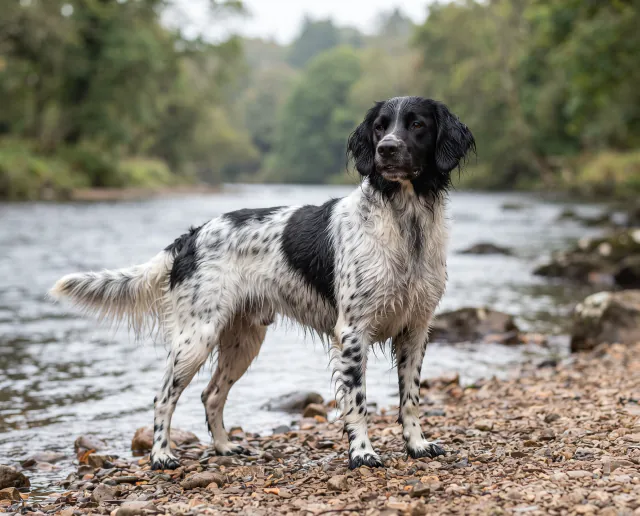
Anyone who knows a working English Springer will recognise much of the Large Munsterlander, though the two breeds share no ancestry. The Munsterlander comes from the country around Münster in north-west Germany, where it was the black and white form of the German Longhaired Pointer until breeders separated it as a breed in the early twentieth century. It was developed as a versatile hunting dog to find, point and retrieve game on land and in water and to track wounded quarry, and that all-round working ability is what brought it to Britain in the early 1970s.
The result is a large, striking, black and white gundog with a long coat, a strong hunting urge and a sociable, straightforward temperament. It has stayed close to its working roots here, with a breed club that runs field trials and working tests, and most litters are bred by people who work their dogs. That is a strength for buyers who want a dog with a job, and a warning for those who do not.
Living with the breed
Munsterlanders are affectionate, sociable dogs that attach strongly to their household and want to be part of everything. Most are good with children and other dogs, and cats can work with early introduction. The breed is a hunter to its bones, and poultry, rabbits and free-ranging small pets are at genuine risk. Guarding is limited to barking, and the breed is vocal in general; many owners report a dog that comments on every arrival and departure. Separation is tolerated poorly by young dogs and moderately by settled adults, and a Munsterlander left all day will be bored, noisy and destructive. Adolescence is long and physical, with a large dog at the height of the dining table and a feathered tail that clears it.
Daily exercise
Two hours a day is a sensible baseline for an adult, and a good deal of it should be free running with a chance to hunt, quarter and use the nose. The breed loves water, and any walk past a canal, burn or beach ends with a very wet dog. Recall needs early, consistent work because the hunting urge is strong and a dog on scent goes deaf; a long line saves a lot of shouting in open country while the dog is young. Take care near livestock and ground-nesting birds, and keep the dog on a lead where signs require it. Puppies grow fast; keep walks short until around a year old and avoid repetitive jumping and stairs.
Training and mental work
The breed is intelligent, biddable and keen to work, which makes training rewarding for an owner who does it and a problem for one who does not. Reward-based training with a calm handler produces a reliable dog; harsh methods produce a dog that goes hunting on its own account. Gundog training classes that understand hunt, point and retrieve breeds are the natural outlet, and working tests, scent work and tracking all suit the breed. A pet Munsterlander still needs a job, and ten minutes of retrieving a dummy from cover goes a long way. A young dog needs controlled exposure to traffic, livestock and other animals.
Grooming and shedding
The coat is long, dense and straight or slightly wavy, with heavy feathering on the ears, chest, legs and tail, and a black head with a white or ticked body and black patches. It sheds moderately all year and heavily in spring and autumn. Brushing several times a week with a slicker and comb keeps the feathering free of mats, and the dog needs combing through after any walk in bracken or long grass, since the coat collects burrs, seeds and twigs. Summer grass seeds lodge between the toes and in the ears, so look after every walk. The drop ears are heavily feathered and prone to infection in a dog that swims, so check them weekly. Feet and ear fringes can be tidied at home, and professional grooming is not needed.
Health and costs
Hip dysplasia is recognised, and buyers should see BVA and Kennel Club hip scores for both parents. A DNA test for hyperuricosuria, an inherited tendency to form urate bladder stones, is used in the breed and results for both parents should be available. Eye testing is recommended and breeding dogs should have a current certificate. Gastric torsion is a risk in a deep-chested dog of this size; a restless dog with a swelling abdomen that retches without result needs a vet at once. Lifespan is typically eleven to thirteen years. Weight rarely troubles a dog that is worked, though a retired or under-exercised one thickens fast. Running costs across food, insurance, routine veterinary care and grooming supplies fall in the region of £105 to £175 a month, with insurance for a large gundog the main variable. The breed is established but not common outside Germany, and litters are limited, often bred by working owners who want to know where their puppies are going. The breed club keeps a breeder list, is the obvious starting point and helps rehome adults.
Verdict
The Large Munsterlander suits an active outdoor household with access to open country, an interest in gundog work or scent sports, and someone at home for much of the day. Walkers, shooting people and families who spend their weekends outside get on well with the breed.
It is a poor choice for a town flat, for a home where the dog is alone all day, or for anyone who wants a decorative dog rather than a working one. Buyers drawn to the colouring alone should spend a day with a working Munsterlander before committing.