At a glance
Key facts
The essentials to compare before deciding whether this breed fits your home and routine.
- Size
- Small
- Lifespan
- 13 to 15 years
- Energy
- Medium to high
- Temperament
- Hardy, inquisitive and cheerfully independent
- Good with children
- Often good with children who leave a busy dog alone when it rests
- Exercise
- About an hour a day across two walks with time to investigate
- Trainability
- Moderate
- Grooming
- Weekly brushing plus hand stripping two or three times a year
- Estimated monthly cost, GBP
- £60 to £110 per month
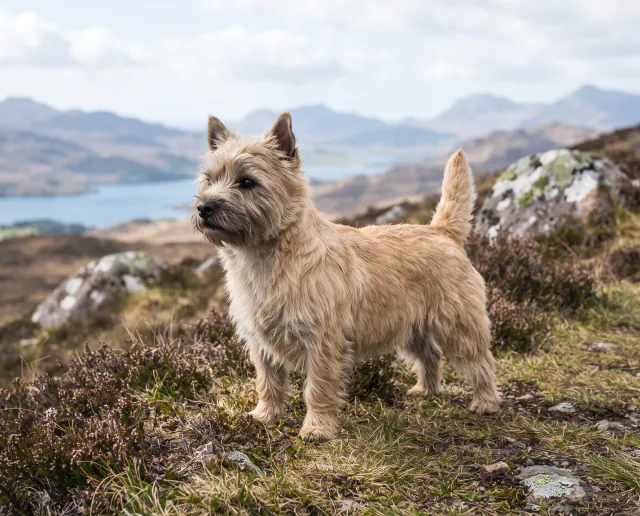
Cairns take their name from the stone piles of the Scottish Highlands and Skye, where the breed’s job was to work into the gaps after fox and otter. Almost everything about the dog follows from that. A harsh outer coat throws off rain, the front is straight enough to push between rocks, and the thick tail was once a convenient handle for a person pulling a dog back out.
Many people recognise the breed from film rather than from the hills, since Toto in The Wizard of Oz was a Cairn. A real one is busy, opinionated, sharply interested in movement underground, and considerably harder to distract than a dog of ten kilograms has any right to be.
Living with the breed
Cairns generally suit family life, including homes with children old enough to understand that a resting dog is left alone. They are sturdier than most small breeds and less likely to be hurt by ordinary household activity. Attachment to the household is warm without being clingy, and most cope with a few hours alone once separation has been taught properly.
Two habits define daily life. The first is digging, which is not a behaviour problem in a breed developed to do exactly that, so a permitted digging area saves the flowerbeds. The second is barking at anything approaching the front of the house. Rewarding a quiet return to the owner from the earliest weeks works better than suppressing the noise later. Small pets are a poor match, since a hamster or rabbit will register as quarry. Adults commonly live thirteen to fifteen years, so this is a long commitment for such a compact dog.
Daily exercise
An hour a day across two outings meets the needs of most healthy adults, and a fit Cairn will happily take a great deal more. Rough ground, woodland and coastal walks suit the breed better than repeated laps of the same pavement. Allow proper time for sniffing, since a terrier reading a hedge line is working, not dawdling.
Recall around wildlife is the honest weak point. Once a scent goes underground or into brambles, many Cairns stop hearing anything else. A long line in open country and a secure field for free running are sensible precautions. Puppies need short outings while the joints are still developing. Older Cairns often stay keen into their teens, which makes it easy to overlook stiffness after a long day.
Training and mental work
Reward-based training suits the breed, provided sessions stay short and the reward is worth having. A Cairn learns quickly and then weighs up whether the request is more interesting than whatever it was already doing. Firm handling achieves nothing useful and tends to create avoidance.
Mental work matters as much as walking. Scatter feeding in long grass, boxes stuffed with paper and treats, and short trick sessions all give the searching instinct somewhere to go. Teach a solid settle, because an under-occupied terrier will patrol instead of resting. Socialisation should be calm and gradual, with quiet exposure to traffic, livestock and other dogs rather than crowded free-for-alls.
Grooming and shedding
The coat has a harsh, weather-resistant outer layer over a soft undercoat, and it is meant to look slightly unkempt. Brushing once or twice weekly keeps it free of tangles, mud and plant debris. Shedding is modest compared with most double-coated dogs, because dead hair stays in the coat until it is removed.
That is why hand stripping matters. Pulling out dead hair two or three times a year preserves the harsh texture and the depth of colour. Clipping is quicker and kinder for an elderly dog, but it softens the coat over time and tends to fade the pigment. Between appointments, tidy the hair between the pads, check the ears and keep the beard clean after meals.
Health and costs
Cairns are generally robust, and the health areas the type is commonly watched for include the kneecaps, the hip joint in young growing dogs, the eyes, the skin, and liver blood flow. Several inherited conditions relevant to the breed have DNA tests available, so ask which were used for the proposed mating and request written results. Any limping, cloudiness in an eye or persistent scratching should be assessed by a vet rather than matched against a list online.
Monthly costs of roughly £60 to £110 are indicative only. Food for a small dog is inexpensive, but insurance, professional grooming, dental care and veterinary treatment vary widely by region and by age. A small garden or a flat both work, provided the fencing goes down as well as up, since a determined Cairn will investigate any gap at ground level.
Verdict
This is a good choice for someone who wants a small dog with genuine substance, enjoys daily walks in poor weather and finds terrier independence funny rather than frustrating. Active families, retired owners who still walk a lot and sensible first-time owners all tend to get on well with the breed.
It is a poor choice for a household wanting a quiet, biddable lapdog, for anyone with free-roaming small pets, or for a garden that must stay pristine. Meet a few adults, ask about coat care before committing to the appearance, and be honest about how much off-lead freedom the local area can safely offer.