
At a glance
Key facts
The essentials to compare before deciding whether this breed fits your home and routine.
- Size
- Small
- Lifespan
- 12 to 16 years
- Energy
- High
- Temperament
- Sociable, bold and eager to be part of everything
- Good with children
- Usually very good with children of most ages
- Exercise
- About 45 minutes a day plus scent games at home
- Trainability
- Beginner friendly
- Grooming
- Hand stripping two or three times a year plus weekly combing
- Estimated monthly cost, GBP
- £80 to £130 per month
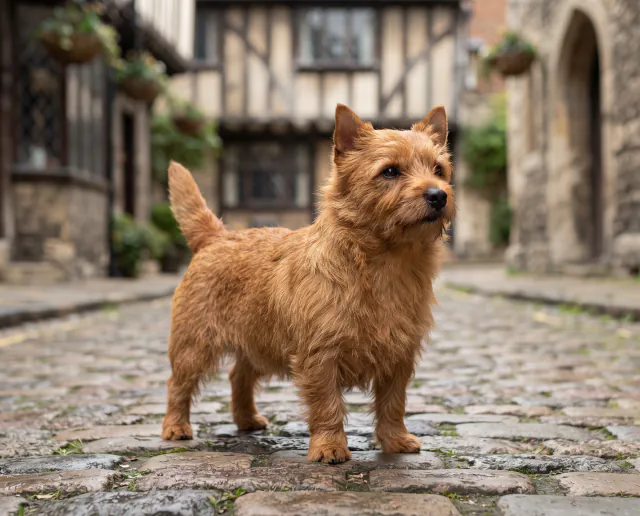
Ask a Norwich Terrier owner what surprised them most and many will mention the mismatch between size and personality. This is one of the smallest terrier breeds recognised in the UK, yet it carries itself with the confidence of a dog twice its weight, a trait that traces directly back to its origins as a working ratter and stable yard terrier around Norwich before it was separated from the drop eared Norfolk Terrier as a distinct breed in 1964. The pricked ears, standing sharply upright, give the breed its most obvious identifying feature and a permanently alert expression.
Despite its terrier toughness, the Norwich has a reputation for genuine sociability that sets it apart from more solitary or combative members of the group. Most individuals enjoy the company of other dogs, adapt readily to a busy household and show real enthusiasm for people generally rather than reserving affection for one owner alone.
Living with the breed
A Norwich Terrier tends to want to be wherever the household activity is happening, and most dislike being shut away from family life for long stretches. The breed gets on well with other dogs and often thrives in a multi dog household, showing little of the same sex friction seen in some terrier breeds. Small pets remain at risk given the working background, and a Norwich left unsupervised with a rabbit or guinea pig is taking a real chance regardless of how friendly the dog seems generally. Children are usually treated with patience and enthusiasm, making the breed a popular family choice among those who know it, though its small size means boisterous play needs the same supervision any small dog requires around young children.
Daily exercise
Around three quarters of an hour a day is enough for most adults, and the breed is adaptable enough to manage on a shorter walk when needed, provided some mental engagement fills the gap. Scent games, short training sessions and interactive feeding toys give a Norwich a legitimate outlet indoors on days when weather or time limits the walk. Off lead exercise should happen in secure areas until recall is thoroughly proven, since the breed’s terrier instincts toward fast moving small animals remain intact under the sociable exterior. Puppies benefit from short, frequent outings rather than long walks while their joints are still developing.
Training and mental work
Norwich Terriers respond well to reward based training and are generally regarded as one of the more biddable terrier breeds, keen to please and quick to pick up new games and commands. Sessions kept short and varied hold the breed’s attention better than repetitive drilling. Early socialising with a wide range of dogs, people and everyday situations builds on the breed’s naturally outgoing temperament rather than leaving it to chance. Mental stimulation matters as much as physical exercise for a dog this alert, and a bored Norwich will find something to occupy itself that an owner is unlikely to appreciate.
Grooming and shedding
The harsh, wiry coat should be hand stripped two or three times a year to maintain its weatherproof texture, with clipping best avoided since it softens the coat over time and dulls the colouring. A weekly comb through the coat, particularly around the legs, chest and eyebrows, keeps tangles from forming between strips. The compact size of the breed makes home grooming genuinely manageable for an owner willing to learn the basics, and shedding from a well kept coat stays consistently low throughout the year.
Health and costs
Norwich Terriers commonly reach twelve to sixteen years, a strong lifespan for a small pedigree breed. The main health point specific to the breed is upper airway syndrome, a group of conditions that can narrow or obstruct part of the airway and cause noisy breathing, reduced exercise tolerance or coughing in affected dogs, and a prospective buyer should raise this directly with any breeder and ask what awareness or screening they apply. Luxating patellas occur in the breed as in many small terriers, and hip dysplasia has been recorded occasionally, making hip scoring under the BVA and Kennel Club scheme a reasonable question to ask. Monthly running costs sit toward the lower end for a small dog, with hand stripping the main predictable extra beyond ordinary feeding and veterinary care.
Verdict
The Norwich Terrier suits families and first time owners wanting a small, sociable, genuinely game dog that copes well with other dogs and a lively household. Its manageable size and biddable nature make it one of the more approachable terrier breeds for someone new to the group.
It is a poor match for anyone hoping to keep small caged pets alongside the dog, and buyers should discuss airway health directly with a breeder rather than assume every individual is unaffected. Chosen carefully, it makes a warm, adaptable companion for many years.