
At a glance
Key facts
The essentials to compare before deciding whether this breed fits your home and routine.
- Size
- Small
- Lifespan
- 12 to 16 years
- Energy
- High
- Temperament
- Sociable, game and remarkably good tempered for a terrier
- Good with children
- Usually very good with children of most ages
- Exercise
- About 45 minutes a day plus games at home
- Trainability
- Beginner friendly
- Grooming
- Hand stripping two or three times a year plus weekly combing
- Estimated monthly cost, GBP
- £80 to £130 per month
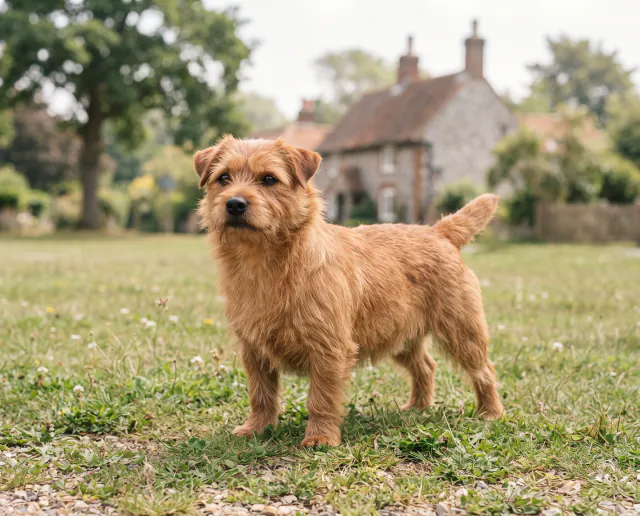
For decades the drop eared and prick eared versions of this small terrier were shown as a single breed, until the Kennel Club split them in 1964 into the Norfolk Terrier and the Norwich Terrier. The Norfolk kept the folded ear, and that soft, houndlike detail belies a dog developed in Cambridgeshire and Norfolk farmyards for exactly the same tough, ratting and fox bolting work as its harder edged relatives. Students at Cambridge reportedly kept the earlier version of the type as unofficial ratting mascots, which says something about how portable and companionable the breed already was.
What distinguishes the Norfolk Terrier within the wider terrier world is temperament rather than function. Most are notably sociable, get along with other dogs better than many terrier breeds manage, and show little of the standoffish or combative streak found elsewhere in the group. That easy going nature, combined with a genuinely small size, has made the breed a popular choice for people wanting terrier grit without terrier friction.
Temperament in the home
Norfolk Terriers are typically outgoing, affectionate and keen to be included in whatever the household is doing, and most settle happily among children, other dogs and even household cats raised alongside them. The breed retains real terrier instincts toward smaller animals outdoors, so garden wildlife and any rodent pets remain at genuine risk regardless of how placid the dog seems on the sofa. Barking tends to be moderate rather than constant, though the breed will announce visitors readily enough. Separation is handled reasonably well compared with more anxious small breeds, though a Norfolk left alone for very long stretches on a regular basis will find its own entertainment, usually at the expense of furniture or a flower bed.
Exercise and training
Around three quarters of an hour of exercise a day satisfies most adults, and the breed adapts well to whatever a household’s daily routine allows, provided it gets a genuine outlet for its energy rather than a token trip round the block. Scent games, a supervised digging patch and interactive toys at home fill in effectively on days when a full walk is not possible. Training tends to go smoothly by terrier standards, since the breed is genuinely food motivated and keen to please compared with more independent minded terriers, though sessions should stay brief and end on a success. Recall around wildlife still needs proper training and testing before it can be trusted off lead in open country.
Coat and grooming
The wiry, weather resistant coat should be hand stripped two or three times a year rather than clipped, which preserves both the texture and the breed’s typical colouring. A weekly combing session, paying particular attention to the beard, legs and the area around the ears, keeps the coat free of tangles between strips. Many owners manage the routine themselves once shown the technique, since the coat is compact and quicker to work through than that of a larger terrier. Shedding from a properly stripped coat is genuinely minimal, which suits owners keen to keep hair off soft furnishings.
Health and lifespan
Norfolk Terriers commonly live twelve to sixteen years, a good span for a pedigree dog of any size. Luxating patellas occur in the breed as they do across many small terriers, and a vet can assess this at a routine check. Hip dysplasia has been recorded occasionally, making hip scoring under the BVA and Kennel Club scheme a fair question for a breeder, and some lines carry a predisposition to a heart valve condition, so a breeder who has hearts checked in their breeding stock is worth seeking out. Mitral valve issues in particular are worth discussing directly with a vet or breeder rather than assuming a small terrier’s heart needs no attention.
Costs and space
Running costs for a Norfolk Terrier sit in a moderate band for a small dog, with hand stripping the main recurring expense for owners who prefer a professional groomer over learning the technique themselves. The breed adapts comfortably to a flat or small house, provided daily exercise and mental stimulation are genuinely provided rather than assumed to come from the size of the home. A secure garden helps manage the breed’s digging habit, though fencing at ground level matters more than the overall size of the plot.
Size and lifespan
Adults typically stand around 25 cm (10 in) at the shoulder and weigh 5 to 5.5 kg (11 to 12 lb), with little difference between the sexes. It is one of the smallest working terriers, low-slung and sturdy rather than delicate, and the breed standard is unusually precise on weight compared with many terriers, which are traditionally judged more by fitness for work than by exact figures.
A typical lifespan is 12 to 16 years, a strong outcome even by small-breed standards, and well-kept Norfolk Terriers commonly remain active and game well into their teens.
Verdict
The Norfolk Terrier suits families, first time owners and anyone wanting a genuinely sociable small terrier that copes well with other dogs and a busy household. Its manageable size and good nature make it an unusually forgiving introduction to the terrier group.
It remains unsuitable for households with small caged pets or an expectation of trouble free recall around wildlife. Given proper exercise and coat care, it is among the more easy going terrier breeds available.