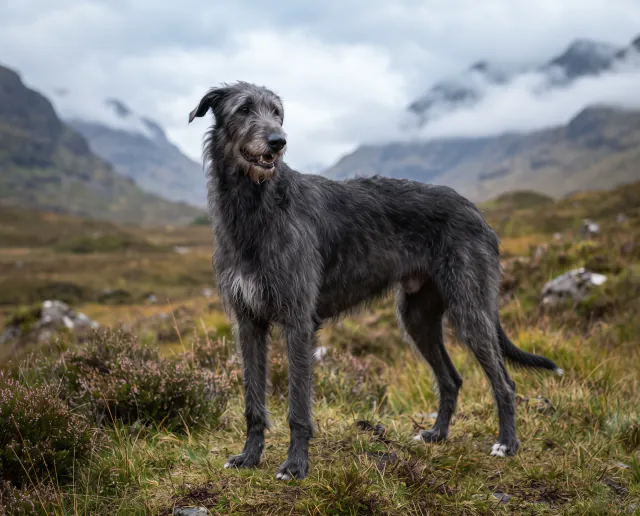
Also known as: Scottish Deerhound.
At a glance
Key facts
The essentials to compare before deciding whether this breed fits your home and routine.
- Size
- Giant
- Lifespan
- 8 to 11 years
- Energy
- Medium
- Temperament
- Gentle, quiet, dignified and devoted
- Good with children
- Often good with children, though size and speed need supervision
- Exercise
- About an hour a day with a free gallop in a secure space
- Trainability
- Moderate
- Grooming
- Weekly brushing with occasional hand stripping and moderate shedding
- Estimated monthly cost, GBP
- £140 to £250 per month
The Deerhound was the dog of the Highland chiefs, bred to run down red deer over rough ground and bring them to bay before the rifle made the work unnecessary. When the clan system collapsed, so nearly did the breed, and it was saved in the nineteenth century by a handful of enthusiasts. The dog that resulted looks like a Greyhound built for a Scottish winter, with a harsh grey coat, a long narrow head, and a height of 76cm or more at the shoulder in males, who weigh around 45kg.
For all that size, Deerhounds are among the gentlest of dogs, quiet in the house and almost apologetic in the way they take up space. That is the appeal. The costs are a short life, a chase drive that never switches off, and the practical burden of any giant.
Suitability
At home the breed is calm to the point of idleness, affectionate without being demanding, and generally fine with other dogs. Children are usually treated with patience, though a dog this size knocks a small child over without meaning to and a swinging tail is at head height for a toddler. Guarding is absent. A Deerhound will greet a burglar and show him the kitchen. The breed does not enjoy being left alone all day and can be destructive when it is. Space is needed in specific ways rather than in general, with room for a dog to lie stretched out full length, a large bed, a car with a proper boot, and a garden with a fence that is secure rather than high, since the breed is more likely to lean through a weak panel than jump. Cats can work when the dog is raised with them, but anything running in the open is quarry.
Exercise
An adult needs about an hour a day and, several times a week, a gallop in a large secure space. Hired dog fields have made that far easier across Britain than it used to be. On the lead the breed walks quietly, and a road walk is a poor substitute for the run it is built for. Off-lead exercise in open country is not safe for a dog that hunts by sight and can reach 60kph before an owner has registered the deer, sheep or hare that set it off. Fields with livestock are lead-only in law and in sense. Puppies of this size grow at an alarming rate and need short, frequent outings on soft ground until eighteen months, with stairs and jumping avoided. Over-exercised Deerhound puppies develop joint problems that last a lifetime. Adults tolerate cold and wet well under a harsh coat and need shade in summer.
Grooming
The rough coat is harsh, wiry and about eight centimetres long on the body, with softer hair on the head, belly and chest. A weekly brush with a slicker and a comb through the beard and legs keeps it tidy, and a few times a year the dead, straggly hairs on the ears, neck and feet are pulled out by hand or with a stripping knife, which most owners learn to do themselves. Shedding is moderate and the coat does not mat easily. Baths are rare. Nails need regular clipping on a dog whose weight rests on long toes, and teeth benefit from routine brushing. The coat holds mud and water after a wet walk, so a towel by the door is essential.
Health
Life expectancy is eight to eleven years, and losing a Deerhound in its ninth year is common enough that owners plan for it. Bloat is the emergency, and a deep, narrow chest makes the breed one of those most at risk. Restlessness, retching without result and a tight, swollen abdomen mean a vet immediately. Dilated cardiomyopathy is well recognised and the Deerhound Club encourages heart checks on breeding stock, so ask what has been done. Bone cancer is the other common cause of death in the breed and most often appears as a persistent limp in middle age. A DNA test exists for Factor VII deficiency, a clotting disorder, and results for both parents should be available. Liver shunts occur in puppies, and many breeders test litters with a bile acid blood test before sale. Sighthounds carry little fat and process some anaesthetics differently, which a vet needs to know. Hips are less often a problem than in heavy breeds. Keep the dog lean.
Choosing and training
Deerhounds are uncommon and the Deerhound Club is the first contact. Litters are few, breeders vet enquiries closely and a wait of a year is not unusual. The breed’s rescue arm rehomes adults occasionally. Ask to see heart results, Factor VII results and bile acid tests, and meet the mother. Training relies on the breed’s willingness rather than its ambition. A Deerhound learns lead manners, a settle and a reliable stand for handling well enough, and sees no purpose in much beyond that. Reward-based methods only, since a harsh word causes real distress. Recall should be trained with a whistle and high rewards as a safety measure, never relied upon around anything that moves.
Verdict
The Deerhound suits a calm household with a big car, a secure garden, access to a safe galloping space and the means to insure and feed a giant, and an owner who wants a quiet, gentle dog rather than an obedient one.
It is the wrong choice for anyone wanting off-lead freedom in open country, for a small home or budget, or for people unable to face a short lifespan. Those who accept the terms rarely change breed afterwards.