At a glance
Key facts
The essentials to compare before deciding whether this breed fits your home and routine.
- Size
- Giant
- Lifespan
- 6 to 8 years
- Energy
- Medium
- Temperament
- Gentle, calm, sensitive and enormous
- Good with children
- Often good, though the size demands constant supervision
- Exercise
- About an hour a day with a secure gallop, strictly limited while growing
- Trainability
- Moderate
- Grooming
- Weekly brushing with hand stripping two or three times a year
- Estimated monthly cost, GBP
- £160 to £280 per month
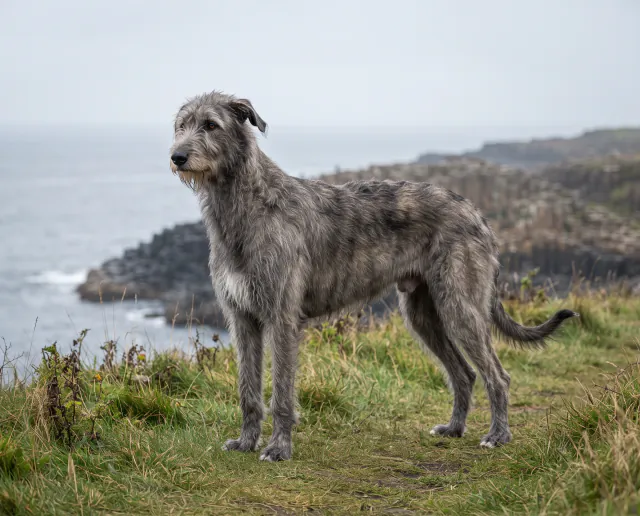
Most people meet their first Irish Wolfhound in a doorway, because that is where the dog fills the frame. A mature male stands a minimum of 79cm at the shoulder under the Kennel Club standard and many are taller, with a weight somewhere between 55kg and 70kg. The dog looks like a wolf hunter and behaves like a large, slightly tired librarian.
The breed’s original job was exactly what the name says. Wolfhounds ran down wolves and deer in Ireland for centuries, dwindled almost to nothing once the wolves were gone, and were rebuilt in the nineteenth century using Deerhound, Great Dane and other blood. The modern dog keeps the sighthound outline, the rough coat and a turn of speed that startles people who have only seen one asleep. It also carries a short lifespan and a set of health problems that anyone considering the breed needs to look at squarely before the puppy arrives.
Living with the breed
Indoors, a well-raised Wolfhound is calm to the point of inertia. Adults sleep a great deal, follow the household from room to room and rest a head on the nearest lap or table edge without meaning any harm by it. They are not guard dogs in any useful sense; most greet strangers with polite interest, and the deterrent value is purely visual. The house has to work around the dog rather than the other way round. Tails sweep low tables clear, water bowls need to be raised and refilled often, and a bed has to be big enough for a dog nearly two metres long when stretched out. Children are usually treated with patience, but a puppy of 40kg that has not yet learned to steer will knock a small child flat, so supervision is a physical necessity rather than a formality.
Daily exercise
Adult Wolfhounds need less than their size suggests. An hour a day, split between a steady walk and a chance to gallop somewhere secure, keeps most fit and content. Recall around deer, hares and sheep can never be assumed, and the law on lead control near livestock applies with particular force to a dog capable of killing a ewe by accident. Puppies are a different case. The breed grows at an alarming rate, reaching most of its adult height inside a year. Long walks, stairs, jumping in and out of cars and rough play with adult dogs all risk damage during that period. Several short outings on soft ground and a lot of rest is the safer pattern until eighteen months or so.
Training and mental work
Wolfhounds learn readily when handled kindly and take offence when handled roughly, which makes them straightforward for patient owners and frustrating for anyone in a hurry. Focus on what matters at this scale, which is walking on a loose lead, waiting at doors and in the car, standing still for the vet and settling on a bed while visitors arrive. All of that needs teaching before the dog weighs more than its handler. Mental work can be light. A scatter feed on the lawn, a stuffed chew and a short session with a few treats will satisfy most, and an overstimulated Wolfhound is rarer than a bored one.
Grooming and shedding
The coat is rough, harsh and medium in length, with longer hair over the eyes and under the jaw. A thorough brush and comb once a week keeps it tidy, and the dead coat is best removed by hand stripping or a stripping knife two or three times a year rather than by clipping, which softens the texture. Shedding is moderate and constant rather than seasonal, though the volume from a dog this size is still noticeable on floors. Nails need regular attention, since an overlong nail changes the way a heavy dog stands.
Health and costs
This is where the breed asks the most of its owners. Six to eight years is a typical lifespan. Heart disease, particularly dilated cardiomyopathy, is well recognised in the breed, and the Irish Wolfhound Club runs a heart testing programme that responsible breeders take part in; ask to see recent results for both parents. Bone cancer is the other great fear, and a persistent limp in a middle-aged Wolfhound is never something to wait and see about. Bloat and torsion of the stomach is an emergency that every owner must be able to recognise, with restlessness, unproductive retching and a swelling abdomen as the warning signs. Liver shunt occurs in puppies of the breed, and many breeders have litters blood tested before sale. Hip and elbow scoring under the BVA and Kennel Club scheme is sensible for a dog this heavy. The monthly running cost sits around £160 to £280 once food for a giant, insurance priced for a giant and veterinary drugs dosed by weight are added together. Puppies are generally available without long waits, but the breed club is still the sensible starting point for a list of breeders who test.
Verdict
The Irish Wolfhound suits a calm household with a large ground-floor space, a big vehicle, a budget for giant-breed insurance and an owner who is home most of the day. People who want a quiet, gentle, physically imposing dog and can accept a short life often find nothing else will do afterwards.
Anyone on a tight budget, in an upstairs flat, or unable to face losing a dog before it is old should look at a smaller sighthound instead. The Deerhound and the Greyhound offer much of the same character with fewer of the giant-breed penalties.