Also known as: Russian Wolfhound.
At a glance
Key facts
The essentials to compare before deciding whether this breed fits your home and routine.
- Size
- Large
- Lifespan
- 9 to 12 years
- Energy
- Medium
- Temperament
- Quiet, aloof, sensitive and quick to chase
- Good with children
- Can be good with calm older children, but easily unsettled by noise
- Exercise
- About an hour a day with a safe gallop several times a week
- Trainability
- Moderate
- Grooming
- Brush several times weekly, with heavy seasonal shedding
- Estimated monthly cost, GBP
- £120 to £215 per month
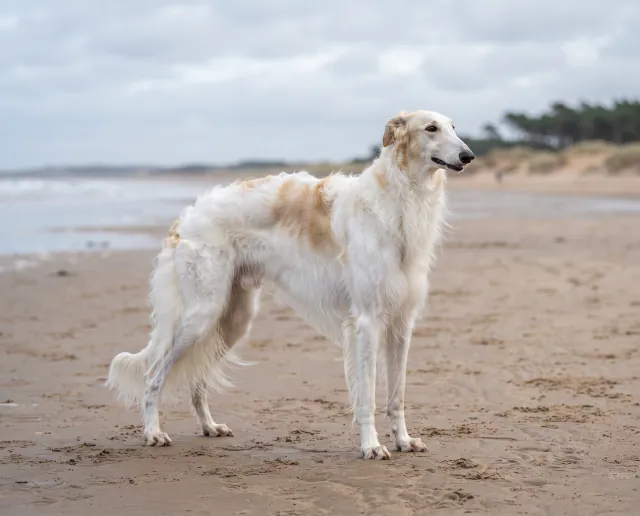
A Borzoi asleep on a sofa looks like a discarded fur stole, and people who expect the Greyhound’s plain practicality are surprised by how much dog is attached to it. Males stand 75cm or more at the shoulder and can weigh over 45kg, though the narrow frame hides most of that. The breed was developed on Russian estates to course wolves across open steppe, running in pairs to catch and hold the animal until the mounted hunter arrived, which demanded speed, courage and a certain independence from human direction.
Those qualities are still there under the silk. The breed is quiet, clean and undemanding in a house, reserved with strangers, and outdoors it becomes a different animal the moment something runs. Understanding both halves of the dog is the whole of Borzoi ownership.
Temperament in the home
Indoors these hounds are calm, softly mannered and often described as catlike, choosing to be near their people without pestering them. They are not demonstrative with strangers and many are indifferent to visitors altogether. The awkward side is a sensitivity that borders on fragility. Loud households, rough play and shouting distress the breed, and a Borzoi that has been frightened does not easily forget. Children who are calm and older tend to do well; toddlers and boisterous younger children generally do not. With other sighthounds the breed is usually sociable, while small dogs, cats and anything with fur that moves fast may trigger a chase, and a dog raised with a cat still cannot be trusted with the neighbour’s. Furniture becomes theirs, since a dog this long cannot curl up in a corner. Barking is rare.
Exercise and training
An adult needs about an hour a day of walking and, several times a week, the chance to gallop flat out in a secure place, which in most of Britain means a hired field or a fenced sighthound run. A Borzoi without a gallop becomes restless and unhappy in a way that walking does not fix. Off-lead exercise in open country is unwise for life, because a hare on the far side of a field will be seen before the owner notices and the dog will be gone at 60kph, across roads if necessary. Puppies grow fast and should have short, frequent outings on soft ground until around a year, with no stairs or jumping. Training relies on gentleness and food, and on accepting that a sighthound was never bred to look to a handler for instruction. Sit is often disliked by the breed on account of its build, and a stand or a down is a better default. Recall training with a whistle and very high rewards repays years of effort, with a long line as the safety net.
Coat and grooming
The coat is long, silky and either flat, wavy or slightly curly, with feathering on the legs, tail and chest and a heavy frill at the neck. It is easier than it looks. Brushing several times a week with a pin brush and a comb through the feathering prevents mats behind the ears, in the armpits and on the trousers, and a bath every few months is enough. Shedding is heavy for a few weeks in spring and autumn and light otherwise. Wet feathering picks up mud and grass seeds on a British walk, and a check between the toes after summer outings is needed. Nails and teeth need regular attention, and the narrow jaw of the breed is prone to tartar.
Health and lifespan
Nine to twelve years is typical. Bloat is the immediate danger in a deep, narrow chest, and owners should learn its signs before the puppy comes home. Heart disease, including dilated cardiomyopathy, is recognised, and asking the breeder about heart testing in the line is fair. Bone cancer affects large sighthounds more than most breeds, and a limp that does not resolve in a Borzoi over six should be investigated. Eyes matter here, as the breed has its own form of retinal degeneration, and both parents should have been examined under the BVA and Kennel Club eye scheme. Like all sighthounds, the breed has little body fat and metabolises some anaesthetic drugs differently, so a vet experienced with the type is a real advantage. Hip problems are less common than in heavier breeds. Keep the dog lean by sighthound standards, which look thin to most people.
Costs and space
Expect £120 to £215 a month across food, insurance, routine care and grooming, with insurance for a large breed the main driver and veterinary bills priced by weight. A big house is not required, but a dog this length needs floor space to lie flat, a bed to match, and a car large enough for it to travel in comfort. The garden fence needs to be around 1.8 metres, because the breed clears lower ones. Borzoi are not common but can be found with patience. The Borzoi Club and a few long-established breeders are the first contact, litters are infrequent, and a wait of six months to a year is normal.
Verdict
A Borzoi suits a quiet, calm household with time for regular gallops in a safe space, a gentle approach to training and an appreciation of a dog that is elegant rather than eager.
It is a poor choice for a busy family with young children, for anyone who wants off-lead walks in the countryside, or for an owner whose idea of training involves firmness. The breed asks for patience and gives back a great deal of dignity and very little fuss.