
At a glance
Key facts
The essentials to compare before deciding whether this breed fits your home and routine.
- Size
- Medium
- Lifespan
- 12 to 15 years
- Energy
- Medium to high
- Temperament
- Alert, lively, vocal and independent minded
- Good with children
- Often good with children, being playful and sturdy
- Exercise
- Around an hour a day with scope to run and sniff
- Trainability
- Moderate
- Grooming
- Weekly brushing, with heavy seasonal shedding twice a year
- Estimated monthly cost, GBP
- £75 to £135 per month
Finland’s national dog was selected for a single hunting talent, and it is the one that causes the most difficulty in a British semi. The Finnish Spitz was bred to range through the northern forests, find capercaillie or black grouse, and then stand beneath the tree barking in a steady rhythm so the bird stayed fixed on the dog while the hunter crept into range. Finland still holds competitions to find the best barking dog. The Kennel Club places the breed in the hound group, a classification that follows the job rather than the shape.
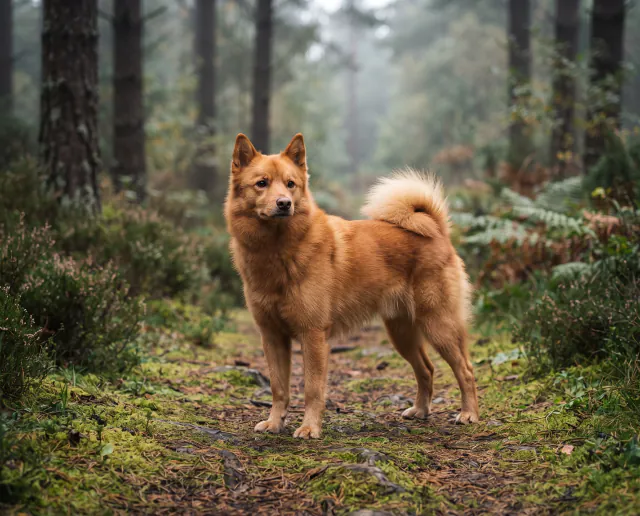
That job produced a compact, fox-red dog of roughly 39 to 50cm at the shoulder, light on its feet, sharply aware of anything moving in the garden and fully prepared to tell the whole street about it.
Temperament in the home
With its own family the Finnish Spitz is affectionate, playful and closer to a cat in its independence than most working breeds. Strangers are watched rather than welcomed, and an adult that stays politely aloof with visitors is behaving as the standard describes. Noise is the central fact of ownership. Doorbells, pigeons, the cat next door and a squirrel on the fence all prompt the same clear, carrying bark, and a dog left to police the garden unsupervised will rehearse the habit until it is fixed. Children usually get on well with these dogs, which are sturdy enough for play and tolerant of reasonable handling. Cats raised alongside a puppy are often accepted; birds, poultry and small pets are not. Moderate periods alone are tolerated better than in the clingier breeds, provided boredom has not become another reason to bark.
Exercise and training
An hour of varied exercise suits most adults, and the useful part is the free running and sniffing rather than the mileage. A secure field, a fenced garden and long-line walks in open country cover the need, because recall around birds, rabbits and squirrels is never something to rely on. Puppies should have short outings and free play rather than long walks, with stairs and repeated jumping kept to a minimum while the joints mature. Training goes best in short, lively sessions with food and variety, since the breed loses interest quickly when asked to repeat an exercise it has already done correctly. A quiet cue, taught by rewarding silence after a bark and practised daily from the start, reduces the noise to something manageable without pretending it will disappear. Scent work and agility give the dog a job, and lead control near livestock and around the release pens of pheasant shoots is not optional in the countryside.
Coat and grooming
The coat is a double one, with a harsh, straight outer layer standing off the body over a dense, soft undercoat, longer on the ruff, the thighs and the plumed tail curled over the back. Colour runs from pale honey to a deep red gold, and puppies are born far darker than the adults they become. For most of the year a thorough weekly brush is enough. Twice a year the undercoat drops out in handfuls for two or three weeks, and daily raking during the moult keeps the hair off the carpets and prevents matting behind the ears. The coat should never be clipped, since it insulates against both cold and sun and grows back wrongly once cut. The dog will need shade and water on hot days, because a coat built for a Finnish winter does not suit a Kent heatwave.
Health and lifespan
Twelve to fifteen years is a reasonable expectation and many go beyond it. The breed is generally hardy, but epilepsy is well recognised in the Finnish Spitz and has been the subject of considerable work in its home country, so ask any breeder directly about seizures in the lines behind a litter and expect a straight answer. Hip dysplasia and luxating patellas occur at modest rates, and hip scoring under the BVA and Kennel Club scheme, along with a patella check, is reasonable to request. Eye examination under the BVA and Kennel Club scheme is sensible in a breed whose UK population is small. The coat hides weight gain completely, so judge condition by feeling the ribs rather than by looking.
Costs and space
Monthly costs of about £75 to £135 are indicative and depend on insurer, region and the individual dog. Space is less of an issue than sound. A flat with shared walls or a tight terrace is a difficult setting for a dog bred to bark for a living, and a detached or semi-detached house with tolerant neighbours is a far better start. Fencing needs to be a solid 1.5 metres or more, since these dogs climb as readily as they jump. Puppies are scarce. Only a few litters are registered outside Finland in a typical year, waiting lists are usual, some dogs are imported from Finland and Scandinavia, and the Finnish Spitz Society is the sensible first contact for anyone serious.
Verdict
The Finnish Spitz suits active owners with a house set slightly apart from the neighbours, who enjoy a sharp, independent, characterful dog and find its running commentary amusing rather than wearing. It works well for people who like scent sports and can commit to daily noise training from the first week.
It is a poor match for a quiet flat, for anyone with sound-sensitive neighbours, and for owners who want a biddable dog with reliable off-lead recall. Anyone buying purely for the striking red coat, without meeting adults and hearing them in full voice, is likely to regret it.