At a glance
Key facts
The essentials to compare before deciding whether this breed fits your home and routine.
- Size
- Medium
- Lifespan
- 13 to 15 years
- Energy
- High
- Temperament
- Cheerful, alert and thoroughly devoted to its family
- Good with children
- Usually very good and keen to join in family activity
- Exercise
- About 1 to 2 hours a day with mental work included
- Trainability
- Moderate
- Grooming
- Weekly brushing, daily during two heavy annual moults
- Estimated monthly cost, GBP
- £90 to £150 per month
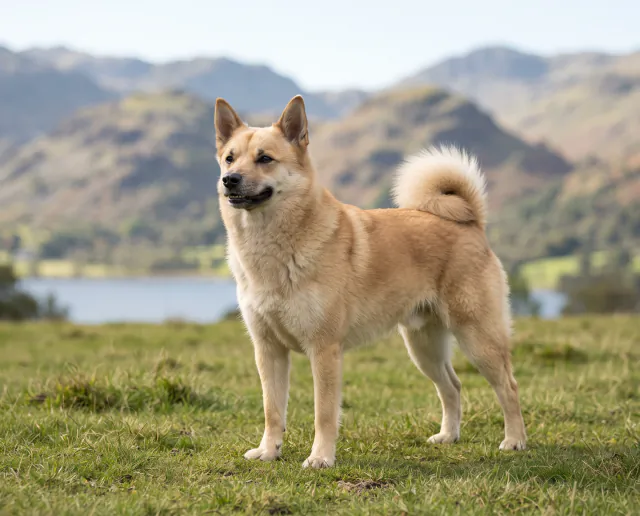
Norse farmsteads once kept a general purpose spitz to guard the homestead, herd whatever livestock was kept, and hunt small game when required, and the Buhund’s name reflects that broad brief directly, coming from the old Norwegian word for farm or homestead. Archaeological evidence suggests dogs of this type accompanied Viking settlers, which makes the breed one of the older working companions still recognisable in something close to its original form. Little of that working versatility has been bred out.
In Britain the Buhund remains a comparatively unfamiliar breed, seen occasionally at shows and increasingly by word of mouth among owners who value a cheerful, biddable spitz over the more independent temperament of some related breeds. It carries plenty of typical spitz character, including a readiness to announce anything unusual, without the aloofness that puts some owners off the wider group.
Temperament in the home
The Buhund is a genuinely sociable dog, happiest included in whatever the household is doing rather than left to its own devices in another room. It tends to form strong bonds across the whole family rather than fixating on one person, and most individuals are excellent with children, treating them as playmates and pack members alike. Visitors are announced loudly, and the breed’s watchfulness makes it an effective doorbell substitute whether or not that is wanted. Other dogs are usually accepted well, and many Buhunds do better with canine company than being the household’s only dog. Long stretches alone do not suit the breed, since it was developed to work closely alongside people rather than independently.
Exercise and training
Between one and two hours of exercise a day keeps an adult Buhund settled, and that time should include mental challenges as well as distance covered, since a purely physical walk leaves the working brain understimulated. Agility, obedience competition, scent work and simple herding style games with a ball all suit the breed’s enthusiasm for having a task. Training tends to progress well given the breed’s biddable nature, though sessions benefit from variety, since repetition bores a quick learner faster than it teaches one. Recall generally develops reliably with consistent early work, though the breed’s alertness to movement means distractions need managing around livestock and wildlife.
Coat and grooming
The double coat is dense, weatherproof and self cleaning to a fair degree, needing a thorough weekly brush through the ruff, trousers and tail to prevent matting. Twice yearly, the undercoat clears out over several weeks in a proper moult, during which daily brushing becomes worthwhile to manage the volume of loose hair around the house. Outside those periods, shedding is moderate rather than constant. Bathing is needed only occasionally, and the coat dries relatively quickly given its structure. Nails, ears and teeth need the routine attention any active dog requires, and owners should plan for a genuinely significant amount of hair during the seasonal blowouts.
Health and lifespan
The breed is generally robust, and hip dysplasia is the main structural concern worth screening for through the BVA and Kennel Club hip scheme. Eye conditions occur occasionally across spitz breeds, and a current BVA and Kennel Club eye certificate for breeding parents is a reasonable request. Some lines carry a predisposition to an inherited kidney condition, and asking a breeder what testing or family history is available on that front is sensible. Well kept Buhunds commonly reach thirteen to fifteen years, among the better lifespans for a medium sized dog, and maintaining a lean weight through adulthood supports that outcome considerably.
Costs and space
Monthly running costs typically fall between ninety and a hundred and fifty pounds once food, insurance and routine veterinary care are included, though the figure varies with region, insurer and the individual dog. Grooming adds modestly to that during the heavier moulting periods unless handled at home. A medium sized garden suits the breed well, and while it adapts to a smaller home, the vocal nature and genuine exercise needs make close neighbours and thin walls worth considering beforehand. Litters remain uncommon outside Norway, so prospective buyers should expect to contact the breed club and wait for a suitable puppy rather than finding one immediately.
Size and lifespan
Males typically stand 45 to 47 cm (17.5 to 18.5 in) at the shoulder and weigh around 14 to 18 kg (31 to 40 lb). Females are slightly smaller, usually 43 to 45 cm (17 to 17.5 in) and 12 to 16 kg (26 to 35 lb). It is a compact, square-built spitz rather than a heavily boned dog, and a lean, athletic build suits the breed’s working history far better than extra weight.
A typical lifespan is 13 to 15 years, among the better outcomes for a medium-sized breed, and many Buhunds stay active and alert well into their senior years provided their weight and joints are looked after throughout adulthood.
Verdict
The Norwegian Buhund suits an active family wanting a cheerful, trainable spitz that genuinely enjoys company, structured activity and the company of children. It rewards owners willing to give it a job and some patience with its vocal habits.
It is a weaker match for anyone needing a quiet dog, living somewhere barking would cause real friction, or unable to provide the daily mental and physical engagement the breed’s working background still demands.