At a glance
Key facts
The essentials to compare before deciding whether this breed fits your home and routine.
- Size
- Medium
- Lifespan
- 12 to 14 years
- Energy
- High
- Temperament
- Cheerful, alert and thoroughly sociable herder
- Good with children
- Usually very good and keen to include everyone in the fun
- Exercise
- About 1 to 2 hours a day with plenty of variety
- Trainability
- Moderate
- Grooming
- Weekly brushing, more during two heavy seasonal moults
- Estimated monthly cost, GBP
- £90 to £150 per month
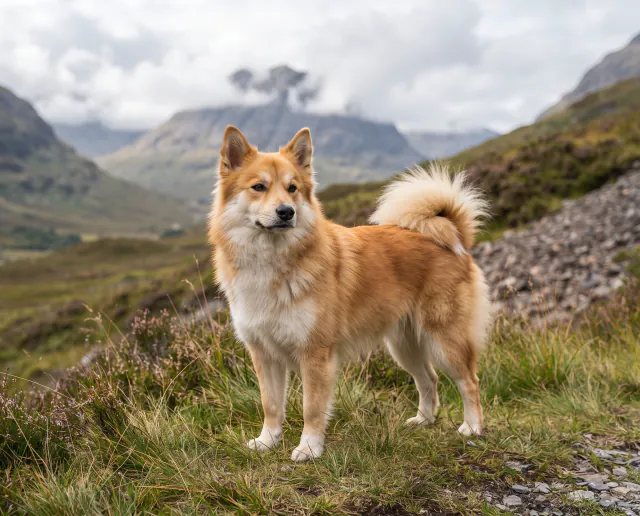
Iceland has almost no native land mammals, so when Norse settlers arrived with livestock and dogs around a thousand years ago, the working spitz that developed there had a narrow, specific job. It gathered sheep and ponies across open, often treacherous ground, warned of anything unfamiliar, and lived closely with the family doing it. That combination of herding instinct and genuine sociability still defines the breed, and it explains why an Icelandic Sheepdog rarely settles for being a spectator in the household.
The breed nearly disappeared twice, once through disease outbreaks that swept the island’s dog population and again through general neglect of native stock in the twentieth century, before dedicated breeders rebuilt numbers from a narrow base. Numbers outside Iceland remain small, and anyone drawn to the breed should expect a search rather than a quick purchase.
Living with the breed
An Icelandic Sheepdog wants to be involved in whatever the household is doing, and that includes greeting visitors loudly enough to be heard two streets away. Barking is not a fault to be trained out so much as a trait to be managed, since the breed was bred to raise the alarm at anything approaching flock or farmstead. Indoors it is playful, affectionate and generally excellent with children, treating a busy family as exactly the sort of flock it was built to mind. Other dogs and cats are rarely a problem once introductions are handled properly. Left alone for long stretches, the breed tends to vocalise and can become genuinely unsettled, so households with someone around for much of the day suit it far better than an empty house all week.
Daily exercise
Plan on something between an hour and two hours of activity most days, split across more than one outing where possible. The breed enjoys distance work, retrieving, agility and anything involving a job rather than an aimless loop of the block, and a securely fenced garden gives it somewhere to patrol between walks. Puppies should be given shorter, more frequent sessions while joints and growth plates mature, with free play favoured over repetitive forced exercise or long runs alongside a bike. Adult dogs that get genuine variety in their week tend to be calmer at home than those given only a lead walk, because the breed’s herding brain needs a task as much as its legs need distance.
Training and mental work
Icelandic Sheepdogs are intelligent and eager to work with their owners, which makes early, consistent training rewarding rather than a battle. Recall deserves particular attention, since a dog bred to range widely over open Icelandic terrain will happily do the same across a British park if the habit is not built early. Mental stimulation matters as much as physical exercise, and scent work, herding-style games with a ball, and simple obedience sequences all help a bright dog use its head productively. Socialising the breed widely as a puppy, to people, dogs, traffic and ordinary household noise, pays off given the strong alerting instinct that can otherwise tip into wariness of anything unfamiliar. Barking during training sessions is common at first and settles with patient, positive handling rather than punishment.
Grooming and shedding
The double coat comes in two lengths, both weatherproof and both requiring a weekly brush to prevent matting behind the ears, under the legs and around the collar line. Twice a year, usually spring and autumn, the undercoat blows out over several weeks and daily brushing during that period keeps the house and the dog considerably more comfortable. Bathing is needed only occasionally, since the coat is naturally self-cleaning and sheds dirt along with loose hair. Nails, ears and teeth need the routine attention any dog requires. Owners sensitive to hair around the home should be realistic about the two moulting periods before committing to the breed.
Health and costs
Reputable lines are generally sound, and hip dysplasia is the main structural concern worth asking a breeder about, alongside hip scoring under the BVA and Kennel Club scheme where results are available. Eye conditions occur occasionally, and a current BVA and Kennel Club eye certificate for both parents is a fair request. The breed’s small UK gene pool means many dogs trace back to a limited number of imported lines, so breeders who track pedigrees carefully and avoid close repeat matings deserve credit. Costs sit around the middle of the range for a medium dog, though insurance for a rare breed can be harder to price competitively and is worth shopping around for. The UK Kennel Club carries the breed on its Imported Breed Register. Litters are few and far between, waiting lists are normal, and the breed club is the sensible first point of contact for anyone serious about buying one.
Verdict
The Icelandic Sheepdog suits an active household that wants a genuinely friendly, family-oriented dog and does not mind vocal alerting or a long wait for a puppy. It works well alongside children, other dogs and an owner willing to give it a job most days.
It is a poor match for anyone needing quiet, for flats with thin walls or close neighbours, or for households that are out at work all day with nobody able to keep the dog company. Noise tolerance and patience with a rare breed’s availability matter as much as garden size here.