At a glance
Key facts
The essentials to compare before deciding whether this breed fits your home and routine.
- Size
- Large
- Lifespan
- 10 to 13 years
- Energy
- Very high
- Temperament
- Sociable, tireless, pack minded and single minded on scent
- Good with children
- Often good with children, though boisterous and strong
- Exercise
- 2 hours or more a day with real running in a secure space
- Trainability
- Experienced handler
- Grooming
- Weekly brushing with year-round shedding of short hair
- Estimated monthly cost, GBP
- £100 to £170 per month
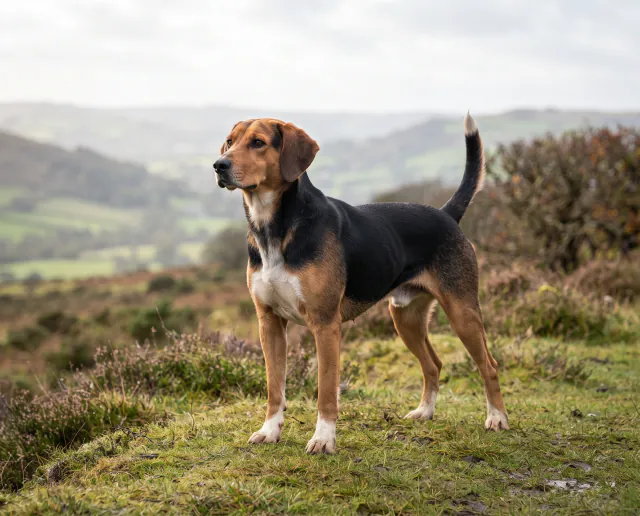
Most Foxhounds in Britain have never been inside a house. They live in hunt kennels in packs of forty or more, are fed together, exercised together behind bicycles and horses, and answer to the huntsman’s voice and horn rather than to a name called from a back door. The English Foxhound was refined over three centuries for mounted hunting across the shires, and since the Hunting Act 2004 in England and Wales, with equivalent legislation in Scotland, the packs follow laid trails instead of live quarry. The hound itself has not changed. It stands about 58 to 64cm, weighs somewhere over 30kg, and is built to run for hours across plough and pasture.
Very few are registered with the Kennel Club in any year, and in most years the figure is nil. Breeding is recorded instead in the Foxhound Kennel Stud Book kept by the Masters of Foxhounds Association, and hounds pass between hunts rather than to the public. A person who wants a Foxhound as a pet is looking for something that barely exists.
Living with the breed
A hound that does come into a home is usually an adult, either retired from a pack or rehomed through a hound welfare organisation after failing to make the grade. It arrives having never met stairs, glass doors, a lead, a car, a cat or a period alone. Foxhounds are sociable, good natured and rarely aggressive, and that same sociability is the difficulty, since a dog bred to live in a group of fifty finds solitude distressing and says so at volume. Kennel-raised adults are not house trained and treat kitchen surfaces as a buffet. Their voice, developed to be heard across a valley, carries through walls. Most settle well with other dogs and do best in a household that already has one. Children are generally safe, though a 32kg hound at full stretch will flatten a toddler without noticing.
Daily exercise
A hunting hound covers twenty or thirty miles on a hunting day and is exercised for hours on the other days. Two hours a day is the minimum for a pet Foxhound, and a good part of it needs to be running rather than pavement walking. Off-lead exercise is only safe inside a fenced field, because a hound that hits a fox line will follow it for miles, across roads, without hearing a word. Country owners with ground of their own manage better than anyone else. Puppies from a hunt are rare, but where one arrives, growth needs the same care as any large breed, with short outings and no forced running before the joints mature. Fencing should be 1.8 metres and dug in at the base.
Training and mental work
Hunt hounds learn to walk in a group at heel, to come to the horn, and to leave livestock alone, and that is roughly the extent of formal training. Everything else must be built from scratch in an adult with fixed habits. Reward-based work with food does succeed, since these are food-driven dogs, but recall in open country will never approach that of a gundog. Scent work is the obvious outlet, whether laid trails in a field, drag lines or tracking classes, and a Foxhound given a trail to work is a calmer animal indoors. Lead control near livestock is a legal matter as well as a practical one, and a hound that has grown up alongside sheep is still a hound.
Grooming and shedding
The short, dense coat needs a weekly brush with a hound glove and sheds steadily all year. Colours are the classic tricolour or any recognised hound colour. Ears are the maintenance point; drop ears trap moisture and need a weekly check and cleaning as required. Nails wear down naturally on a dog doing proper mileage but need attention on a pet. Baths are rare, and the hound smell is mild but never absent.
Health and costs
Foxhounds are among the soundest breeds in the country because they have been selected for function for generations, and ten to thirteen years is a fair expectation. Hip dysplasia occurs, and a deep chest brings some risk of gastric torsion, so feed two or three smaller meals rather than one and avoid running straight after eating. Hunt-bred hounds will not have BVA and Kennel Club hip scores, and a buyer should not expect them. Running costs of roughly £100 to £170 a month are a guide rather than a promise, with food for a hard-working large dog the biggest item and insurance the most variable.
Verdict
The Foxhound suits a rural household with land, secure fencing, other dogs, someone at home most of the day and a realistic view of what a kennel-raised adult can and cannot learn. Retired hounds placed through a welfare organisation with experienced owners do sometimes make good pets.
It is unsuitable for a town, a flat, a single-dog home, a household that is out all day, or anyone expecting the ease of a Labrador. Most people drawn to the look would be better served by a Beagle.