At a glance
Key facts
The essentials to compare before deciding whether this breed fits your home and routine.
- Size
- Small
- Lifespan
- 13 to 15 years
- Energy
- Medium
- Temperament
- Alert, confident and thoroughly convinced of its own importance
- Good with children
- Often good when handled calmly and given a say
- Exercise
- About 45 minutes a day split across two outings
- Trainability
- Moderate
- Grooming
- Frequent brushing to manage a dense standing coat
- Estimated monthly cost, GBP
- £70 to £130 per month
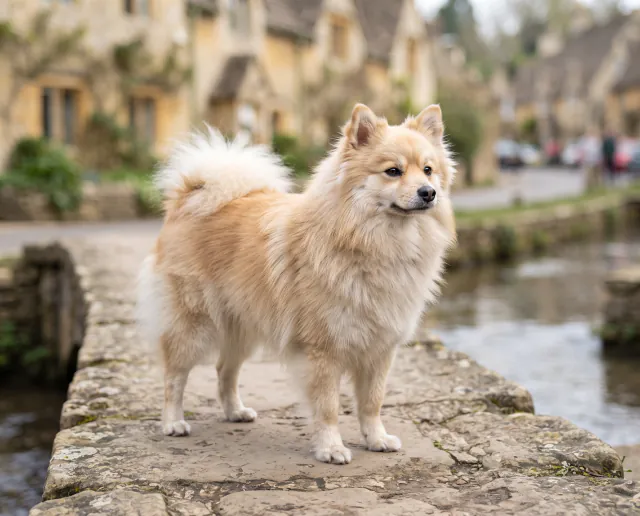
The Kennel Club registers the German Spitz in two sizes under one breed standard, the Klein and the larger Mittel, and beyond the difference in stature the two are the same dog in temperament, coat and character. Both trace back to the general central European spitz stock that also produced the Pomeranian at the small end and the Keeshond at the larger, and the breed’s fox like face, pricked ears and tightly curled tail over the back are unmistakable at either size.
What surprises people meeting the breed for the first time is how little the appearance predicts the temperament underneath. A German Spitz is not a lapdog in outlook. It is watchful, opinionated and quick to announce anything it considers worth mentioning, traits that made it a valued farm and barge dog on the continent long before it became a companion breed in Britain.
Suitability
The breed suits owners who want a small dog with genuine character and do not mind a housemate that has views on most things. Both sizes are affectionate with their own family and tend to form a particular attachment to one person, while remaining sociable enough with the rest of the household. Children are usually well tolerated, especially when they understand that the dog prefers to approach on its own terms rather than be scooped up without warning. Strangers get a suspicious welcome and a fair amount of noise before the dog decides whether to relax, which some households enjoy as a doorbell substitute and others find wearing. Flats and terraced houses suit the breed physically, since its exercise needs are modest, though thin walls and a vocal dog are not always a comfortable combination for neighbours.
Exercise
Around 45 minutes a day, split into two shorter walks, keeps most adults content, and the breed enjoys investigating hedgerows and verges as much as covering distance. Puppies need shorter, more frequent outings while their joints and growth plates develop. Off lead exercise works well once recall is established, though a spitz that has spotted a squirrel or a cat can become temporarily deaf to instruction, so quiet residential streets and enclosed parks are safer choices than open land near roads. The breed does not generally do well confined to a garden as its sole source of activity, since boredom tends to express itself as barking at everything passing the fence.
Grooming
The standing double coat is the breed’s defining feature and its main upkeep cost. A soft dense undercoat sits beneath a longer, harsher outer coat that should stand away from the body rather than lie flat, and left unbrushed it mats quickly behind the ears, under the arms and around the trousers. Several sessions a week with a slicker brush and a metal comb keep the coat in order, rising to daily attention during the two significant moults each year when the undercoat blows out in real volume. The coat does not need clipping or professional trimming to look correct, which keeps grooming costs down compared with breeds that need a salon visit, but the time commitment at home is genuine rather than occasional.
Health
Both sizes are generally long lived, commonly reaching thirteen to fifteen years with good care. Patellar luxation, where the kneecap slips out of its groove, is reported in the breed and worth asking a breeder about, along with any history of eye problems in their lines. Dental crowding can be an issue in the smaller Klein variety given the compact jaw, so a routine of teeth checks and brushing from puppyhood pays off. Weight creeps on easily on a dog this size fed to appetite rather than to a measured ration, and extra weight on small joints accelerates the very problems a breeder’s screening tries to catch early. There is no specific DNA panel widely used for the breed at present, so a general veterinary health check of the puppy and an honest conversation with the breeder about any recurring issues in their lines is the practical approach.
Choosing and training
Training responds best to patience and consistency rather than repetition, since the breed is intelligent but easily bored by drilling and can be stubborn when it sees no point in a request. Early socialisation matters more for this breed than obedience polish, because a German Spitz that has met plenty of calm strangers and other dogs as a puppy barks less indiscriminately as an adult than one that has not. Barking itself is worth addressing directly from the start, teaching a reliable quiet cue rather than hoping the habit fades on its own, since it rarely does without guidance. Litters of either size are not common compared with more fashionable small breeds, so expect a wait for a puppy from a breeder who health tests and socialises early, and treat that wait as part of getting the right dog rather than an obstacle to route around.
Verdict
The German Spitz suits owners who want a genuinely characterful small companion, are prepared to commit proper time to coat care and early training, and can accept a dog that will always have something to say about the world outside the window. It works well in flats, houses and family homes provided the barking is managed from puppyhood.
Anyone wanting a quiet, undemanding lapdog, or unwilling to invest the grooming time a standing double coat requires, would do better with a different small breed. Bought and raised properly, this is a resilient, long lived companion that punches well above its size.