At a glance
Key facts
The essentials to compare before deciding whether this breed fits your home and routine.
- Size
- Small
- Lifespan
- 13 to 15 years
- Energy
- High
- Temperament
- Bright, alert and closely attached to its household
- Good with children
- Usually good with considerate children
- Exercise
- About an hour a day plus daily training games
- Trainability
- Beginner friendly
- Grooming
- Brushing several times a week, daily during moults
- Estimated monthly cost, GBP
- £70 to £120 per month
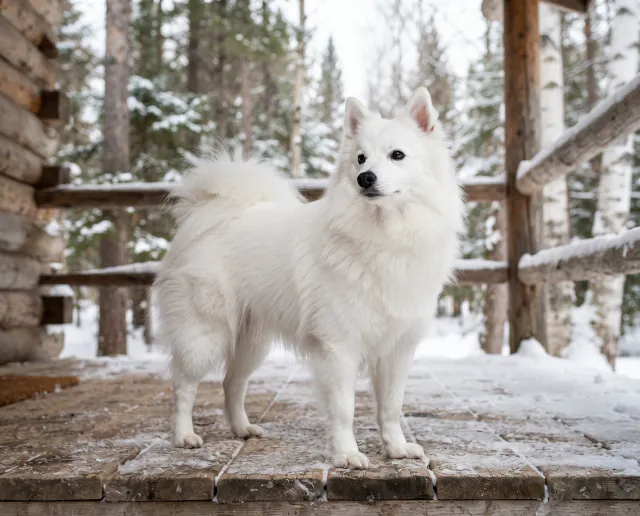
The American Eskimo Dog is a white spitz shown in three sizes, toy, miniature and standard, all treated as one breed with the same outline, coat and character. Despite the name, it has no connection with Arctic peoples or with sled work. It descends from German Spitz dogs brought across the Atlantic by European settlers, and the current name was adopted in the early twentieth century when German associations had become unpopular. The result is an alert, vocal, closely bonded companion that is more biddable than many spitz types but a long way from undemanding.
Origin and purpose
German Spitz dogs travelled with immigrant families to the American Midwest during the nineteenth century, where they earned their keep as farmyard watchdogs and household companions rather than as hunting or hauling dogs. Travelling circuses took up the type for trick and rope walking acts, which spread it across the country and rewarded exactly the quickness and showmanship the breed still displays. The American Kennel Club recognised the breed in 1995 and it remains familiar throughout North America. It is uncommon elsewhere, and in many countries the related German Spitz or Japanese Spitz occupies the same niche, so acquiring one may mean a long wait.
Temperament and behaviour
Expect a watchful, opinionated dog that notices everything and comments on much of it. Most are affectionate and demonstrative with their own household while remaining reserved with strangers for the first few minutes, warming quickly once introductions are made. Barking is the defining behavioural trait. The breed alerts to deliveries, footsteps, doorbells and neighbouring dogs, and a bored or under-exercised individual will bark simply because it has nothing better to do. Intelligence cuts both ways. An Eskie left to invent its own occupation tends to choose chewing, digging or door watching.
Family life and other animals
Considerate children usually get on well with the breed, which enjoys games and tolerates ordinary household bustle. Toy examples are genuinely fragile and are better suited to families with older children who understand how to handle a very small dog. Other dogs are generally accepted, and cats are usually fine when the dog has grown up alongside them, though small caged pets should be kept securely out of reach. First-time owners can succeed here, provided they go in knowing that the noise and the coat are the two commitments most people underestimate.
Exercise and mental stimulation
Around an hour of daily activity suits most adults, with standard sized dogs generally wanting more than toys. This is not a distance breed and it does not need to be run to exhaustion, but it does need something to think about. Trick training, scent games, food puzzles and small scale agility all suit the breed’s aptitude and its history as a performing dog. Short, varied sessions spread through the day work better than one long outing. A dog that has worked its brain settles far more readily than one that has only walked.
Training
Few small spitz breeds learn as readily. The breed is food motivated, attentive and genuinely enjoys the process, which makes reward based training straightforward. Sensitivity is the limiting factor, since harsh corrections produce a shut down or noisier dog rather than a quieter one. Teach a quiet cue early, before barking becomes a habit, and reward silence rather than only interrupting noise. Recall deserves real work because the breed is fast and independent enough to ignore a casual call. Keep sessions brief, upbeat and frequent.
Coat, grooming and shedding
The stand off double coat has a harsh straight outer layer over a dense undercoat, and it should never be clipped short, since the coat regulates temperature in both directions and may not recover its texture. Brushing two or three times a week keeps it open and tangle free, rising to daily during the heavy seasonal moults, which are substantial. Pay attention to the ruff, behind the ears, the trousers and between the toes. White coats show tear staining and mud, so faces and feet need regular attention. Bathing is occasional rather than routine.
Size, lifespan and health
The three sizes span a wide range. Toys typically stand 23 to 30 cm (9 to 12 in) at the withers, miniatures 30 to 38 cm (12 to 15 in) and standards 38 to 48 cm (15 to 19 in), with weights running from roughly 2.5 kg (6 lb) in the smallest toys to about 16 kg (35 lb) in a substantial standard. Most live 13 to 15 years. Recognised screening themes include hip evaluation, eye testing for inherited conditions including progressive retinal atrophy and juvenile cataract, patella assessment and the relevant DNA tests. Ask a breeder for written results and discuss what they mean with a vet.
Living costs, space and time alone
Running costs sit in a moderate band for a small to medium dog, with professional grooming the main variable for owners who would rather not manage the coat themselves. The breed adapts to a flat or small house in terms of space, but barking makes shared buildings and close neighbours a genuine consideration in a way that square footage does not. Time alone is the weak point. This is a dog that attaches firmly to its people and tends to become noisy and destructive when regularly left for long working days without company or cover.
Verdict
The American Eskimo Dog suits an owner who is home a good deal, enjoys daily training and is realistic about brushing and barking. Handled well, it is a bright, funny, affectionate companion with an unusual willingness to learn.
It is a poor choice for a household out at work all day, for anyone hoping to avoid white hair on furniture, or for someone living where noise complaints are likely. Availability outside North America is limited, so patience may be part of the commitment.