At a glance
Key facts
The essentials to compare before deciding whether this breed fits your home and routine.
- Size
- Large
- Lifespan
- 10 to 12 years
- Energy
- Medium to high
- Temperament
- Calm indoors, deep voiced, relentless on a scent
- Good with children
- Often good with children, patient but very large and heavy
- Exercise
- 90 minutes or more a day of long steady walks
- Trainability
- Moderate
- Grooming
- Weekly brushing with regular ear cleaning and moderate shedding
- Estimated monthly cost, GBP
- £110 to £200 per month
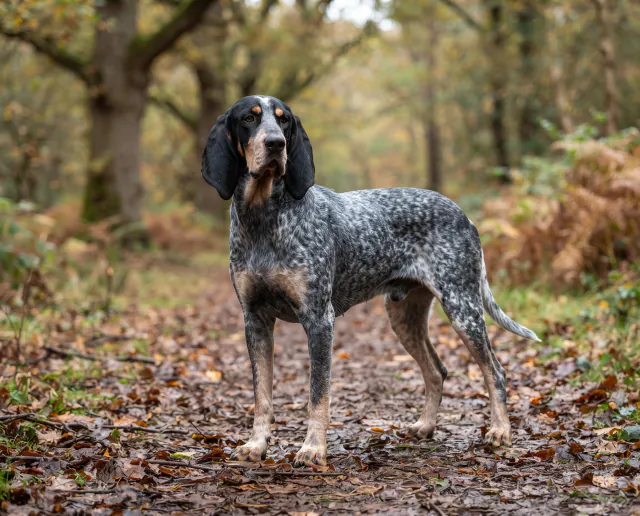
The Grand Bleu de Gascogne is a hound of the old French kind, big, slow spoken and built for a long day’s work in the hills of Gascony. It hunted wolf and later boar and deer in packs, and its deep, ringing voice was bred so that hunters on foot could follow the pack through wooded country by sound alone. Standing 62 to 72cm and weighing about 35 to 40kg, it is one of the largest scent hounds in the world, and the mottled blue and black coat, long velvety ears and heavy dewlap give it a look that stops people in a park.
Almost nobody outside France has one. The breed is listed on the UK Kennel Club’s Imported Breed Register. Litters are very few, and buyers usually wait or import from France.
Suitability
Indoors the Grand Bleu is a calm, affectionate, rather lazy dog once exercised, happy to spread across a sofa or stretch along a hallway. It tolerates children patiently but is heavy enough to knock a small one flat by turning round. It is sociable with other dogs, as a pack hound should be, and usually settles with a cat it has grown up with, though anything that runs in a field is game. The voice is the awkward part. A bored or lonely Grand Bleu bays, and the sound carries a long way, which makes terraced housing, flats and close neighbours a poor fit. Being left alone for long periods suits the breed badly. Guarding is minimal; a stranger gets a solemn look and a wagging tail. Strength on the lead, a great deal of drool around water bowls and a coat that smells of hound are all part of the deal.
Exercise
An adult needs ninety minutes or more a day, best given as long, steady walks with plenty of time to use its nose, plus a run inside a secure field. Off-lead exercise in open country is unwise, since the dog will follow a deer line for miles and hear nothing. A long line and a harness that spreads the load are the usual answer. Puppies grow fast and large, so limit walks to short outings, avoid stairs and jumping, and let the dog sleep as much as it wants until it is at least a year old. The rules on keeping dogs under control near livestock apply with particular force to a hound this size.
Grooming
A rubber mitt run over the short dense coat once a week deals with moderate year-round shedding. The ears do most of the work. Long, low set and folded, they trap moisture and food, dragging through puddles and bowls, and need a weekly inspection and gentle cleaning to prevent infection. The loose skin around the mouth and the dewlap should be wiped after meals. Nails on a heavy dog that does no roadwork need regular trimming, and the feet should be checked after walks on wet ground.
Health
The breed is generally hardy, and ten to twelve years is a fair expectation for a hound this size. Hip dysplasia is the condition to ask about, so ask whether breeding dogs have been hip scored, under the BVA and Kennel Club scheme in Britain or the French equivalent for imported parents. Gastric torsion is a risk in any deep-chested large hound, so feed twice a day, avoid exercise around meals and know the signs. Ear infections are common where cleaning lapses. Drooping lower eyelids can trap debris and need an occasional look. Keep the dog lean; a Grand Bleu carrying extra weight loads its joints and shortens its life, and the loose skin makes fat easy to miss without feeling the ribs.
Choosing and training
Because so few are bred, the practical route is through the breed’s enthusiasts, whose contact details the UK Kennel Club holds for breeds on its Imported Breed Register. Expect to wait, to travel, and possibly to bring a puppy in from France with the paperwork that involves. Insist on seeing the dam and, where possible, adult dogs living in a home. Training should start early and lean on food, because the breed is amiable but not eager to please in the gundog sense. Priorities are loose-lead walking taught while the puppy is small, a settle on a bed, standing for handling and a recall practised only where success is likely. Scent work suits these dogs perfectly and tires them far more than distance. A budget of £110 to £200 a month is a starting estimate; food for a 40kg dog, medication priced by weight and large-breed insurance premiums push it up. A large garden with tall, solid fencing and a car with a big boot are both needed.
Verdict
The Grand Bleu de Gascogne suits a rural or edge-of-town household with space, tolerant neighbours, previous experience of large hounds, and a taste for a dog that is rare, striking and quietly affectionate at home.
It is the wrong dog for a first-time owner, for anyone in a flat or terrace, for households out all day, or for people who need a dog that comes back when called. Anyone who simply likes the colour should meet an adult first and listen to it bay.