At a glance
Key facts
The essentials to compare before deciding whether this breed fits your home and routine.
- Size
- Large
- Lifespan
- 10 to 13 years
- Energy
- Medium to high
- Temperament
- Cheerful, boisterous, noisy and slow to mature
- Good with children
- Often good with older children who can cope with a boisterous hound
- Exercise
- 90 minutes to 2 hours a day plus swimming where possible
- Trainability
- Moderate
- Grooming
- Thorough weekly brushing plus regular brushing of beard and ears
- Estimated monthly cost, GBP
- £110 to £200 per month
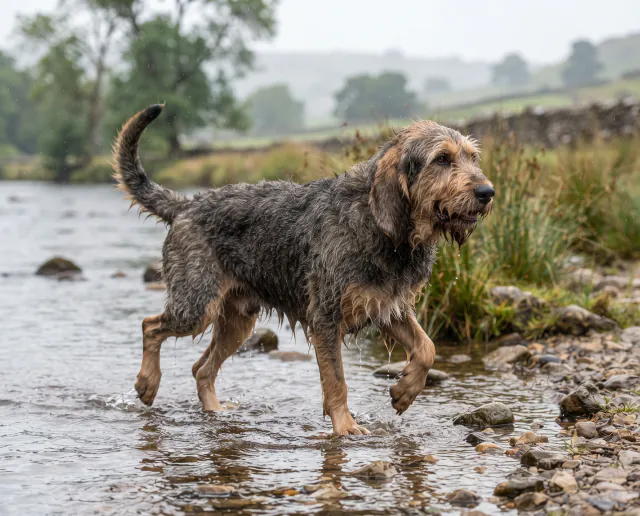
Wet, muddy and singing about it: that is an Otterhound coming out of a river, and it is the picture to hold in mind before falling for a shaggy puppy. The breed is one of the oldest British scent hounds and one of the rarest of the native breeds, with very few litters registered in any year. It was bred to hunt otters along rivers in packs, working the banks and the water with a deep, carrying voice. Otter hunting was banned in 1978, the packs dispersed and the breed has been kept alive by a small group of enthusiasts ever since.
What remains is a big, rough-coated hound, 60 to 69cm at the shoulder and anywhere from 30 to 50kg, with webbed feet, a nose that overrides everything else and an affectionate, easy-going nature that owners defend fiercely.
Temperament in the home
Otterhounds are cheerful, boisterous and slow to mature, with a puppyhood that can run to three years. They are friendly with people, usually good with other dogs after a life bred for pack work, and mostly tolerant of children, though a hound of this size in high spirits will send a small child flying with no ill intent. Their voice is the first thing neighbours notice. Otterhounds bay rather than bark, the sound carries across a valley and they use it when excited, when bored and sometimes for no reason an owner can identify. Water is irresistible, and any pond, puddle or trough on a walk will be entered, after which the beard and the coat carry it home. Small pets are not safe. The breed is not clingy and copes with reasonable periods alone better than many, provided it has been walked first.
Exercise and training
A fit adult needs an hour and a half to two hours a day and will keep going long after the owner has had enough. Scent hounds walk with their heads down and their attention elsewhere, so a lead or a long line is the norm anywhere with roads or livestock, and the recall on a hound that has struck a line is largely theoretical. Somewhere secure to run and, ideally, swim is the real need. Puppies grow into heavy dogs and should not be over-exercised while the joints are forming. Training works when the dog can see the point and there is food involved; it does not work as a contest of wills. Loose-lead walking is the priority, since a 45kg hound that pulls towards a river is a genuine hazard to an older or smaller handler. Scent work, tracking and mantrailing give the breed a legal outlet for what it was bred to do and settle it more than any amount of ball throwing.
Coat and grooming
The coat is rough, dense and slightly oily, three to six centimetres long over a woolly undercoat, and it is designed to shed water rather than to look tidy. A thorough weekly brush with a slicker and a comb through to the skin keeps it free of mats, with regular brushing of the beard, ears and feathering between times because that is where mud, food and burrs collect. Clipping is not recommended, since the harsh outer coat protects the dog and grows back softer. The long, heavy ears trap moisture and need checking and cleaning every week, and a dog that swims will need it more often. Shedding is moderate, though the hair that comes out is long and tangles in carpet. Baths are occasional and best done outside; the coat’s natural oil is part of its function and washing it away too often defeats the point.
Health and lifespan
Ten to thirteen years is typical. The best-documented breed-specific problem is Glanzmann’s thrombasthenia, an inherited bleeding disorder for which a DNA test exists, and any UK breeder should show results for both parents. Hip and elbow dysplasia are recognised, so BVA and Kennel Club hip and elbow scores are the second thing to ask for. As a deep-chested breed the Otterhound is at risk of bloat and torsion of the stomach, and owners should know the signs and feed sensibly rather than in one large meal. Ear infections are the routine complaint. Weight creeps on under a rough coat, so the dog should be felt for ribs rather than judged by eye.
Costs and space
Running an Otterhound costs about £110 to £200 a month across food for a large dog, insurance, routine veterinary care and grooming, with the top of the range reached quickly if a groomer does the coat. Space is a serious question. A flat or a small terraced house with a tiny yard is not workable for a wet, muddy, loud hound of this size, and a secure garden with a fence the dog cannot climb or bulldoze is a basic requirement. Finding one is the real difficulty. Litters are few, buyers wait, and the Otterhound Club is where anyone serious should begin, both to be assessed as a suitable home and to be placed on a list.
Verdict
The Otterhound suits an experienced, outdoors household with room, a tolerance for noise and mud, patience with a slow-maturing dog, and an interest in scent work or hill walking. Owners who go through the breed club and wait for a puppy usually know exactly what they are taking on.
A tidy house, close neighbours, a garden without a serious fence or a wish for reliable off-lead walking all point elsewhere. The breed is rare because it demands a particular kind of owner, not because it is a poor dog.