At a glance
Key facts
The essentials to compare before deciding whether this breed fits your home and routine.
- Size
- Medium
- Lifespan
- 11 to 14 years
- Energy
- High
- Temperament
- Friendly, even, vocal and driven by scent
- Good with children
- Usually very good with children, being tolerant and easygoing
- Exercise
- Around 90 minutes a day including a proper run
- Trainability
- Moderate
- Grooming
- Weekly brushing with moderate year-round shedding
- Estimated monthly cost, GBP
- £90 to £155 per month
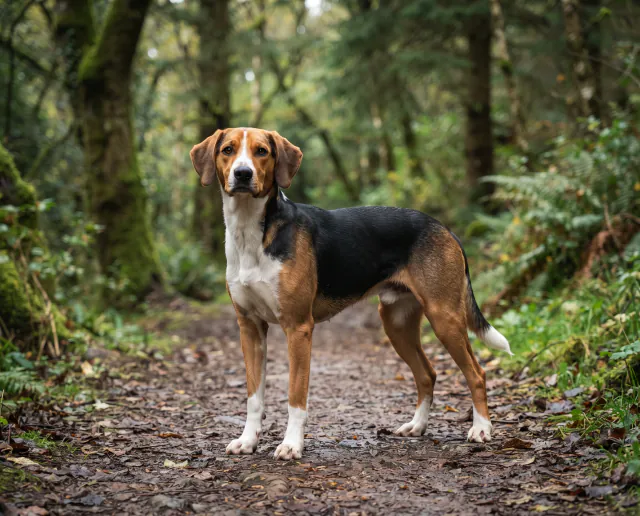
The Hamiltonstovare was put together in Sweden in the late nineteenth century by Count Adolf Patrick Hamilton, who founded the Swedish Kennel Club and wanted a hound that would work alone through the forest on hare and fox, giving voice so the hunter could follow. He blended English Foxhound and Harrier with German and Baltic hounds, and the result is a handsome tricolour of 49 to 61cm and about 23 to 27kg that looks like a lighter, longer-legged Foxhound. Because it hunts singly rather than in a pack, it settles into a family home rather better than the pack hounds do, and the Hamiltonstovare is one of the more practical scent hounds for a British pet owner willing to look for one.
Living with the breed
Hamiltons are friendly, even-tempered and tolerant, and most are calm in the house once exercised. They are affectionate without being clingy, sociable with other dogs and generally good with children, whose games they join with patience. Strangers get a polite welcome; there is no guarding instinct to speak of. The voice is a real part of the breed, since a hound bred to signal its whereabouts across a forest has a loud, musical bay, but a Hamilton that is neither bored nor lonely uses it far less than a pack hound would. Cats are possible with an early introduction, while rabbits and other small pets are not. Being left alone all day does not suit the breed. Some will counter-surf and most will steal food if given the chance.
Daily exercise
About ninety minutes a day, including a proper run, keeps an adult in good order. These dogs were bred to cover many miles of forest on a hunting day and have the stamina to match. Free running is safe only inside a secure boundary or a hired field, because a Hamilton that finds a hare line will follow it for a long way and return in its own time. A long line on a harness gives freedom in open country without the risk. Puppies should have short outings and no forced exercise, stairs or jumping until well into their second year. Around sheep, cattle and pheasant release pens the dog goes on the lead, whatever its recall looks like at home.
Training and mental work
The breed is intelligent and reasonably keen to cooperate, which is unusual among scent hounds, but attention evaporates when a scent arrives. Short, upbeat, food-based sessions from puppyhood build a dog that walks on a loose lead, settles on its bed and comes back in a field where nothing better is on offer. Recall in woodland with deer is never going to be certain, and owners who accept that early are the ones who stay relaxed. Tracking, mantrailing and scent detection classes are the natural outlets and tire the dog far more than distance. Harsh handling is unnecessary and counterproductive with a soft-natured hound.
Grooming and shedding
The coat is short, dense and weather resistant with an undercoat that thickens in winter, and it sheds moderately all year with heavier drops in spring and autumn. A weekly brush with a rubber mitt or hound glove is enough, and the tricolour pattern of black saddle, tan and white markings needs no trimming. Drop ears should be checked and cleaned weekly. Nails need regular trimming on a dog that mostly walks on grass. Baths are rare; a wipe down after a muddy walk is usually all that is needed.
Health and costs
Eleven to fourteen years is a reasonable expectation, and the breed is generally sound. Hip scores for both parents, whether through the BVA and Kennel Club scheme or a Scandinavian one, are the first thing to ask for, since hip dysplasia is the condition most associated with the breed. Drop ears mean occasional ear infections. Weight creeps on easily in a hound that is fed as if it were still hunting, and a lean dog lives longer. Somewhere between £90 and £155 a month covers most Hamiltons, with insurance the part that varies most; there is no grooming bill and a 25kg dog eats moderately. The breed is numerically small outside Sweden, with few litters in a typical year and some years none, so buyers usually wait, some dogs are imported from Sweden or Norway, and the breed club is the sensible first contact. A garden with 1.8 metre fencing is realistic because these dogs jump well.
Verdict
The Hamiltonstovare suits an active family or couple with a securely fenced garden who want a handsome, good-natured scent hound that lives comfortably in a house and will take up scent sports or long hill walks.
It is a poor choice for anyone in a flat, for households out all day, for people who need reliable off-lead recall in woodland, or for buyers who want a puppy within a few weeks rather than a year.