At a glance
Key facts
The essentials to compare before deciding whether this breed fits your home and routine.
- Size
- Medium
- Lifespan
- 12 to 14 years
- Energy
- Very high
- Temperament
- Gentle and quiet indoors, tireless and single minded outside
- Good with children
- Generally gentle with children, given proper exercise
- Exercise
- Two hours or more daily, with secure space for free running
- Trainability
- Experienced handler
- Grooming
- A weekly brush, or hand stripping for the wire-coated variety
- Estimated monthly cost, GBP
- £80 to £140 per month
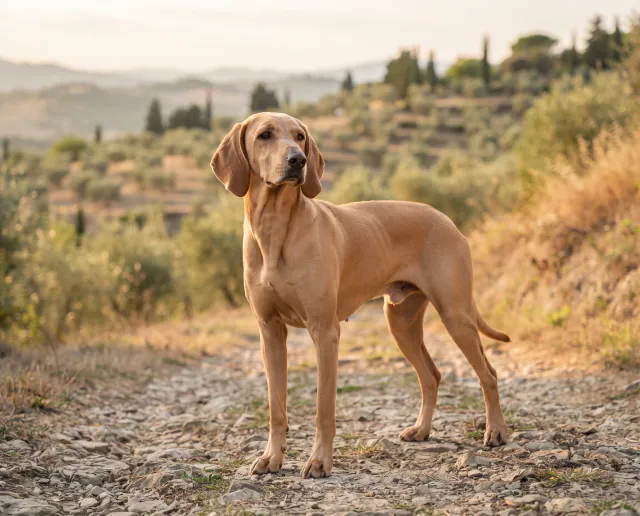
The Segugio Italiano is one of the older working scent hound types still bred largely for its original job. In its homeland it is a common hunting dog, worked singly or in small groups on hare, and it is far less familiar elsewhere. Owners describe the same contrast: a quiet, gentle, almost self-effacing dog in the house, and a driven, hard-to-stop animal the moment it finds a line worth following.
Origin and purpose
Italian scent hounds of this type appear in art and hunting literature over many centuries, and the modern breed was consolidated from regional hunting stock. The task shaped everything. A Segugio finds the overnight trail of a hare, unravels it patiently, drives the hare in a wide circle and gives tongue continuously so the hunter can follow the chase by ear across broken hill country, which demands stamina, a fine nose, independent judgement and a loud voice. Two coat varieties developed, short-coated and wire-coated, and the international governing body now treats them as separate breeds.
Temperament and behaviour
A well-exercised Segugio is calm, quiet, affectionate with its household and content to sleep for long stretches, gentle rather than exuberant. Outdoors, a different animal takes over. The nose dominates, and a hound working a trail will keep going a long way, giving voice the whole while. That voice is deep, resonant and built to carry across a valley, which makes it a real issue in built-up areas. Boredom produces roaming, digging and barking. Segugi are also sensitive, and respond badly to shouting and harsh handling.
Family life and other animals
The breed is tolerant, gentle with children and not prone to guarding, though a hound short of exercise is restless company for anyone. Other dogs are usually welcome, since these hounds were bred to work in small groups. Cats and small pets are the weak point, because the hunting instinct is strong and small fast animals trigger it reliably. A resident cat introduced from puppyhood sometimes works, but nothing should be assumed. A first-time owner would find this a demanding starting point, given the exercise load, the escape risk and the recall problem.
Exercise and mental stimulation
Two hours a day is a working minimum, including real free running rather than lead walking alone. Undersupplying exercise is the root of nearly every behaviour problem in the breed. Free running belongs in fenced ground or on a long line, because a Segugio that picks up a scent will not respond to a recall and can travel a long way before it stops. Garden fencing should be around 1.8 metres and solid at the base. Mental work should use the nose, and tracking, laid trails, scatter feeding and food puzzles suit the breed far better than obedience drilling.
Training
Training a Segugio calls for patience and a light hand. They are intelligent and quick to learn, but they were selected to make decisions at a distance, and they apply that judgement to training. Reward-based methods with food and praise work; correction and confrontation produce a shut-down dog rather than a compliant one. Set realistic goals. A loose lead, a settle on cue and a recall that works in quiet places are achievable. A recall that works over a live scent is not, and a sensible owner keeps the lead on where it matters. Steadiness around livestock is essential in rural areas, and loose dogs among sheep carry legal consequences in many countries.
Coat, grooming and shedding
The short-coated variety needs a weekly rub with a rubber mitt and no more. The wire-coated variety has a harsh outer coat, roughly five centimetres long, needing regular brushing and periodic hand stripping to keep its texture. Colours are solid fawn in various shades and black and tan, often with limited white. Both varieties shed moderately and steadily. The long drop ears need weekly checking, since they trap moisture and are a common site of infection. Nails need regular trimming.
Size, lifespan and health
Adults typically stand 48 to 59 cm (19 to 23 in) at the withers and weigh 18 to 28 kg (40 to 62 lb), with males at the upper end of both ranges and a light, square, athletic build. Twelve to fourteen years is a fair expectation, and generations of selection on hunting ability have kept the breed comparatively sound. Hip dysplasia is the main structural concern, and hip scoring of breeding stock is the recognised screening route, with eye examination also worth asking about. Ear infections are frequent, given the ear shape and the time these dogs spend in undergrowth, and working hounds pick up cuts, thorns and grass seeds. Any hereditary concern, and the interpretation of any screening result, should be discussed with a vet, and buyers should ask what testing has been done.
Living costs, space and time alone
Roughly £80 to £140 a month is a reasonable estimate, with food and insurance making up most of it and grooming adding a modest amount for the wire-coated variety. A flat is not workable, and the breed does best in rural or semi-rural homes with access to open country. Time alone is limited. A hound bred to work in company and to give tongue when excited is not the dog to leave through a full working day, and neighbours will hear the result. The breed is also uncommon outside Italy, so buyers often wait or import.
Verdict
The Segugio Italiano suits an active owner in the countryside who walks or runs for hours in most weathers, has secure ground and is interested in scent work rather than obedience competition. In the right home it is a gentle, quiet housemate.
It suits nobody who is out at work all day, who lives in a flat or a dense street, who has small pets, or who wants a dog that can be trusted off lead in open country. Underexercised, it becomes noisy and destructive, and that outcome is predictable.