At a glance
Key facts
The essentials to compare before deciding whether this breed fits your home and routine.
- Size
- Medium
- Lifespan
- 12 to 14 years
- Energy
- Very high
- Temperament
- Affectionate, sensitive, clingy and tireless outdoors
- Good with children
- Usually very good with active families who include the dog in everything
- Exercise
- 2 hours a day plus scent work and off-lead running
- Trainability
- Beginner friendly
- Grooming
- Weekly brushing with occasional hand stripping and light shedding
- Estimated monthly cost, GBP
- £95 to £165 per month
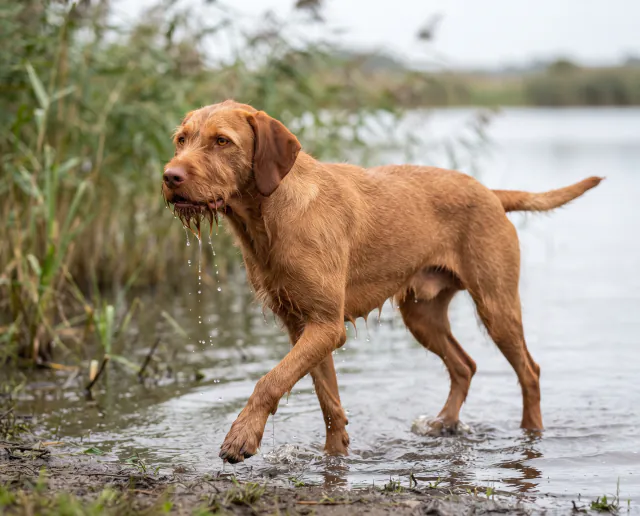
People often assume the Wirehaired Vizsla is a coat variety of the smooth Hungarian Vizsla, the way a Dachshund comes in three coats. It is not. The Kennel Club registers it as a separate breed, and the two are not interbred. The wirehaired dog was created in Hungary in the 1930s by crossing smooth Vizslas with German Wirehaired Pointers, with the aim of producing a rougher, heavier-boned dog that could work in cold water and thick cover through a Hungarian winter, and the result carries a somewhat different character alongside the different coat.
The temperament is still unmistakably Vizsla, affectionate to the point of clinginess and thoroughly wedded to its people, but many who have owned both describe the wirehaired dog as a shade calmer and less highly strung. It is still a hunt, point and retrieve dog with enormous energy and a nose that never switches off. The breed sits in the gundog group and remains uncommon here, with far fewer registered each year than the smooth.
Suitability
Wirehaired Vizslas want to be with their people all day, and shadowing an owner from room to room is normal. Long hours alone produce a bored, vocal and often destructive dog, so households where someone works from home or the dog can come along suit the breed far better than a routine of full days in an empty house. They are sociable with other dogs, tend to be good with cats they have grown up with, and are usually gentle with children, though an excited young dog is strong enough to knock a small child flat. The breed is not much of a guard. It barks at a visitor and then fetches a shoe. A raised voice affects a Vizsla out of all proportion, and a noisy, shouting household is a poor place for one.
Exercise
Two hours a day is a fair baseline for an adult, and it needs to be real exercise rather than a lead walk around the block. Free running in fields or woodland, swimming, canicross and long days on the hills are what the breed was built for, and a Wirehaired Vizsla that gets them is a calm dog at home. One that does not is a nuisance. The wire coat makes the breed better suited to a British winter than the smooth, and most are keen swimmers, which helps on the Norfolk Broads, in reservoirs or in the sea. Puppies should not be run for miles. Keep outings short and frequent until around twelve months. Recall needs consistent work, since the dog hunts with its head up and will range, but the Vizsla’s wish to stay near its people makes this easier than in most pointing breeds.
Grooming
The coat is dense, harsh and close-lying, with a pronounced beard and eyebrows, and it should feel wiry rather than soft. It sheds lightly and needs a weekly brush with a slicker or a rubber curry to lift dead hair, and a hand strip once or twice a year to keep it harsh and weatherproof. Some owners do this themselves; others use a groomer who works wire coats. The coat should never be clipped, which softens it and spoils its function. The beard traps water, food and mud and drips across the kitchen floor after every drink. The drop ears benefit from a weekly check, especially in a dog that swims.
Health
The breed is generally sound, with twelve to fourteen years typical. Hip dysplasia is recorded and hip scoring under the BVA and Kennel Club scheme is expected of breeding stock. Eye conditions including inturned or outturned eyelids occur, and breeding dogs should have a current certificate under the BVA and Kennel Club eye scheme. A DNA test for hyperuricosuria, an inherited tendency to form urate bladder stones, is used in the breed, and a buyer should ask for results for both parents. Deep-chested gundogs are at some risk of gastric torsion, and knowing the signs is wise. Weight is rarely a problem in a properly exercised Vizsla, but the breed can carry too little rather than too much if fed from a standard chart during heavy work.
Choosing and training
Litters are limited in most countries, and the sensible first step is the breed club, which keeps a list of breeders and can advise on waiting times. Some dogs are imported from Hungary and other European countries, and buyers should see health results from the country of origin. Price is not the measure of a good breeder; access to the mother, a clean home environment and honest talk about the breed’s demands are. Training is a pleasure with this breed as long as it stays kind. Wirehaired Vizslas are quick, eager to please and hold a grudge against rough handling. Gundog classes, scent work and agility all channel the energy usefully. Socialise widely, because a sensitive dog left under-exposed can become worried about the world.
Verdict
The Hungarian Wirehaired Vizsla suits active owners who are around for most of the day, enjoy long outdoor days in any weather and want a dog that is involved in everything they do. Shooting people, runners and walkers with a settled routine do well with the breed.
It is not a match for a household out at work all day, for anyone hoping for an independent dog, or for a home that cannot provide two hours of proper exercise every day of the year. The clingy nature comes with the breed, and buyers who find that wearing should look at a less people-focused dog.