
At a glance
Key facts
The essentials to compare before deciding whether this breed fits your home and routine.
- Size
- Large
- Lifespan
- 12 to 14 years
- Energy
- High
- Temperament
- Gentle, eager, people-oriented and steady
- Good with children
- Usually very good with children in an active household
- Exercise
- 1.5 to 2 hours a day with a chance to hunt about off lead
- Trainability
- Beginner friendly
- Grooming
- Weekly brushing with hand stripping a few times a year and light shedding
- Estimated monthly cost, GBP
- £100 to £175 per month
Eduard Korthals set out in the 1870s to build a rough-coated pointing dog that could work any ground in any weather, and the griffon that carries his name was the result. He was Dutch, spent much of his working life in Germany, and drew on a variety of continental griffons and pointing breeds to fix the type. France later adopted the breed as its own, which is why it is sometimes called the French Wirehaired Pointing Griffon. In Britain the Kennel Club lists it on the Imported Breed Register, and it remains one of the rarest gundogs in the country.
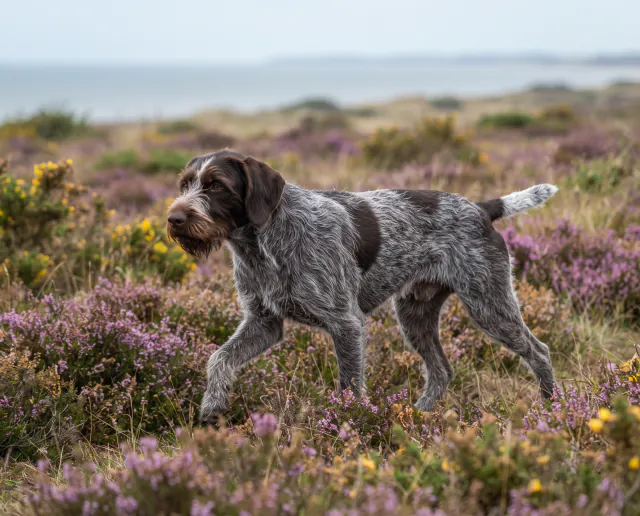
Buyers who track one down get a dog of solid medium to large size with a harsh, rough coat in steel grey and brown, a beard and moustache, a soft expression and an unusually gentle nature for a pointing breed. It works in a steady, thorough style close to the handler, which suits rough shooting over hedgerows and reed beds and translates into a dog that is easier to keep in touch with than many hunt, point and retrieve breeds.
Suitability
The Griffon is a people dog, affectionate, biddable and inclined to stick close. It is not clingy in the way a Vizsla can be, but it does not enjoy being left, and a home where the dog spends all day alone is the wrong home. Most are gentle with children and tolerant of other dogs, and many live with cats. Guarding runs to an alerting bark. Sensitivity is marked, and a Griffon told off harshly withdraws rather than pushing back. The breed is happiest in a household that walks, rides, shoots or otherwise spends its days outdoors and takes the dog along. It is not a first dog for someone who has never trained a gundog, but it is one of the more forgiving of the pointing breeds for a committed novice.
Exercise
An adult wants between an hour and a half and two hours of exercise daily, a good part of it off lead with a chance to hunt through cover, cast across a field and investigate ditches. The breed is not a runner in the Weimaraner sense and prefers to work ground thoroughly rather than fast, so a Griffon on a Suffolk heath will trot and quarter while the owner walks. Swimming is enjoyed and the coat copes with cold water. Recall is generally good because the dog wants to stay in touch, but a scent still pulls it off a path and early training pays. Puppies need short, frequent outings and no forced exercise until around twelve months, with the usual caution about stairs, jumping and slippery floors for a growing dog.
Grooming
The correct coat is harsh, coarse and straight, never curly or woolly, over a dense undercoat that keeps water off the skin. It sheds lightly. A weekly brush through with a slicker and a comb keeps it tidy, and hand stripping two or three times a year removes dead outer coat and preserves the texture. Clipping ruins the coat’s function and should be avoided. The beard holds water and picks up food; the eyebrows and ears need combing, and the ear canals, well protected by hair, are a common site of infection and should be checked weekly. Grass seeds lodge in the coat in summer. A groomer familiar with wire-coated gundogs is a help but not a requirement, and many owners learn to strip the coat themselves.
Health
The breed is generally healthy, with twelve to fourteen years typical. Hip dysplasia is recognised, and hip scoring under the BVA and Kennel Club scheme should be asked for; with imported dogs, buyers should see the equivalent results from the country of origin. Eye conditions occur as they do across the pointing breeds, and breeding dogs should have a current certificate under the BVA and Kennel Club eye scheme or its foreign equivalent. Ear infections are the most common everyday complaint in a drop-eared, wire-coated dog that swims. Bloat is a risk in any deep-chested breed. Weight is rarely a problem in a Griffon that works, but a pet dog on an unadjusted diet will thicken quickly. The breed club can advise on which tests are currently recommended.
Choosing and training
Litters are few and irregular in most countries, and most buyers wait, sometimes for more than a year. Some dogs are imported from France, the Netherlands and elsewhere in Europe, which adds paperwork, travel and cost, and buyers should take advice on health testing and on the import rules before committing. The breed club is the sensible first contact and keeps a list of breeders and expected litters. Training goes well when it is kind and consistent. The breed is quick to learn, keen to please and remembers a rough hand. Reward-based gundog classes, scent work and steady recall training from the first week are the foundations. Socialise carefully, because a sensitive dog left under-exposed can become worried, and the beard and grey coat draw comments and hands from strangers.
Verdict
The Korthals Griffon suits an outdoor household that wants a gentle, close-working, weatherproof gundog, is prepared to wait for a puppy and would rather have a dog that stays in touch than one that covers the county.
It is a poor match for a home where the dog is alone all day, for anyone who wants a dog quickly, or for owners who cannot give an hour and a half of real exercise every day. Meeting a few adults through the breed club is the sensible first step.