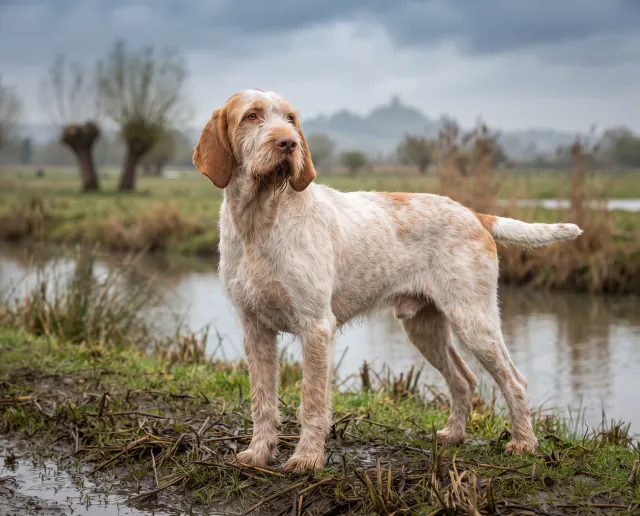
Also known as: Spinone Italiano.
At a glance
Key facts
The essentials to compare before deciding whether this breed fits your home and routine.
- Size
- Large
- Lifespan
- 10 to 12 years
- Energy
- Medium
- Temperament
- Patient, sociable, slow-paced and quietly stubborn
- Good with children
- Usually very good with children who accept drool and a wet beard
- Exercise
- About 1.5 hours a day at a steady trot rather than a sprint
- Trainability
- Moderate
- Grooming
- Weekly brushing with hand stripping a few times a year, plus beard washing
- Estimated monthly cost, GBP
- £115 to £195 per month
Watch an Italian Spinone work a hedge line and the first surprise is the pace. It trots. Where a pointer sprints across a field and a spaniel bustles through cover, the Spinone moves at a steady, economical trot it can hold all day, nose down, beard dripping, in and out of ditches and reed beds. The breed comes from the Piedmont region of northern Italy, where it was kept as an all-purpose hunting dog for marsh and mountain, finding, pointing and retrieving game in cold water and thorn scrub that would strip a smooth-coated dog.
That working style translates directly into the sort of dog it is in a house. Spinoni are patient, sociable, slow-moving and hard to hurry. They are also large, wet-bearded, prone to drool and quite capable of deciding a request is not worth acting on.
Living with the breed
A Spinone in the house is a gentle, affectionate and rather clumsy presence that likes to lean on people and lie across doorways. Most are easy with children, other dogs and visiting adults, and guarding is limited to a deep bark when someone arrives. The beard is the practical issue. It soaks up water at every drink and deposits it across the floor, and it collects food. Drool follows any excitement, and a shaken head sends it a surprising distance. Separation is tolerated moderately by a mature, exercised dog, but a young Spinone alone all day will chew, and the breed is people-oriented enough to be genuinely unhappy in an empty house. Cats can be fine if introduced early. Poultry are not, and rabbits in the garden should expect a point followed by a lumbering chase.
Daily exercise
Roughly an hour and a half a day of steady exercise suits an adult, ideally with a good part of it off lead where the dog can trot, hunt and cast about. The breed does not need to gallop and will not do so for long, but it does need to cover ground and use its nose, and lead-only walking makes for a frustrated dog. Spinoni enjoy water and will wade through any ditch, pond or estuary mud they find, which has consequences for the car. Recall is generally better than in faster pointing breeds because the dog stays within reach. Puppies grow slowly; short walks, no stairs and no jumping in and out of cars until around eighteen months. Overweight Spinoni are common because the dog is easy to overfeed and slow to burn it off.
Training and mental work
The breed is intelligent and willing but has an independent streak that owners of Labradors find startling. A Spinone asked to do something considers it first. Reward-based training with plenty of food and a calm, patient handler produces a reliable dog; force produces a dog that lies down and declines. Sessions should be short and end while the dog is still interested. Scent work is the natural outlet, and even a pet Spinone benefits from hunting for a hidden dummy or working through a scent detection class. Adolescence is long, and the dog may not settle mentally until three. Socialisation is straightforward since most are easy-going, though the size and beard can worry people.
Grooming and shedding
The coat is harsh, dense and single, about four to six centimetres long, with a pronounced beard, moustache and eyebrows and a rough, unkempt look that is correct for the breed. It sheds lightly to moderately. A weekly brush with a slicker or pin brush removes dead hair and debris, and hand stripping two or three times a year keeps the texture harsh and the coat weatherproof. Clipping softens the coat and should be avoided except for tidying feet and ears. The beard needs washing after meals and drying after drinks, and it develops a smell if neglected. The drop ears with their heavy hair trap moisture and are a common site of infection in a dog that swims. Grass seeds in summer lodge in the beard, ears and feet. Some owners use a groomer who knows wire coats; others manage at home.
Health and costs
Hip scoring under the BVA and Kennel Club scheme matters in a breed this heavy, and elbow scores are useful too. A DNA test exists for cerebellar ataxia, a progressive condition that affects puppies of the breed, and both parents should have results. Eyelid problems, both entropion and ectropion, occur with the loose skin of the head, so breeding dogs should have current eye certificates. Bloat is a risk in a deep-chested dog and every owner should know the signs and act immediately. Lifespan is typically ten to twelve years. Running costs across food, insurance, routine care and coat maintenance sit in the region of £115 to £195 a month, with the top end for professional grooming and full insurance. Spinoni are established in most countries with active breed clubs and a steady trickle of litters, but buyers should expect to wait and to travel, and the club is the place to start for puppies and rehoming alike.
Verdict
The Italian Spinone suits a household that wants a big, gentle, slow-paced gundog for long walks in all weather, does not mind drool, wet beards and mud, and has the patience to train a dog that likes to think first.
It is a poor fit for an immaculate house, a small flat without countryside nearby, or an owner who wants a quick, obedient dog. Anyone sensitive to slobber should meet an adult Spinone straight after a drink of water before deciding.