At a glance
Key facts
The essentials to compare before deciding whether this breed fits your home and routine.
- Size
- Large
- Lifespan
- 12 to 14 years
- Energy
- High
- Temperament
- Willing, gentle and strongly bonded to its handler
- Good with children
- Often good with children in an active household
- Exercise
- Around 2 hours a day with free running and scent work
- Trainability
- Beginner friendly
- Grooming
- Weekly brushing and hand stripping of the harsh coat, with light shedding
- Estimated monthly cost, GBP
- £100 to £170 per month
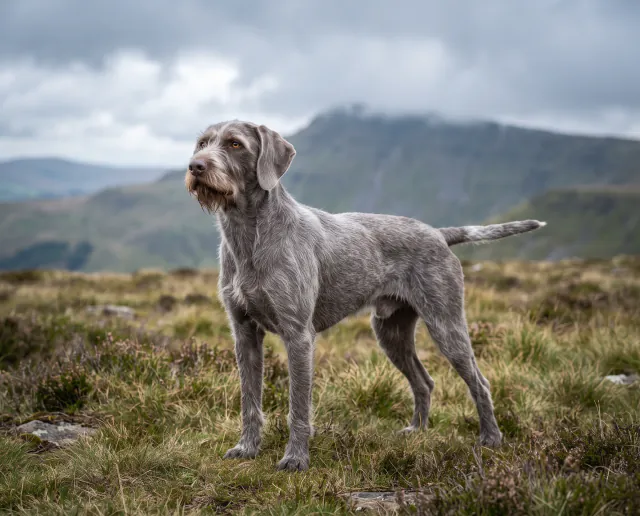
Few gundog breeds have as tidy a pedigree as the Slovakian Rough Haired Pointer. It was created in Slovakia in the years after the Second World War by crossing the Weimaraner with the Cesky Fousek and later the German Wirehaired Pointer, with the aim of producing an all-round hunt, point and retrieve dog for the forests, fields and marshes of central Europe that would work in rough weather over rough ground. The Weimaraner gave it the grey coat and the amber eyes; the wire-haired breeds gave it the harsh jacket, the beard and the eyebrows.
The first dogs reached Britain in the late 1990s, and the breed sits on the Kennel Club’s Imported Breed Register with a small but organised following, most of it in working homes. Litters are few, a good proportion of breeding stock is imported, and the breed club is the only realistic route to a puppy.
Living with the breed
Indoors the breed is gentle, affectionate and often quieter than its size and its drive suggest, provided the exercise has happened. These dogs bond strongly to one or two people and follow them about, and they dislike being left for long, with separation problems common in dogs expected to spend the day alone. Children in the family are generally well treated, and the breed’s soft temperament makes it patient, though an adolescent of 30kg with a wagging tail at table height is hard on toddlers and ornaments. Prey drive is high, as in any HPR breed, and cats are workable only with early and careful introduction; rabbits and poultry are not safe. The beard drips water across the floor after every drink, and the harsh coat carries mud in from the garden.
Daily exercise
Two hours a day of proper exercise keeps an adult content, and it needs to be varied. Free running on open ground, scent work, retrieving from water and long walks over hills all suit the breed, which was bred to cover ground for hours in cold, wet conditions and does not mind British weather. Recall must be built early and maintained, because a working HPR that hits scent ranges out fast, and near livestock the lead stays on. Puppies grow into big, athletic adults and need the opposite regime, with short, frequent outings and free play on soft ground until at least twelve months, and no road running or repeated jumping.
Training and mental work
These dogs want to work with a handler, and that willingness makes them easier to train than some of the more independent pointing breeds. They are sensitive, and heavy-handed correction produces a worried dog that stops offering behaviour, so reward-based methods, consistency and short sessions are the approach. Gundog training is the natural fit, and the breed club runs working tests and training days that welcome newcomers, but scent work, tracking, canicross and working trials all serve the same purpose in homes that never go shooting. A dog bred to find, point, flush, retrieve and track needs a job that uses those instincts, and a bored one finds substitutes.
Grooming and shedding
The coat is the breed’s most distinctive feature after the colour. It is a harsh, close, weatherproof jacket about 4cm long over a dense undercoat, with a pronounced beard, moustache and eyebrows, in a grey that ranges from pale silver to a darker mousy shade, sometimes with a brownish cast. The face and ears carry shorter hair. A weekly brush with a slicker or a firm bristle brush keeps the coat clean, and the dead hair should be hand stripped a few times a year to keep the jacket harsh, since clipping softens it and reduces its weather resistance. Shedding is light. The beard needs a wipe and a check for food and burrs, and ears set close to the head should be looked at weekly for the redness and smell that signal infection, especially in a dog that swims.
Health and costs
Twelve to fourteen years is realistic. As a numerically small breed the Slovakian Rough Haired Pointer has no long list of documented disorders, and that should be read as limited data as much as good fortune. Hip dysplasia is the condition to ask about, and breeding stock should be scored under the BVA and Kennel Club hip scheme, with imported dogs carrying their equivalent overseas results. Eye examination under the BVA and Kennel Club eye scheme is a fair request too. As a deep-chested breed it can suffer gastric torsion, so feed two meals a day, avoid exercise straight after eating and learn the warning signs. Weight is rarely an issue in a dog exercised as it should be. Costs fall around £100 to £170 a month across food, insurance, routine veterinary care and stripping done at home or occasionally by a groomer who knows wire coats. A secure garden is essential, and the breed does best with easy access to open countryside.
Verdict
The Slovakian Rough Haired Pointer suits a working or seriously outdoor home, where someone is around most of the day and wants a gentle, biddable HPR to train for the field, for scent work or for a demanding country life. Owners with previous gundog experience and a taste for the breed club’s working tests get the best from it.
Anyone wanting a striking grey dog for suburban walks, or a pet that fits around a full-time job, should look elsewhere. Litters are scarce, the wait is long and the breed’s need for real work does not diminish because a home is comfortable.