At a glance
Key facts
The essentials to compare before deciding whether this breed fits your home and routine.
- Size
- Small
- Lifespan
- 12 to 14 years
- Energy
- Moderate
- Temperament
- Alert, agile, playful and thoroughly independent
- Good with children
- Better with older children who let a wary dog come to them
- Exercise
- About an hour a day across walks, climbing and play
- Trainability
- Experienced handler
- Grooming
- A weekly brush, with heavy moults twice a year
- Estimated monthly cost, GBP
- £70 to £130 per month
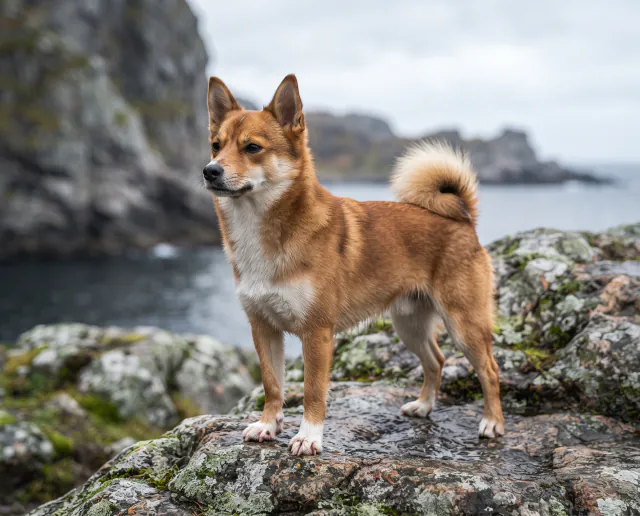
The Norwegian Lundehund is a small spitz built for a job that no longer exists. It hunted puffins on sea cliffs, working into narrow rock crevices to take birds alive, and its anatomy was shaped by that work in ways found in no other breed. It is rare almost everywhere, including in its homeland, where registrations are counted in dozens rather than hundreds.
Origin and purpose
The breed comes from the remote islands off the Norwegian coast, particularly Værøy in the Lofoten group, where puffin meat and feathers were part of the household economy for centuries. Dogs went out on the cliffs with their handlers, entered the nesting crevices and carried the birds back undamaged. Nets replaced dogs in the nineteenth century, and a dog tax removed most of the remainder. Numbers collapsed further around the Second World War, when distemper outbreaks reduced the entire breed to a handful of animals on Værøy. Norwegian enthusiasts rebuilt the population from those survivors, and everything alive today descends from them.
Temperament and behaviour
Lundehunds are cheerful, curious and busy, with the alertness typical of northern spitz breeds and an independence sharpened by generations of working out of sight of the handler. They attach strongly to their household and are reserved rather than effusive with strangers. They are agile beyond reason, climbing furniture, scaling fences and squeezing through gaps. They are vocal, announcing visitors, birds and anything else of interest. House training is notoriously slow, often taking many months.
Family life and other animals
They suit a calm household better than a busy one. With older children who let a dog be left in peace they are affectionate and playful, while very young children are too unpredictable for a breed that dislikes being grabbed. Other dogs are usually accepted, and many owners keep more than one. Small pets are not safe, since this remains a hunting dog, though cats can work if the dog is raised with them. This is not a breed for a first-time owner.
Exercise and mental stimulation
Physical needs are moderate, and around an hour a day suits most adults, better split between walks, climbing and play than delivered as a single route march. What the breed really needs is problem solving. They were bred to work out how to get into a rock crevice and out again, and apply the same thinking to cupboards, gates and fences. Puzzle feeders, scent games, trick training and low agility all suit them. Fencing must be secure top and bottom, because a Lundehund that decides to leave will climb, jump or dig.
Training
Training works best as a game, in short sessions. Lundehunds learn quickly and then decide independently whether the instruction is worth following, so motivation matters more than repetition. Food, play and variety hold attention; drilling and correction lose it. Recall is achievable in familiar places but not where there are birds, small animals or roads. House training deserves a structured routine, frequent trips outside and patience over many months, with no punishment for accidents. Early, gentle socialisation matters, because an undersocialised individual becomes shy rather than pushy.
Coat, grooming and shedding
The coat is a short, dense double coat with a harsh outer layer and a soft undercoat, usually reddish brown to fallow with black tips and white markings. Weekly brushing keeps it in order for most of the year, with an undercoat rake needed during the two heavy moults. The ears should be checked and cleaned regularly, since they fold closed. Nails need routine trimming, including on the extra toes.
Size, lifespan and health
Adults typically stand 32 to 38 cm (13 to 15 in) at the withers and weigh 6 to 9 kg (13 to 20 lb), with males at the larger end. Lundehunds carry at least six toes on each foot, with extra pads, giving grip on wet rock. The neck is flexible enough for the head to bend back over the shoulders, and the shoulder joints let the forelegs extend out to the sides, which let the dog turn in a narrow passage. Twelve to fourteen years is typical. The gene pool is extremely small, since every dog descends from a few post-war survivors, and Norwegian breed authorities have run a controlled outcross programme with other Nordic breeds since the 2010s to widen it. A group of digestive disorders is strongly associated with the breed, involving poor absorption and loss of protein through the intestine, and it can appear at any age. Signs may include weight loss, appetite changes and persistent digestive upset. It is usually managed rather than cured, through diet and long-term veterinary supervision, and prospective owners should discuss it with a vet before committing. Buyers should also ask breeders about eye testing, patellar assessment and the health history of the immediate family.
Living costs, space and time alone
A dog this size eats very little and grooming costs almost nothing, so a typical £70 to £130 a month is dominated by insurance and routine care. The digestive condition can push costs well above any average, and insurers may exclude it if signs appear before cover starts. Space needs are modest, and the breed lives comfortably in a small home or a flat. Time alone is moderate: they tolerate a few hours but become noisy and inventive when bored. Waiting lists are long in most countries and buyers often import.
Verdict
The Norwegian Lundehund suits a patient, experienced owner who wants a small, clever, quirky companion, who is prepared for a long house training project and has the capacity to manage a chronic health condition if it appears.
It is a poor choice for anyone wanting a straightforward small pet, a quiet dog, a fast learner or a breed that is easy to buy. Owners who take it on with clear eyes tend to find it fascinating; those drawn only by the six toes are usually unprepared for the rest.