At a glance
Key facts
The essentials to compare before deciding whether this breed fits your home and routine.
- Size
- Medium
- Lifespan
- 12 to 15 years
- Energy
- High
- Temperament
- Bold, vocal, independent and loyal to family
- Good with children
- Often good with children taught to respect a bold dog
- Exercise
- Around 90 minutes a day over rough ground
- Trainability
- Moderate
- Grooming
- Brush several times weekly, with heavy seasonal shedding
- Estimated monthly cost, GBP
- £85 to £150 per month
The elk in the name is a moose, and the job was to find one in Norwegian forest, hold it at bay by darting and barking, and keep barking until a hunter arrived on skis or on foot. That single sentence explains most of what a new owner discovers in the first month. The Norwegian Elkhound is loud by design, independent by design and built to work in cold, wet conditions all day without complaint.
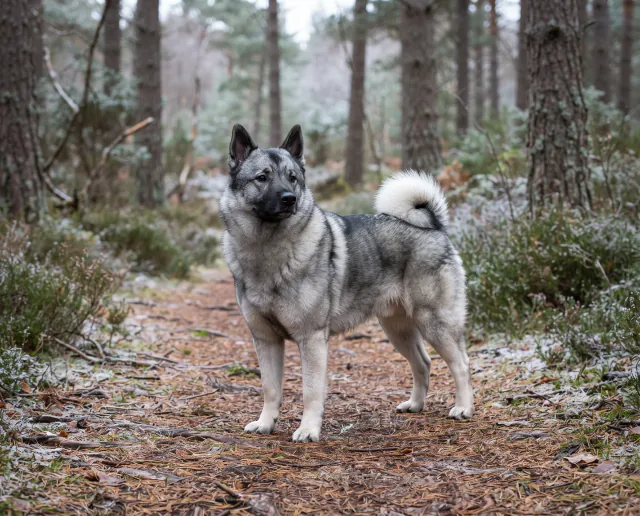
The breed is Norway’s national dog and one of the oldest spitz types in Europe, with the wedge head, prick ears, curled tail and thick grey coat that mark the group. It is medium sized, around 50cm at the shoulder and 20 to 25kg, but the coat and the confident bearing make it look bigger. In the UK it has a small but long-established following, and puppies are not hard to find with a little patience.
Suitability
Elkhounds are affectionate and steady with their own family, watchful with strangers and inclined to announce every arrival, delivery and passing cat at full volume. In a detached house with tolerant neighbours that is a feature. In a terrace or a flat it is a source of complaints, and owners who cannot manage the barking should think hard. The breed is bold rather than aggressive and generally friendly once introduced, though same-sex friction with other dogs is not unusual. Children are usually well tolerated, and the breed’s patience with rough handling is better than that of many working dogs, provided adults teach limits early. Small pets are at risk from a dog bred to chase and hold, and rabbits in the garden will be regarded as a job. Long hours alone produce a bored, noisy dog that digs.
Exercise
An adult needs a good hour and a half a day and will happily take more, with the emphasis on varied walking over rough ground rather than pavement circuits. Elkhounds are not fast but they have enormous stamina, and a weekend on the fells in Cumbria or the Peak District suits them better than any sports field. Off-lead reliability is patchy, because a scent will pull the dog into the trees and the breed’s job was specifically to keep going once it found something. A long line in open country is realistic for many. Heat is the limiting factor. Thick double coats and a summer afternoon in Surrey are a poor match, so walks in July and August move to early morning and evening. Puppies should have short outings only until their joints mature, since a heavy-boned spitz puppy is easy to overdo.
Grooming
The coat is the main daily reality. A thick, soft undercoat sits beneath harsh, straight grey guard hairs tipped with black, and twice a year the undercoat comes out in handfuls over two or three weeks. During those periods daily brushing with a rake and a slicker is needed to stay ahead of it, and the vacuum cleaner earns its keep. Between moults, a thorough brush two or three times a week is enough. The coat should never be clipped, since it insulates against heat as well as cold and grows back badly. It is largely self-cleaning and does not carry much odour, so baths are rare. Ears, nails and teeth need the usual attention.
Health
Elkhounds are generally robust and twelve to fifteen years is a fair expectation. Hip dysplasia is recognised, and both parents should have BVA and Kennel Club hip scores. Eye disease is the other area to ask about. Progressive retinal atrophy occurs in the breed and there is a DNA test for the form associated with it, and glaucoma is also reported, so an eye certificate under the BVA and Kennel Club scheme and DNA results for both parents are reasonable requests. Hypothyroidism is seen in middle-aged dogs and shows as weight gain, lethargy and a poor coat. The breed puts on weight very easily under a coat that hides it, and a spitz should feel like a dog under the fur, with a waist and ribs a hand can find. Skin cysts are common and usually harmless but should be checked.
Choosing and training
Training an Elkhound is an exercise in negotiation. The breed is intelligent, quick to learn and equally quick to decide that repetition is beneath it, so sessions should be short, rewarding and varied. Harsh handling produces stubbornness rather than compliance. Teach a reliable quiet cue from the first week and pay it well, because barking that has been rehearsed for a year is much harder to reduce. Socialise widely with other dogs while the puppy is small. The Norwegian Elkhound Club of Great Britain is the sensible first contact for breeders, and a good one will show hip scores, eye certificates and DNA results without being asked twice. Rescue Elkhounds turn up occasionally through breed rescue, often because the noise or the shedding defeated a first owner.
Verdict
The breed suits active, outdoorsy owners with a house rather than a flat, neighbours at a reasonable distance, and a tolerance for hair on every surface. Walkers who want a sturdy, weatherproof dog with character and a long life often find it a very good fit.
It is a poor choice for a quiet household, for anyone who wants an obedient dog, or for someone who cannot face two full coat changes a year. The barking, in particular, is not a training failure but the breed doing what it was made for.