At a glance
Key facts
The essentials to compare before deciding whether this breed fits your home and routine.
- Size
- Medium
- Lifespan
- 12 to 14 years
- Energy
- High
- Temperament
- Even-tempered, affectionate and reserved with strangers
- Good with children
- Often good with sensible children and normal supervision
- Exercise
- Upwards of 90 minutes a day with scent work
- Trainability
- Beginner friendly
- Grooming
- Weekly brushing with heavier seasonal shedding
- Estimated monthly cost, GBP
- £90 to £155 per month
Anyone searching for a Polish Hunting Dog outside Poland will spend more time waiting than choosing. The breed, known at home as the Gończy Polski, comes from the Carpathian foothills of southern Poland, where it was developed to track boar, deer and hare through steep forest and to tell the hunter exactly where it was by voice. It gained international recognition through the FCI only in this century and sits on the Kennel Club’s Imported Breed Register, which means it can be registered and shown but is not yet a fully recognised breed here.
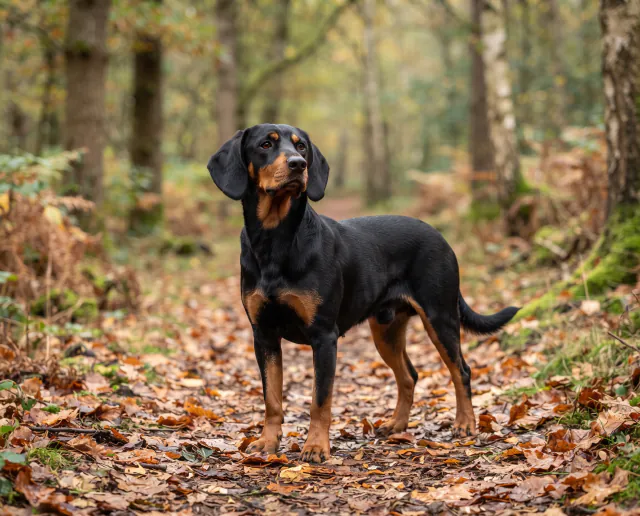
It is a compact, powerful scent hound of medium size, males around 55 to 59cm at the shoulder and bitches a little less, weighing roughly 25 to 30kg. The coat is short and dense, black with rich tan markings on the muzzle, legs and chest, and occasionally brown and tan. Long drop ears, a broad skull and a calm, direct expression give it a look somewhere between a Bloodhound and a heavier Beagle.
Suitability
At home the breed is affectionate, even-tempered and quieter than the hunting voice would suggest, though that voice still appears when something moves in the garden or a fox crosses the road at night. Polish Hunting Dogs bond closely with their family and can be reserved with strangers without being nervous, and early social contact with plenty of people keeps that reserve from hardening. Bred to work in company, most are easy with other dogs and settle well into a two-dog household. Children are usually treated gently, and a hound of this build is sturdy enough to cope with a busy family, with the usual rule that toddlers and dogs are never left together. Cats are a risk unless raised together, and anything that runs in a field will be followed. This is not a dog for long days alone, since boredom in a scent hound comes out as howling and digging.
Exercise
An adult needs upwards of an hour and a half a day and is happiest on rough ground where there is scent to work. Walking briskly through woodland in the Forest of Dean or along a Welsh valley is closer to its natural rhythm than a park. Recall against a hot trail is unreliable, and this is a breed whose whole purpose is to follow a line for as long as it takes, so a long line or a securely fenced field is the sensible default near roads and livestock. Tracking, mantrailing and scent work classes have grown across the UK and suit the breed exactly. Puppies should be built up gradually, with short outings and no forced running until the joints are mature. The coat copes well with cold, wet British winters and less well with a hot afternoon in July.
Grooming
The short, thick double coat needs a weekly brush with a bristle brush or rubber mitt, more during the spring and autumn moults when the undercoat comes out. Shedding is moderate through the year and heavier at the changes of season. The coat is weatherproof and does not hold much smell, so baths are occasional. The long ears need weekly checks and cleaning, since a hound that pushes through wet undergrowth collects debris and moisture in them. Nails, teeth and a check for ticks after woodland walks complete the routine.
Health
Because the breed is rare and recent, the documented health picture is thinner than for established hounds, and a buyer should treat that as a reason for caution rather than reassurance. Hip dysplasia is a concern in any hound of this build, and BVA and Kennel Club hip scoring of both parents is a reasonable request, as is an eye examination. Deep-chested dogs carry some risk of bloat, so feeding two meals a day and avoiding hard exercise straight after eating is sensible. Ear infections are the most likely routine complaint. Weight should be watched, because a scent hound is often willing to eat far beyond its needs. A lifespan of twelve to fourteen years is a fair expectation on current knowledge.
Choosing and training
Polish Hunting Dogs are biddable for scent hounds, keen to please the people they trust and responsive to food and praise. Training should be reward based, short and consistent; harsh methods produce a dog that avoids rather than cooperates. Loose-lead walking, a solid recall in enclosed spaces and a settle in the house are the early priorities. Finding a puppy is the harder task. Litters are few, buyers usually wait, and a proportion of dogs are imported from Poland or elsewhere in Europe, which brings pet passport and rabies vaccination rules into play. The breed club is the right first contact for breeder details, health advice and realistic timescales, and a breeder who has hip scored and eye tested their stock will say so readily. Monthly costs run at around £90 to £155 for a medium hound, with insurance and food the main items.
Verdict
The breed suits an active, patient owner with a secure garden, an interest in scent work or hill walking, and a willingness to wait for the right puppy from a breeder who health tests. Households with another steady dog and time at home often get the best from it.
It is not well matched to a flat, to long working days away, or to anyone who wants a dog that is easy to source and easy to let off the lead. Rarity is part of the appeal for some buyers, and it is also the main practical obstacle.