Also known as: St. Hubert Hound.
At a glance
Key facts
The essentials to compare before deciding whether this breed fits your home and routine.
- Size
- Giant
- Lifespan
- 7 to 10 years
- Energy
- Medium
- Temperament
- Gentle, sensitive, stubborn and enormously strong
- Good with children
- Often good with older children who can cope with drool and bulk
- Exercise
- About 90 minutes a day with tracking work, limited while growing
- Trainability
- Experienced handler
- Grooming
- Weekly brushing with year-round shedding and daily fold and ear care
- Estimated monthly cost, GBP
- £150 to £260 per month
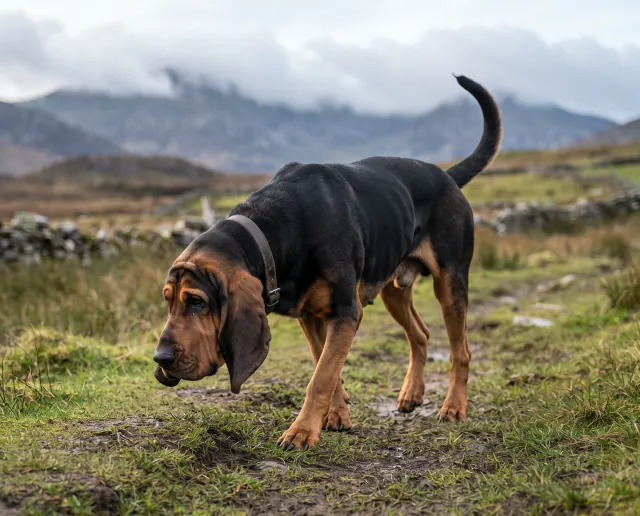
Most people meet a Bloodhound through a film and picture a mournful dog asleep on a porch. The reality is a 50kg hound that can pull a grown adult off their feet on a lead and follow a trail laid days earlier across a city. The type was kept at the Abbey of St Hubert in the Ardennes and reached England after the Norman Conquest, where it was bred to track deer and later people, and the modern breed’s whole design, from the loose skin and long ears to the deep chest, serves the nose.
That heritage produces a dog that is gentle and sensitive with people and completely deaf to them once a scent is found. Bloodhounds are big, wet, expensive to keep and short-lived, and they are rare enough that most prospective owners have never met one.
Suitability
Indoors the breed is calm, affectionate and slow-moving, and it wants to be close to its people. The drawbacks are physical. Drool is copious, made worse by loose flews, and it is flung onto walls at head height when the dog shakes. The smell is strong and the coat sheds all year. A tail at table height and a body that leans hard on legs make it a poor match for frail relatives and toddlers, although the temperament itself is mild. Bloodhounds are sensitive and take criticism to heart, and a raised voice does more harm than good. They are not guard dogs, although the size and the bay at the door will deter callers. A dog this length needs a bed it can lie flat on and a garden it cannot leave, and the fence has to be tall and buried, since a scent trail is the one thing the breed will go through anything to follow.
Exercise
Around ninety minutes a day suits an adult, and a substantial part of that should be nose work. In the UK, Bloodhound packs still hunt the clean boot, following a human runner rather than a quarry, and the Association of Bloodhound Breeders and several mantrailing groups can put a pet owner in touch with the sport. A hound doing that work once a week is a different dog from one walked round a park. Puppies must be protected. Growth is rapid and the frame is heavy, so short outings on soft ground, no stairs and no jumping until eighteen months is the accepted rule. Off-lead exercise is a matter of secure fields rather than recall, which is poor by any standard. On the lead the dog must never learn that pulling works, because nobody holds a determined adult by strength. Heat is dangerous for a heavy dog with loose skin, and summer walks belong in the early morning.
Grooming
The short coat needs a weekly brush with a hound glove and sheds steadily. The daily work is elsewhere. Facial folds and the wrinkles around the neck trap moisture, food and drool and must be wiped and dried every day to prevent dermatitis, more often in wet weather. The long ears hang in water bowls and mud, block the ear canal and need a weekly clean and a daily look and sniff. Eyes with loose lower lids collect debris and need a gentle wipe. Nails grow fast on a dog that moves slowly and need trimming every few weeks. Pressure sores on elbows are a risk on hard floors, so bedding needs to be thick.
Health
Life expectancy is short, commonly seven to ten years, and buyers need to accept that before anything else. Gastric dilatation and torsion is the emergency, and Bloodhounds are among the breeds most affected. Restlessness, unproductive retching, drooling more than usual and a swelling behind the ribs mean a vet immediately, whatever the hour. Feeding smaller meals and keeping the dog quiet after eating reduce the risk but do not remove it. The Kennel Club lists the breed on Breed Watch, with points of concern including excessive skin and loose eyelids, and both entropion and ectropion are common enough that eye surgery is a familiar bill. Hip and elbow dysplasia are recognised, and scoring under the BVA and Kennel Club scheme is the test to request. Ear infections and skin fold dermatitis are routine. Weight control matters for joints and for bloat risk alike, and a dog of this size should show a visible waist.
Choosing and training
Bloodhounds are scarce in most countries. A handful of breeders produce litters, usually with a waiting list, and the breed club is the place to start. Expect to be questioned about fencing, experience and the height of the walls. Ask to see the parents, check the tightness of the eyelids and the amount of skin, and choose the moderate dog over the impressive one. Training relies on patience and food. The breed is willing and gentle but slow to see the point of obedience, and sessions should be short and end on a success. Lead manners and a reliable stand for handling are the priorities. Ask the breeder about temperament in the line, since a nervous giant is a serious problem. Rescues occasionally have adults, often for reasons of size rather than fault.
Verdict
A Bloodhound suits an experienced, physically capable owner with a large secure garden, a big car, a generous budget and an interest in tracking, who can accept a short life and a wet house.
It is unsuitable for a first-time owner, a small home, a tight budget or anyone squeamish about drool. Those who have lived with one tend to speak of the breed with an affection that survives everything on the debit side.