
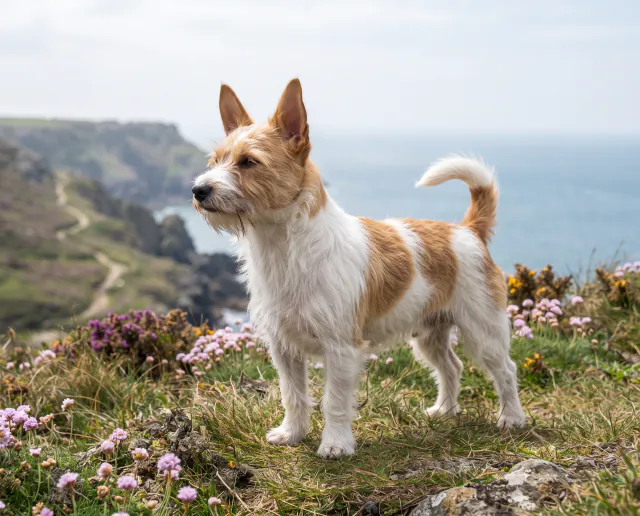
Also known as: Podengo Português.
At a glance
Key facts
The essentials to compare before deciding whether this breed fits your home and routine.
- Size
- Medium
- Lifespan
- 12 to 15 years
- Energy
- High
- Temperament
- Alert, quick, watchful and self-reliant
- Good with children
- Often good with children who play calmly with a quick small dog
- Exercise
- An hour a day for the small size, more for the larger sizes
- Trainability
- Moderate
- Grooming
- Weekly brushing for either coat, with light to moderate shedding
- Estimated monthly cost, GBP
- £65 to £130 per month
The Portuguese Podengo is three dogs under one name, and buyers need to know which one they are looking at. The Pequeno stands 20 to 30cm at the shoulder and weighs four to six kilograms; the Médio is 40 to 54cm and 16 to 20kg; the Grande is 55 to 70cm and can reach 30kg. Each comes in a smooth coat or a wire coat, in shades of yellow and fawn with or without white. All three were bred in Portugal as rabbit and hare hunters, with the Grande also used on boar, and all share the wedge head, large upright ears, curled sickle tail and alert, springy build of a primitive hunting dog.
In the UK the small wire-coated Podengo accounts for most of the dogs seen, and it is the size most families are actually asking about. The medium and large sizes exist here in small numbers, and finding one usually means a long wait or an import.
Temperament in the home
Podengos are lively, watchful, intensely curious and never entirely off duty. They announce visitors, cats, birds and anything else that crosses the garden, and the small size does so at a pitch that carries. With their own people they are affectionate and playful, and many are fine with children who play sensibly, though a fast, bouncy dog and a toddler need watching in both directions. Digging is a breed habit, since rabbits live underground, and a lawn will show it. The prey drive is as strong in a five kilogram Pequeno as in a Grande, and small pets are not safe housemates. Cats can work where the dog grows up with them. Podengos are agile climbers and jumpers; a garden fence that keeps a Border Terrier in will not necessarily keep one of these in.
Exercise and training
A small Podengo needs an hour a day of walking and play and will use every minute; the medium and large sizes need considerably more and a chance to run flat out. All three sizes are hunters first and will leave at the sight of a rabbit, so off-lead exercise belongs in enclosed spaces, and secure fields are a better investment than hope. Agility, flyball and scent work suit the breed’s speed and brain well. Training is a matter of persuasion. Podengos are quick, independent and easily bored, and they work for food and fun rather than for approval. Short sessions and a quiet cue taught early pay off. Puppies of the larger sizes should not be over-walked while growing; the small size matures faster but still benefits from restraint in the first six months. Cold, wet weather does not bother the wire coat much; the smooth coat feels it more.
Coat and grooming
Both coats are low maintenance. The smooth coat is short and dense and needs a weekly rub with a mitt. The wire coat is harsh, medium length and shaggy about the face, with a beard and eyebrows, and it needs a weekly brush and comb plus occasional tidying of stray hairs, ideally by hand rather than clippers, which soften the texture. Neither coat should be clipped short. Shedding is light to moderate in the wire coat and a little more noticeable in the smooth, with a heavier turnover in spring. Ears, nails and teeth get the usual weekly check, with particular attention to the teeth of the Pequeno, since small dogs accumulate tartar quickly.
Health and lifespan
The breed is long-lived and generally sound, with twelve to fifteen years typical and Pequenos often going further. There is no long list of well-documented inherited disease, which is partly a reflection of the breed’s small UK population rather than proof of anything. Sensible questions for a breeder are hip scoring for the medium and large sizes, patella checks for the small, and whether the parents have had eye examinations under the BVA and Kennel Club scheme. Podengos stay lean and athletic if fed for their work rather than their charm, and the small size in particular is easy to overfeed. Skin tears on brambles and barbed wire are the most common injury in a dog that hunts through cover.
Costs and space
Monthly costs vary with size. A Pequeno runs at around £65 to £115 for food, insurance and routine care, a Médio somewhat more, and a Grande sits nearer £100 to £170. A small Podengo lives comfortably in a flat or a terraced house provided the exercise happens and the barking is managed, while the larger sizes need a house and a proper garden. Fencing is the real space question, since a dog that jumps and digs needs a boundary that is high, solid and continued below ground level. Finding a puppy means the breed club first. Small wire Podengo litters are bred in modest numbers outside Portugal; the other sizes and the smooth coat are rare, buyers wait, and some dogs are imported.
Verdict
The Portuguese Podengo suits an active owner who enjoys a sharp, comical, self-reliant dog, has a properly fenced garden, and will put the time into training and enclosed off-lead running. The small size is a workable first dog for someone who has done the reading; the larger sizes are better in experienced hands.
It is a poor match for a quiet home with close neighbours, for households with rabbits or hamsters, or for anyone who wants an easy recall in open country. The breed’s appeal and its difficulty come from the same place, which is that it has never stopped being a hunting dog.