
At a glance
Key facts
The essentials to compare before deciding whether this breed fits your home and routine.
- Size
- Large
- Lifespan
- 11 to 14 years
- Energy
- High
- Temperament
- Gentle, quiet indoors, athletic and strongly prey driven
- Good with children
- Often good with children who are calm around a sensitive dog
- Exercise
- Around 90 minutes a day including free running in a secure field
- Trainability
- Experienced handler
- Grooming
- Weekly brushing for the smooth coat, with occasional hand stripping for the wire coat
- Estimated monthly cost, GBP
- £95 to £170 per month
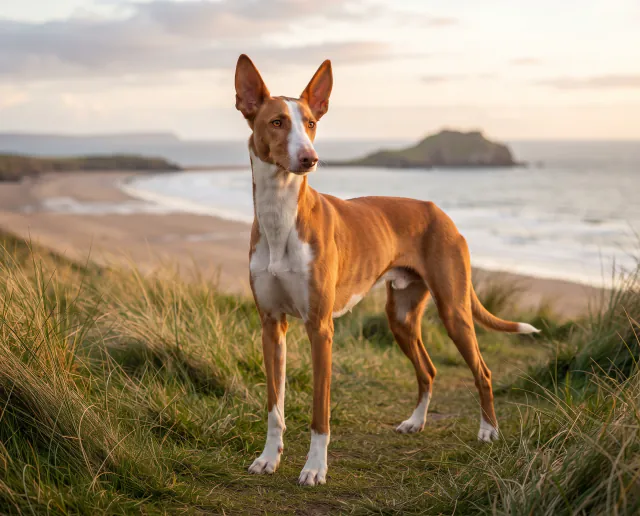
The first thing most owners mention about the Ibizan Hound is the jumping. A dog that stands 56 to 74cm can clear a six foot fence from a standing start, and the breed was made for it, hunting rabbits across the rocky scrub of Ibiza, Majorca and Formentera in loose packs, leaping to spot quarry in cover and using sight, hearing and scent together. Britain knows it by the Kennel Club name, but the Balearic farmers who kept the breed for centuries call it the Podenco Ibicenco. Tall, narrow, with huge upright ears, amber eyes, a pale nose and a coat in red and white, it looks like something from an Egyptian wall painting and behaves like a very athletic cat.
Temperament in the home
Indoors an Ibizan is quiet, gentle and clean, spending long stretches asleep on the softest available surface and greeting the family with real affection. Strangers are met with reserve rather than suspicion, and there is no guarding worth mentioning. The prey drive is total. Cats living in the house from puppyhood may be accepted; the same cat running across a garden may not, and rabbits, guinea pigs and chickens are quarry, not housemates. Children who are calm and respectful of a sensitive dog get on well with the breed, and it is sturdy enough for family life, though it dislikes rough handling and will remove itself. Separation is tolerated in moderation, but a bored Ibizan is an escape artist, and worktops, tables and the tops of fridges are all within reach. These dogs are quiet by hound standards, though a howl is possible.
Exercise and training
About ninety minutes a day suits most adults, and part of that must be free running in a properly enclosed space, since a sighthound needs to gallop. Two metre fencing is the realistic minimum and even that will not hold every individual, so a hired secure field is the safe choice. Open country and a loose Ibizan mean a dog half a mile away in seconds, and roads make that dangerous, so a long line on a well-fitting harness is normal. Puppies need short outings and no jumping or stairs while growing, which is easier said than done with a breed that leaps for pleasure. Training is straightforward in one sense, because the breed is quick and sensitive, and frustrating in another, because repetition bores it and pressure shuts it down. Short, gentle, food-based sessions from the first week, with an emphasis on settling, lead walking and a recall practised only where it can succeed, are the pattern. Lure coursing, hoopers and scent work suit these dogs. A lead near livestock is a legal duty and, for a dog this fast, a practical one.
Coat and grooming
Two coats exist. The smooth is short and close and needs a weekly rub with a mitt to lift dead hair, shedding lightly all year. The wire is harsh and dense, an inch or so long, and needs a weekly brush plus occasional hand stripping to tidy it. Neither coat gives much protection. Thin skin tears easily on bramble and wire, so look for cuts after every run, and a fleece or waterproof coat is needed for British winters and long waits outside. Feet and nails need regular attention. The skin on the large upright ears is pale and thin, and it can burn in summer.
Health and lifespan
A well-kept Ibizan usually reaches eleven to fourteen, and the breed as a whole is hardy. Like all sighthounds, Ibizans carry little body fat and can be sensitive to some anaesthetics and sedatives, so a vet who knows sighthounds is an asset. Seizure disorders and deafness are reported in the breed and are fair questions for a breeder. Hip dysplasia is uncommon, but scoring under the BVA and Kennel Club scheme and an eye examination under the same scheme are fair to ask about in a breed whose UK gene pool is small. Allergies and skin irritations occur. The breed is naturally lean, with visible hips and the last ribs showing, and well-meaning visitors will say it looks starved. It does not, and fattening one up is a mistake.
Costs and space
Costs run to roughly £95 to £170 a month, with the extras being winter coats, a secure field subscription and the occasional stitched-up leg; food for a lean 22kg animal is moderate and grooming is negligible. A house with a tall, solid fence and no low walls is the realistic minimum, and a flat is possible only with a serious commitment to daily running. Finding a puppy is slow. Litters are few, the breed club is the first contact, and some dogs are imported from Spain or Scandinavia. Separately, large numbers of podencos leave Spanish hunting regions for rescue abroad each year, and while most are not pedigree Ibizan Hounds, they share the temperament and offer much the same life at lower cost.
Verdict
The Ibizan Hound suits a calm, active household with a tall fence, access to a secure field, an interest in coursing or scent sports and a liking for an elegant, quiet, faintly aloof dog that is affectionate on its own terms.
It is a poor choice for anyone with cats they let outdoors, small pets, a low garden wall, or an expectation of off-lead walks in the countryside. People who buy for the look alone tend to meet the jumping and the prey drive within the first month.