
At a glance
Key facts
The essentials to compare before deciding whether this breed fits your home and routine.
- Size
- Small
- Lifespan
- 11 to 13 years
- Energy
- Medium
- Temperament
- Independent, dignified and quietly stubborn
- Good with children
- Better suited to calm, respectful older children
- Exercise
- About 45 minutes to an hour a day
- Trainability
- Experienced handler
- Grooming
- Hand stripping or clipping every few months plus weekly combing
- Estimated monthly cost, GBP
- £80 to £150 per month
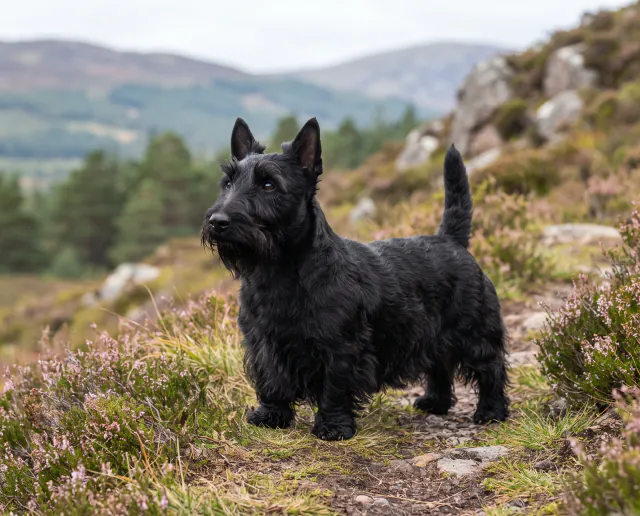
There is a reason toy manufacturers reach for the Scottish Terrier’s silhouette whenever they need a dog that reads as serious. The low, square outline, the beard and eyebrows and the level, unhurried gait all belong to a breed developed in the Scottish Highlands to dig fearlessly after foxes, badgers and vermin among rocks and gorse. That work called for a dog with its own judgement, since a handler could rarely see or reach it once it went to ground, and the breed still carries that self-reliance into ordinary domestic life.
Living with a Scottie means accepting that the dog has opinions, and that a chin scratch or a treat will not automatically override them. Most are calm, watchful and reserved with strangers rather than sociable in the way many terriers are, and they form close attachments to their own household while treating the rest of the world with polite suspicion. None of this makes the breed difficult so much as unforthcoming about doing things purely to please, which suits some owners perfectly and frustrates others within a fortnight.
Temperament in the home
A Scottish Terrier tends to be composed indoors, content with a settled routine and disinclined to demand attention the way some small breeds do. That composure sits alongside a genuine stubborn streak, and a dog that has decided a walk is finished will make its view known. Watchfulness around the front door and a tendency to bark at anything unfamiliar are typical rather than exceptional, and early socialisation does more to soften this than any amount of correction later. The breed’s digging instinct remains close to the surface, so borders and vegetable patches need protecting. Scotties generally prefer calm handling to boisterous play, and while many tolerate children well, they are happier with older children who understand that a dog walking away has ended the interaction.
Exercise and training
Around three quarters of an hour to an hour of walking a day suits most adults, and the breed is not built for distance running or long off-lead scrambles. What matters more than duration is variety, since a Scottie investigating hedgerows and verges stays satisfied far longer than one marched along the same pavement. Training benefits from patience and consistency rather than repetition, because the breed learns quickly but reserves the right to decide whether an instruction is worth following. Food rewards and short, engaging sessions work better than long drilling. Recall around rabbits or anything that bolts is unreliable in many individuals, so open ground calls for a lead or a long line rather than optimism.
Coat and grooming
The harsh, wiry double coat was built to shed water and resist thorns, and it needs proper management to look and function as it should. Show-style hand stripping every few months keeps the jacket harsh and weatherproof, while clipping is a common and acceptable alternative for a pet dog, though it softens the texture and lightens the colour over repeated clips. Weekly combing through the beard, skirt and legs prevents matting and keeps food and mud from building up in the furnishings. The coat sheds very little between grooming sessions, which is part of the appeal for owners sensitive to hair around the house. Regular checks of the skin under a dense coat catch irritation before it becomes a problem.
Health and lifespan
Eleven to thirteen years is a fair expectation for the breed. Scottie cramp is a condition specific to the breed in which exercise or excitement triggers a temporary, uncomfortable gait abnormality that usually resolves with rest, and while it looks alarming, most affected dogs live full lives once the pattern is recognised and managed. Von Willebrand’s disease, an inherited bleeding disorder, occurs in the breed at a meaningful rate, and a DNA or clotting test before any surgery is a sensible precaution that many vets will suggest unprompted. Scottish Terriers are also more prone than most breeds to certain bladder and other cancers in later life, so any change in urination, unexplained weight loss or a persistent lump deserves prompt investigation rather than a wait and see approach. Patellar problems and skin allergies are worth asking a breeder about as well.
Costs and space
Coat care is the main recurring cost beyond the basics, and a professional strip or clip every couple of months adds up over a year even where insurance and food sit at the modest end for a small dog. A typical monthly figure lands somewhere between £80 and £150, though the exact number depends heavily on whether grooming is done professionally or learned at home. Space requirements are modest, and the breed manages well in a small house or bungalow with a secure garden, though an unfenced boundary is a genuine risk given the digging habit. The breed does not crave constant company in the way some companion breeds do, which suits households where someone is out for part of the day, though it is not a dog to leave for long stretches routinely.
Verdict
The Scottish Terrier suits owners who want a distinctive, low-energy small dog with real character and do not need constant affection returned on demand. It works well for calmer households, older owners and anyone who enjoys a dog with a mind of its own.
It is a poor fit for families wanting an eager, biddable companion, homes with small pets, or owners unwilling to invest in coat care. Approached on its own terms rather than as a miniature version of a friendlier breed, a well-kept Scottie is a settled and rewarding companion.