At a glance
Key facts
The essentials to compare before deciding whether this breed fits your home and routine.
- Size
- Small
- Lifespan
- 12 to 14 years
- Energy
- Medium
- Temperament
- Reserved, devoted to its own people and long backed
- Good with children
- Better suited to older children who respect a reserved dog
- Exercise
- About 45 minutes to an hour a day on level ground
- Trainability
- Experienced handler
- Grooming
- Daily to weekly combing of a long flowing double coat
- Estimated monthly cost, GBP
- £85 to £160 per month
Queen Victoria kept Skye Terriers at Balmoral, and the story usually told alongside the breed is Greyfriars Bobby, the dog said to have kept vigil at his owner’s grave in Edinburgh for years. Whatever the truth of that tale, it captures something real about the breed’s character. The Skye Terrier was developed on the Isle of Skye and the wider Hebrides to go after fox, otter and badger among rock cairns, and it grew a body long and low enough to work such ground topped with a coat dense enough to shed Highland weather.
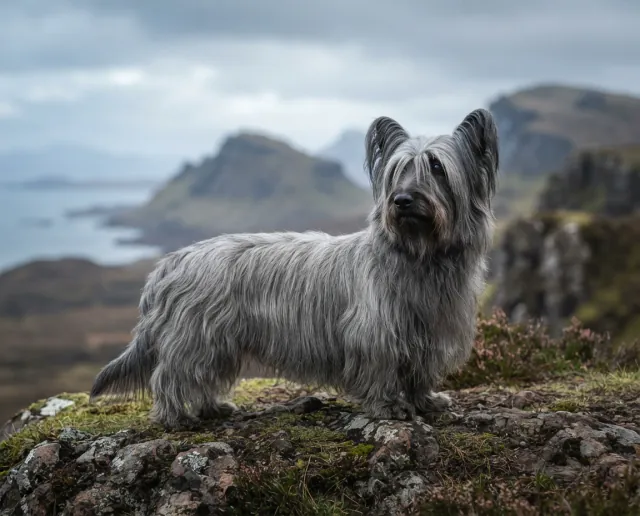
That combination, a body roughly twice as long as it is tall under a straight, flat-lying coat that reaches the ground, makes the Skye Terrier one of the most visually distinctive dogs bred in Britain, and also one of the rarest. Kennel Club registrations sit at a fraction of what they were a century ago, and the breed appears on the vulnerable native breeds list most years. Anyone keen on the breed should expect to contact the breed club directly, accept a wait for a litter, and treat any breeder claiming ready availability with some caution.
Suitability
The Skye Terrier bonds intensely with its own household and is frequently described, with good reason, as a one-person or one-family dog. Strangers are met with reserve rather than enthusiasm, and the breed does not warm quickly to new people or settings, which makes early and consistent socialisation important rather than optional. Within the family the dog is typically affectionate and calm, content to lie nearby for long stretches. Children who understand that this is not an instantly playful breed generally do well with a Skye, though the long back and low build mean rough handling, lifting incorrectly or encouraging jumping from height all carry real risk. The breed does not enjoy being left for long periods and can become anxious or vocal when isolated from its person.
Exercise
Three quarters of an hour to an hour of steady walking a day suits most adults, ideally on level or gently sloping ground rather than steep scrambling or repeated jumping, given the strain either can place on a long spine. The breed is not built for distance running, agility-style activity or anything involving sustained twisting. A securely fenced garden lets the dog patrol and investigate at its own pace between walks. Recall in open country is not something to take for granted, since the working instinct behind the breed remains intact even in a dog that spends most of its day on a rug by the fire. Puppies in particular need gentle, limited exercise while bones and spine develop.
Grooming
The coat is the single largest commitment the breed asks of an owner. Kept long, it needs combing through to the skin several times a week at minimum, and daily attention in practice prevents the felting and matting that a coat this length and density can develop quickly, particularly behind the ears, under the legs and along the flanks. Some pet owners choose a shorter, more manageable trim rather than the full show-length coat, which reduces the grooming load considerably without harming the dog. Bathing needs care to dry the undercoat thoroughly, since damp coat left close to the skin invites irritation. Nails, ears hidden under a heavy fall of hair, and eyes that can become obscured by fringe all need regular checking.
Health
Twelve to fourteen years is typical for the breed. The long back that defines the Skye Terrier’s silhouette carries a real risk of intervertebral disc problems, and any reluctance to jump, yelping when picked up, dragging of the back feet or sudden weakness needs urgent veterinary attention rather than a wait and see approach. Keeping the dog lean reduces strain on the spine considerably, and steps or a ramp for furniture and the car are sensible from puppyhood rather than introduced after an injury. Hip and joint health, along with hereditary eye conditions covered by the BVA and Kennel Club eye scheme, are worth discussing with a breeder. Because the gene pool is small, breed clubs increasingly encourage broader health testing and openness about lines, and a buyer asking detailed questions should expect detailed answers.
Choosing and training
Patient, reward-based training works far better than pressure with a breed inclined to shut down or become wary under harshness. Priorities include calm handling for grooming, comfortable use of a ramp or steps, and confidence around unfamiliar people and situations built up gradually rather than forced. Because litters are scarce, prospective owners often join a waiting list run through the breed club, and travelling some distance for a well-bred puppy from health-tested parents is common. Meeting the mother and, where possible, other adults from the same lines gives a far better sense of adult temperament than a litter of puppies alone.
Verdict
The Skye Terrier suits a calm, committed owner who wants a striking, devoted companion, is prepared to invest real time in coat care, and has the patience to find a genuine breeder. It fits households where someone is usually around, since the breed does not thrive on long stretches alone.
It is not a sensible choice for anyone wanting a sociable dog with strangers, a low-grooming coat, or a breed suited to an active, jumping lifestyle. Those prepared to meet the breed on its own terms tend to find its devotion returned many times over.